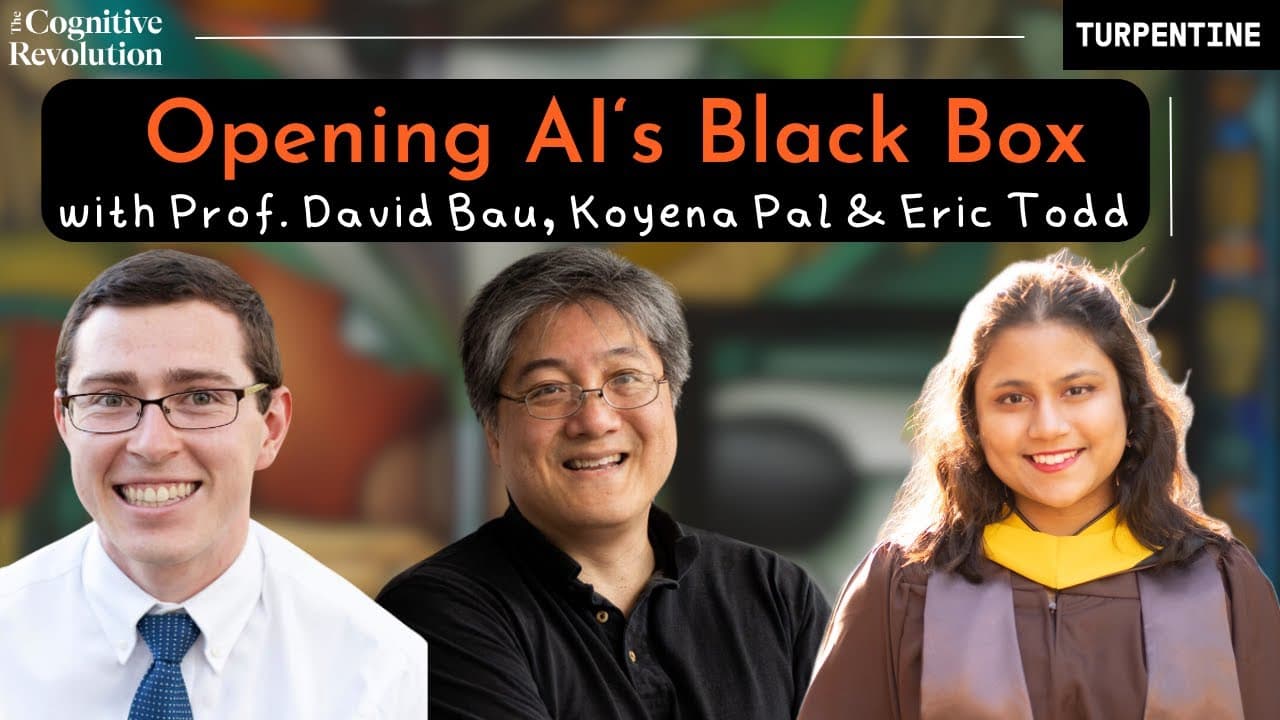
Opening AI's Black Box with Prof. David Bau, Koyena Pal, and Eric Todd of Northeastern University
TL;DR
Exploration of AI interpretability with Future Lens and Function Vectors.
Transcript
machine learning worked okay but didn't really work in profound ways until the last 10 years or so but now it's really working it's really working remarkably well and so we're facing a new type of software that we cannot use traditional computer science tools and traditional computer science methods for dealing with how to ensure that it's correct ... Read More
Key Insights
- Future Lens reveals that mid-sized language models can predict multiple tokens ahead, indicating complex internal processing.
- Function Vectors identify specific attention heads responsible for in-context learning, showing task information mediation.
- The lab's agenda focuses on understanding AI's internal mechanisms to enhance control over powerful systems.
- Soft prompts, created through optimization, outperform manual prompts in decoding future token information.
- The research highlights a potential structure in AI models, suggesting a method for unlocking hidden information.
- Attention heads in Transformers play a crucial role in task understanding and have a distributed process across layers.
- The study of mechanistic interpretability aims to find the right abstraction level to understand AI computations.
- Open-source tools and libraries facilitate further research into AI interpretability and model behavior exploration.
Install to Summarize YouTube Videos and Get Transcripts
Explore YouTube Video Summarizer or Get YouTube Transcript Extractor
Questions & Answers
Q: What is the focus of the Future Lens paper?
The Future Lens paper focuses on understanding how mid-sized language models can predict multiple tokens ahead. It explores the internal processes of these models by examining hidden states and probing for future token information. The study reveals that even smaller models have complex internal processing capabilities, challenging the notion of language models as mere next-token predictors.
Q: How do Function Vectors contribute to AI interpretability?
Function Vectors identify specific attention heads responsible for mediating task understanding in in-context learning. By analyzing these attention heads, researchers can understand how task information is processed and communicated within the model. This insight into the distributed process across transformer layers enhances our understanding of AI's internal mechanisms and contributes to the broader goal of AI interpretability.
Q: What role do attention heads play in Transformers?
Attention heads in Transformers are crucial for task understanding and information flow. They act as mediators for processing and communicating task information across layers. The research shows that a small set of attention heads can influence the model's behavior significantly, indicating their importance in the distributed process of encoding task understanding within the model.
Q: How do soft prompts improve future token prediction?
Soft prompts, created through optimization, significantly improve future token prediction by enhancing the model's ability to decode information from hidden states. Unlike manual prompts, which rely on natural language, soft prompts are optimized in the vector space, allowing them to better capture and utilize the information encoded in the model's hidden states for predicting future tokens.
Q: What is the broader agenda of the lab's research?
The lab's broader agenda focuses on mechanistic interpretability and understanding AI's internal mechanisms. By uncovering how AI models process information and make predictions, the research aims to enhance control over increasingly powerful systems. This involves identifying key abstractions that link low-level computations to higher-level model behaviors, ultimately contributing to the development of more robust and interpretable AI systems.
Q: What tools are available for further research in AI interpretability?
Open-source tools and libraries, such as the Insight library and the Future Lens tool, are available to facilitate further research in AI interpretability. These tools allow researchers to explore AI model behavior, extract and patch activations, and conduct experiments on model interpretability. They provide a platform for the research community to collaborate and advance the understanding of AI's inner workings.
Q: How does the research address the challenge of AI model interpretability?
The research addresses AI model interpretability by developing methods to probe and understand the internal processes of language models. By identifying key components like attention heads and exploring techniques like soft prompts, the research uncovers how models process information and make predictions. This contributes to a deeper understanding of AI behavior and the development of more interpretable and controllable AI systems.
Q: What are the implications of this research for future AI development?
The implications of this research for future AI development include the potential for more interpretable and controllable AI systems. By understanding the internal mechanisms of AI models, researchers can develop methods to enhance model transparency and accountability. This knowledge can inform the design of future AI systems, ensuring they align with human values and operate in a predictable and understandable manner.
Summary & Key Takeaways
-
Future Lens paper shows mid-sized language models think multiple tokens ahead, revealing complex internal processes. The research aims to uncover AI's inner workings by examining hidden states and probing for future token information. Soft prompts, optimized for performance, significantly outperform manual prompts in decoding future tokens.
-
Function Vectors identify specific attention heads that mediate task understanding in in-context learning. This discovery suggests a distributed process across transformer layers, with attention heads playing a crucial role. The research highlights the importance of understanding AI's internal mechanisms for better control and interpretability.
-
The lab's broader agenda focuses on mechanistic interpretability, seeking to find the right abstraction level to understand AI computations. Open-source tools and libraries are developed to facilitate further research, enabling a deeper exploration of AI model behavior and enhancing the ability to unlock hidden information.
Read in Other Languages (beta)
Share This Summary 📚
Summarize YouTube Videos and Get Video Transcripts with 1-Click
Try YouTube Summary with ChatGPT & Claude or YouTube Transcript Generator
Explore More Summaries from Cognitive Revolution "How AI Changes Everything" 📚





Summarize YouTube Videos and Get Video Transcripts with 1-Click
Try YouTube Summary with ChatGPT & Claude or YouTube Transcript Generator