What Are the Implications of the Muon g-2 Experiment Results?
TL;DR
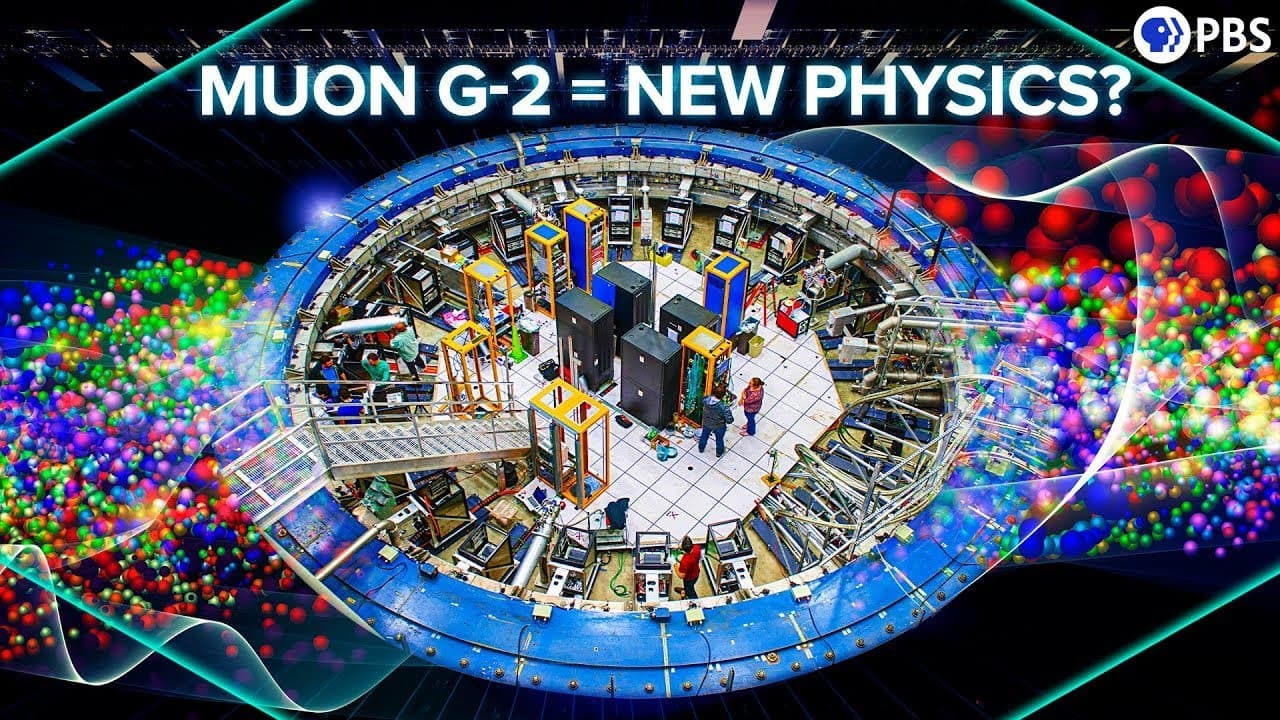
The Muon g-2 experiment at Fermilab indicates a significant anomaly in the muon's magnetic dipole moment, suggesting physics beyond the Standard Model. With findings at a 4.2 sigma confidence level, the experiment points to the possibility of unknown particles or forces affecting the muon, highlighting the Standard Model's incompleteness and the need for a unified theory of physics.
Transcript
- When a theory makes a prediction that disagrees with an experimental test. Sometimes it means we should throw that theory away. But what if that theory has otherwise produced the most successful predictions in all of physics. Then that little glitch maybe pointing the way to layers of physics deeper than we've yet imagined. Well Fermilab's Muon g... Read More
Key Insights
- The Muon g-2 experiment at Fermilab has found a significant anomaly in the muon's magnetic dipole moment, suggesting potential physics beyond the Standard Model.
- The Standard Model of particle physics has been incredibly successful but lacks explanations for gravity and other fundamental forces, indicating that it is incomplete.
- The muon, a heavier cousin of the electron, does not conform to the g-factor predictions made by quantum electrodynamics, hinting at new physics.
- Quantum electrodynamics (QED) accurately predicts the electron's g-factor, but discrepancies with the muon suggest the presence of unknown particles or forces.
- The muon's higher mass increases its likelihood of interacting with virtual particles, making it a promising candidate for discovering new physics.
- The Fermilab experiment has achieved a 4.2 sigma confidence level in its results, approaching the 5 sigma threshold needed for a discovery.
- The experiment involves measuring the muon's precession rate in a magnetic field to determine its g-factor with high precision.
- Further experiments and independent verifications are necessary to confirm the findings and explore the implications for theoretical physics.
Install to Summarize YouTube Videos and Get Transcripts
Explore YouTube Video Summarizer or Get YouTube Transcript Extractor
Questions & Answers
Q: What is the significance of the Muon g-2 experiment?
The Muon g-2 experiment is significant because it has detected an anomaly in the muon's magnetic dipole moment that suggests the presence of physics beyond the Standard Model. This finding challenges existing theories and opens the door to discovering unknown particles or forces that could reshape our understanding of fundamental physics.
Q: How does the Muon g-2 experiment work?
The experiment measures the precession rate of muons as they travel through a magnetic field in a circular path. By analyzing the energy of the particles resulting from muon decay, researchers can determine the muon's g-factor with high precision. This precise measurement allows scientists to compare experimental results with theoretical predictions and identify any discrepancies.
Q: Why is the muon's g-factor discrepancy important?
The discrepancy in the muon's g-factor is important because it indicates that the Standard Model may be incomplete. The muon's behavior deviates from predictions made by quantum electrodynamics, suggesting the influence of unknown particles or forces. This anomaly provides a potential pathway to discovering new physics and advancing our understanding of the universe.
Q: What challenges does the Muon g-2 experiment face?
The experiment faces challenges in achieving the high level of precision required to identify deviations from theoretical predictions. Additionally, researchers must rule out systematic errors and confirm findings through independent experiments. Achieving the 5 sigma confidence level needed for a discovery requires meticulous data collection and analysis.
Q: What are the implications of the Muon g-2 findings?
The implications of the Muon g-2 findings are profound, as they suggest the existence of new physics beyond the Standard Model. This could lead to the discovery of unknown particles or forces and potentially reshape our understanding of fundamental interactions. The results also highlight the need for a unified theory that can explain both quantum mechanics and gravity.
Q: How does the muon's mass affect the experiment?
The muon's mass is significant because it increases the likelihood of interactions with virtual particles. Being 200 times more massive than the electron, the muon is more susceptible to perturbations from heavy virtual particles, making it a promising candidate for detecting new physics. This increased interaction probability is central to the experiment's focus on the muon.
Q: What is the current confidence level of the Muon g-2 results?
The current confidence level of the Muon g-2 results is 4.2 sigma, which indicates a significant deviation from theoretical predictions. This level of confidence suggests a very low probability of the results being due to random fluctuations, but further experiments are needed to reach the 5 sigma threshold required for a formal discovery in physics.
Q: What future steps are necessary to confirm the Muon g-2 results?
To confirm the Muon g-2 results, additional experiments with increased precision and independent verification are necessary. Researchers must continue to collect data, analyze potential sources of error, and replicate the findings in other laboratories. Achieving a 5 sigma confidence level will be crucial for establishing the results as a genuine discovery of new physics.
Summary & Key Takeaways
-
The Muon g-2 experiment at Fermilab has unveiled a potential anomaly in the muon's magnetic dipole moment, suggesting the presence of physics beyond the Standard Model. This discovery challenges existing theories and points to the possibility of unknown particles or forces influencing the muon's behavior.
-
The Standard Model, while successful in predicting many phenomena, does not account for gravity or certain quantum interactions. The muon's deviation from expected g-factor values highlights the need for a more comprehensive theory that can unify these aspects of physics.
-
Fermilab's experiment has reached a 4.2 sigma confidence level in its findings, indicating a significant deviation from theoretical predictions. This result, if confirmed, could lead to groundbreaking advancements in our understanding of particle physics and the fundamental forces of nature.
Read in Other Languages (beta)
Share This Summary 📚
Summarize YouTube Videos and Get Video Transcripts with 1-Click
Try YouTube Summary with ChatGPT & Claude or YouTube Transcript Generator
Explore More Summaries from PBS Space Time 📚



Summarize YouTube Videos and Get Video Transcripts with 1-Click
Try YouTube Summary with ChatGPT & Claude or YouTube Transcript Generator