How Does Income Affect Happiness Levels?
TL;DR
Income can influence happiness, but beyond a certain point, additional money has diminishing returns on day-to-day happiness. Unemployment and long commutes decrease happiness, while comparisons with others' income can also affect satisfaction. Economic growth alone may not lead to greater happiness, suggesting a need to consider broader measures like Gross National Happiness.
Transcript
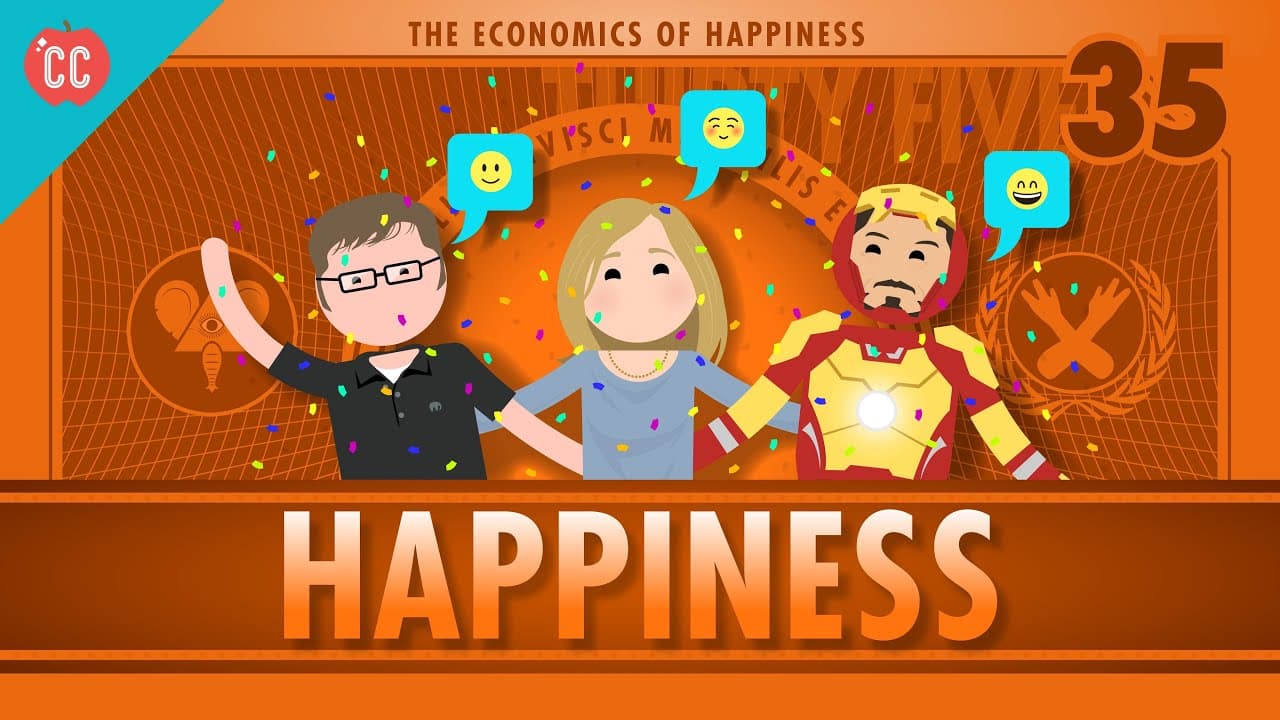
Hi, I’m Adriene Hill, and this is Crash Course Economics. So, you want to be happy? Here’s your checklist: Get a job where you make about $82,000 a year. Do not get fired from that job. Make sure your commute is no more than 22 minutes. And, please, please: you’ve got to stop looking at your friends’ Facebook profiles. [Theme Music] In the U.S., th... Read More
Key Insights
- Income has a positive correlation with happiness, but the effect diminishes after a certain income level.
- Unemployment significantly reduces happiness more than just the loss of income would suggest.
- Long work hours and commutes can decrease happiness, indicating a balance is needed for well-being.
- The reference-income hypothesis suggests happiness depends on how one's income compares to others.
- The Easterlin Paradox highlights that national income growth doesn't always lead to increased happiness.
- Hedonic adaptation means people quickly return to a baseline level of happiness despite changes in fortune.
- Bhutan uses Gross National Happiness to measure progress, prioritizing well-being over economic output.
- Economic policies focused solely on GDP growth may overlook critical aspects of societal well-being.
Install to Summarize YouTube Videos and Get Transcripts
Explore YouTube Video Summarizer or Get YouTube Transcript Extractor
Questions & Answers
Q: How does income affect happiness?
Income positively affects happiness, but the relationship weakens after reaching a certain threshold, approximately $82,000 in the U.S. Beyond this point, additional income has diminishing returns on day-to-day happiness. Factors like unemployment, long work hours, and comparison with others' income also significantly influence happiness.
Q: What is the Easterlin Paradox?
The Easterlin Paradox posits that while income correlates with happiness, increases in national income do not always lead to higher average happiness levels. This paradox suggests that happiness may depend more on relative status than on absolute wealth. However, its validity is debated, with some studies showing it mainly applies to wealthy countries.
Q: Why does unemployment reduce happiness?
Unemployment reduces happiness not only due to the immediate loss of income but also because of increased anxiety about the future and loss of social status. Studies show that unemployed individuals report significantly lower life satisfaction, with greater negative effects observed in high-income countries and among middle-aged individuals.
Q: How does hedonic adaptation affect happiness?
Hedonic adaptation refers to the phenomenon where individuals quickly return to a baseline level of happiness despite positive or negative life changes. This means that while acquiring new possessions or achieving goals may initially boost happiness, the effect is often temporary as people become accustomed to their new circumstances.
Q: What is Gross National Happiness?
Gross National Happiness (GNH) is a measure used by Bhutan to assess the collective happiness and well-being of its citizens. GNH considers factors such as social, physical, spiritual, and environmental health, prioritizing these over economic output like GDP. It reflects a holistic approach to development, focusing on sustainable and equitable progress.
Q: How do long commutes affect happiness?
Long commutes negatively affect happiness by reducing time available for leisure and social interactions, leading to increased stress and decreased life satisfaction. Studies suggest that shorter commutes contribute to higher happiness levels, highlighting the importance of work-life balance for overall well-being.
Q: What is the reference-income hypothesis?
The reference-income hypothesis suggests that an individual's satisfaction with their income and consumption is influenced by how it compares to others around them. This means that even with a high income, a person may feel less satisfied if they perceive others as having more, underscoring the role of relative status in determining happiness.
Q: Why might GDP growth not lead to increased happiness?
GDP growth might not lead to increased happiness because it often overlooks factors like income inequality, environmental degradation, and social well-being. While economic growth can improve living standards, it may not address issues that directly impact happiness, such as social connections, mental health, and work-life balance.
Summary & Key Takeaways
-
Income correlates with happiness, but beyond a threshold, additional income yields diminishing returns. Unemployment and long commutes negatively impact happiness more than just financial loss. Comparisons with others' income also play a significant role in individual satisfaction.
-
The Easterlin Paradox suggests that increased national income doesn't always equate to higher happiness. Instead, happiness might derive from relative status rather than absolute wealth. This paradox is debated, with some arguing it holds mainly for wealthy countries.
-
Alternative measures like Gross National Happiness emphasize broader aspects of well-being over economic growth. Bhutan and the UN advocate for considering happiness in development policies, challenging traditional GDP-centric views on progress.
Read in Other Languages (beta)
Share This Summary 📚
Summarize YouTube Videos and Get Video Transcripts with 1-Click
Try YouTube Summary with ChatGPT & Claude or YouTube Transcript Generator
Explore More Summaries from CrashCourse 📚





Summarize YouTube Videos and Get Video Transcripts with 1-Click
Try YouTube Summary with ChatGPT & Claude or YouTube Transcript Generator