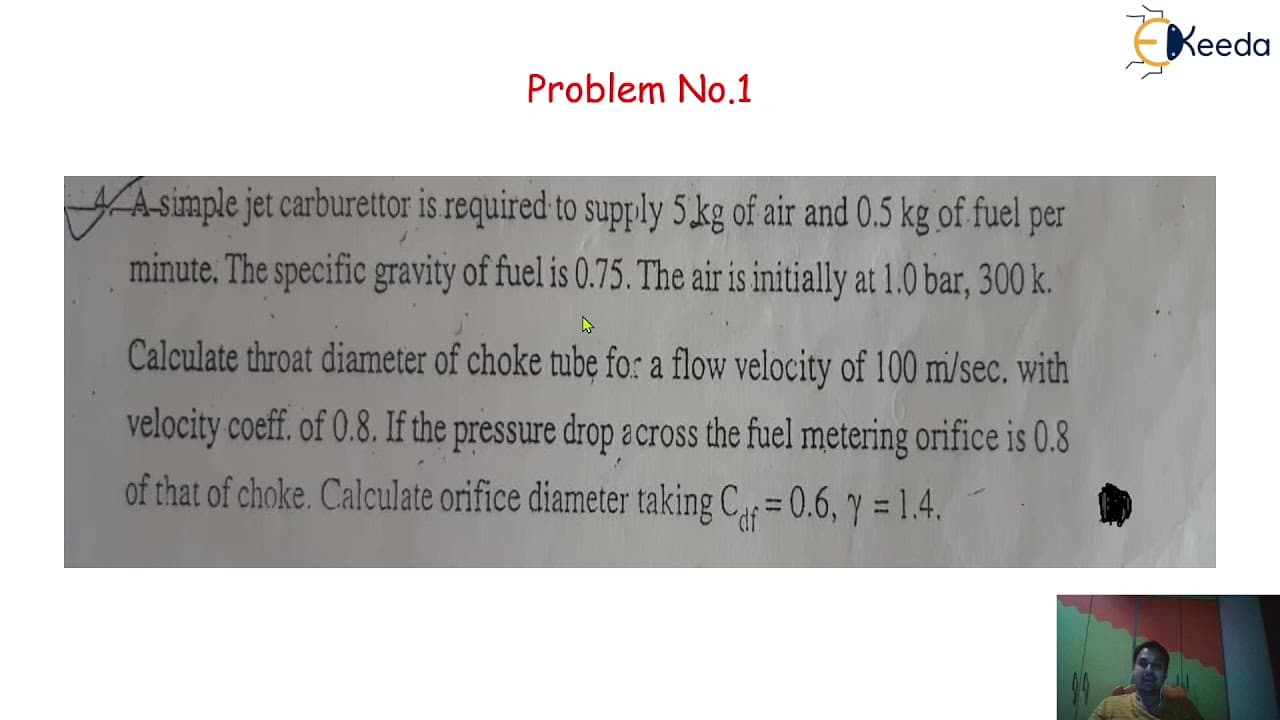
Numerical 1 on Carburetor Dimensions - S.I. Engines Fuel Supply System - Internal Combustion Engines
TL;DR
This content discusses the numerical analysis of carburetor dimensions and the importance of altitude compensation.
Transcript
dear friends now we are going to solve the different numerical on carburetor dimensions and in the last few videos we discussed about a very important derivations of carburetor that is the exact analysis method and the approximate analysis method of the carburetor and we have discussed the different derivation part with the help of the different eq... Read More
Key Insights
- 👱 Altitude compensation is essential for carburetors as it allows for adjustments in air-fuel ratios based on changes in air density.
- 🤢 Sea level is used as a reference for carburetor calibration, with adjustments needed for different altitudes.
- 😘 Lean mixtures at lower altitudes result in poor drivability, while rich mixtures at higher altitudes can lead to incomplete combustion and increased emissions.
- 👱 The weight of air decreases with increasing altitude, influencing the air-fuel ratio requirements for proper combustion.
- 🚒 Altitude compensation ensures optimal engine performance and emissions control.
- 👱 The specific gravity of fuel and the temperature and pressure of air also impact carburetor performance and calculations.
- ❓ Numerical analysis and equations can be used to determine carburetor dimensions and for solving altitude compensation-related problems.
Install to Summarize YouTube Videos and Get Transcripts
Explore YouTube Video Summarizer or Get YouTube Transcript Extractor
Questions & Answers
Q: What is altitude compensation in carburetors?
Altitude compensation in carburetors is the adjustment of air-fuel ratios to account for changes in air density at different altitudes. It ensures optimal combustion and performance of the engine.
Q: How does altitude affect the weight of air?
As altitude increases, the weight of one cubic meter of air decreases. This is because air density decreases with increasing altitude, leading to changes in the air-fuel mixture requirements for proper combustion.
Q: Why are automobile carburetors calibrated at sea level?
Most automobile carburetors are calibrated at altitudes near sea level because it provides a reference point for air density and allows for optimal air-fuel ratio calculations. Calibrations are required when operating at different altitudes.
Q: How does altitude affect carburetor performance?
Operating a vehicle at an altitude lower than the calibrated level results in a lean mixture, which leads to poor drivability. Conversely, operating at a higher altitude results in a rich mixture, incomplete combustion, and increased emissions of hydrocarbons and carbon monoxide.
Summary & Key Takeaways
-
The content explains the concept of altitude compensation in carburetors, which is crucial for maintaining proper air-fuel ratios at different heights.
-
Carburetors supply air and fuel mixture by volume, not weight, and the weight of air decreases with increasing altitude.
-
Operating a vehicle at an altitude lower than the calibrated level results in a lean mixture, while operating at a higher altitude leads to a rich mixture.
Read in Other Languages (beta)
Share This Summary 📚
Summarize YouTube Videos and Get Video Transcripts with 1-Click
Try YouTube Summary with ChatGPT & Claude or YouTube Transcript Generator
Explore More Summaries from Ekeeda 📚




Summarize YouTube Videos and Get Video Transcripts with 1-Click
Try YouTube Summary with ChatGPT & Claude or YouTube Transcript Generator