Dark Matter Evidence, Oort Cloud Shape, Size of Lagrange Points | Q&A 229
TL;DR
A weekly Q&A show answering space-related questions, including discussions on Oort Cloud, Betelgeuse, dark matter, and more.
Transcript
why is the Oort cloud a sphere well Betelgeuse turn into a black hole and how are scientists so sure about dark matter all this and more in this week's question show it's time for the question show your questions my answers as always wherever you are across my channel if a question pops into your brain just write it down I will gather them up and I... Read More
Key Insights
- 🤩 The Oort Cloud's spherical shape is due to interactions between stars and ejected material.
- ✴️ Betelgeuse's transition to a black hole or neutron star depends on its mass loss before a supernova.
- ⚾ Dark matter is an observation based on various phenomena like galaxy rotation, requiring further exploration for definitive understanding.
- 👋 Gravitational waves from a Betelgeuse supernova could be detected by LIGO.
- 🧭 Earth's magnetic pole wandering impacts compass accuracy.
- 🫢 Transitioning through the heliosphere termination shock or observing the Milky Way's center requires specific telescopes for detection.
- 🫢 An accretion disk around Sagittarius A wouldn't be visible due to obscuration by gas and dust.
Install to Summarize YouTube Videos and Get Transcripts
Explore YouTube Video Summarizer or Get YouTube Transcript Extractor
Questions & Answers
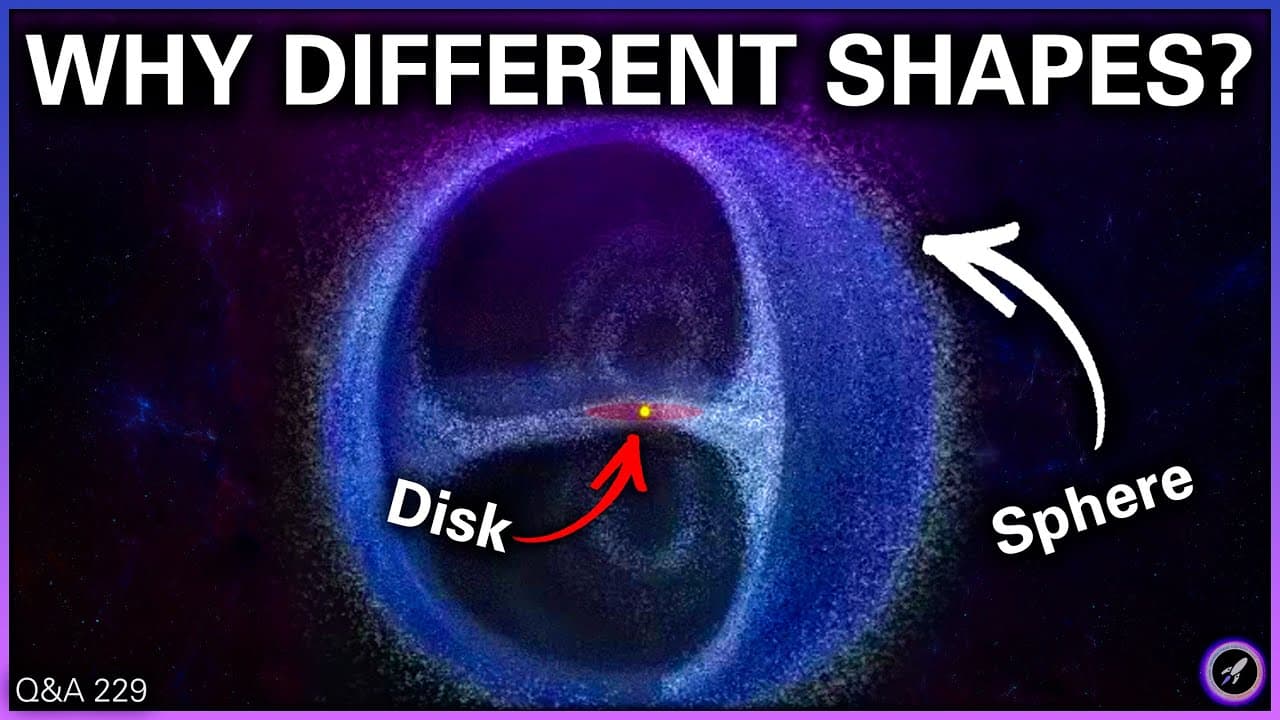
Q: Why is the Oort Cloud a sphere when everything else in the solar system is a disk?
The Oort Cloud's spherical shape is due to interactions between stars and objects being ejected from the solar system, creating a balance over time.
Q: Could field stars be similar to population three stars?
Field stars are ejected from galaxies due to interactions, or they may have formed in isolation, potentially similar to population three stars.
Q: Will Betelgeuse turn into a black hole?
Betelgeuse's fate as a black hole or neutron star depends on its mass loss during its red giant phase, with the possibility of a supernova.
Q: How are scientists sure about dark matter?
Dark matter is an observation based on galaxy rotation rates, cosmic microwave background, and gravitational lensing, prompting ongoing research for explanations.
Summary & Key Takeaways
-
The Oort Cloud is a spherical cloud of comets that surrounds the solar system, a remnant of interactions between stars over 4.5 billion years.
-
Betelgeuse, a red supergiant star, may turn into a black hole or neutron star when it supernovas, depending on its mass loss.
-
Scientists are confident in dark matter due to various observations such as galactic rotation rates, cosmic microwave background, and gravitational lensing.
Read in Other Languages (beta)
Share This Summary 📚
Summarize YouTube Videos and Get Video Transcripts with 1-Click
Try YouTube Summary with ChatGPT & Claude or YouTube Transcript Generator
Explore More Summaries from Fraser Cain 📚




Summarize YouTube Videos and Get Video Transcripts with 1-Click
Try YouTube Summary with ChatGPT & Claude or YouTube Transcript Generator