Bohr Model (3 of 7) Calculate the Wavelength of Light Absorbed
TL;DR
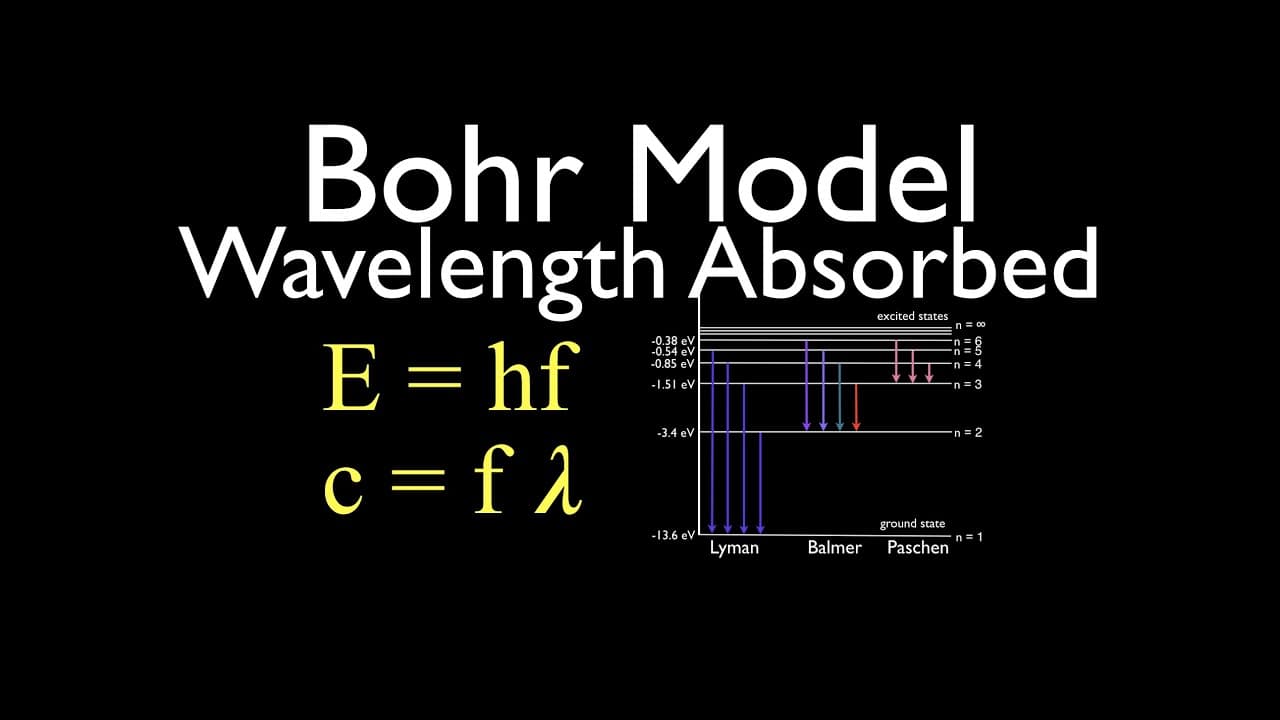
Calculating wavelength absorbed in a Bohr model transition from ground state to n=3 in Hydrogen atom.
Transcript
okay in today's video we're going to be going over another problem involving the Bohr model in this video we're gonna be calculating the wavelength absorbed for a specific transition before we do that please don't forget to subscribe to my youtube channel get all my excellent physics chemistry and math videos right down there in the bottom right ha... Read More
Key Insights
- 🫀 Understanding the Bohr model assists in calculating energy transitions in atoms accurately.
- ⚡ Converting energy units from electron volts to joules is a fundamental step in solving such physics problems.
- 🙂 Energy equations incorporating Planck's constant and speed of light are pivotal in determining frequency and wavelength.
- 🫀 The wavelength transition for a Hydrogen atom in this case is calculated to be 103 nanometers.
- 🆘 Sharing of educational content on physics topics helps in enhancing learning and understanding.
- 🎮 Subscribing to educational channels like "Step-by-Step Science" provides access to quality physics, chemistry, and math videos.
- 🦻 Demonstrating the step-by-step process of solving physics problems aids in comprehension and application of concepts.
Install to Summarize YouTube Videos and Get Transcripts
Explore YouTube Video Summarizer or Get YouTube Transcript Extractor
Questions & Answers
Q: What is the problem discussed in the video?
The video addresses calculating the wavelength absorbed in a transition from ground state to n=3 in a Hydrogen atom within the Bohr model.
Q: How is the energy level difference calculated in this problem?
The energy level difference is computed by subtracting the energies of the ground state and n=3 state sources, leading to a value of 12.09 electron volts.
Q: What conversion steps are involved in determining the wavelength?
The conversion steps include converting electron volts to joules, utilizing Planck's constant and the speed of light equations to derive the frequency, and finally calculating the wavelength in nanometers.
Q: Why is it essential to convert energy values to joules before calculating wavelength?
Converting energy values to joules is crucial as the equations for wavelength involve Planck's constant and the speed of light, both requiring energy values in joules for accurate calculations.
Summary & Key Takeaways
-
Explanation of determining wavelength absorbed in a transition from ground state to n=3 in Hydrogen atom using energy levels.
-
Conversion process from electron volts to joules to frequency to wavelength is detailed.
-
Final result obtained for the wavelength transition in nanometers is 103nm.
Read in Other Languages (beta)
Share This Summary 📚
Summarize YouTube Videos and Get Video Transcripts with 1-Click
Try YouTube Summary with ChatGPT & Claude or YouTube Transcript Generator
Explore More Summaries from Step by Step Science 📚
Summarize YouTube Videos and Get Video Transcripts with 1-Click
Try YouTube Summary with ChatGPT & Claude or YouTube Transcript Generator