How To Find The Limit At Infinity
TL;DR
Learn how to find the limit as x approaches infinity or negative infinity for different types of functions.
Transcript
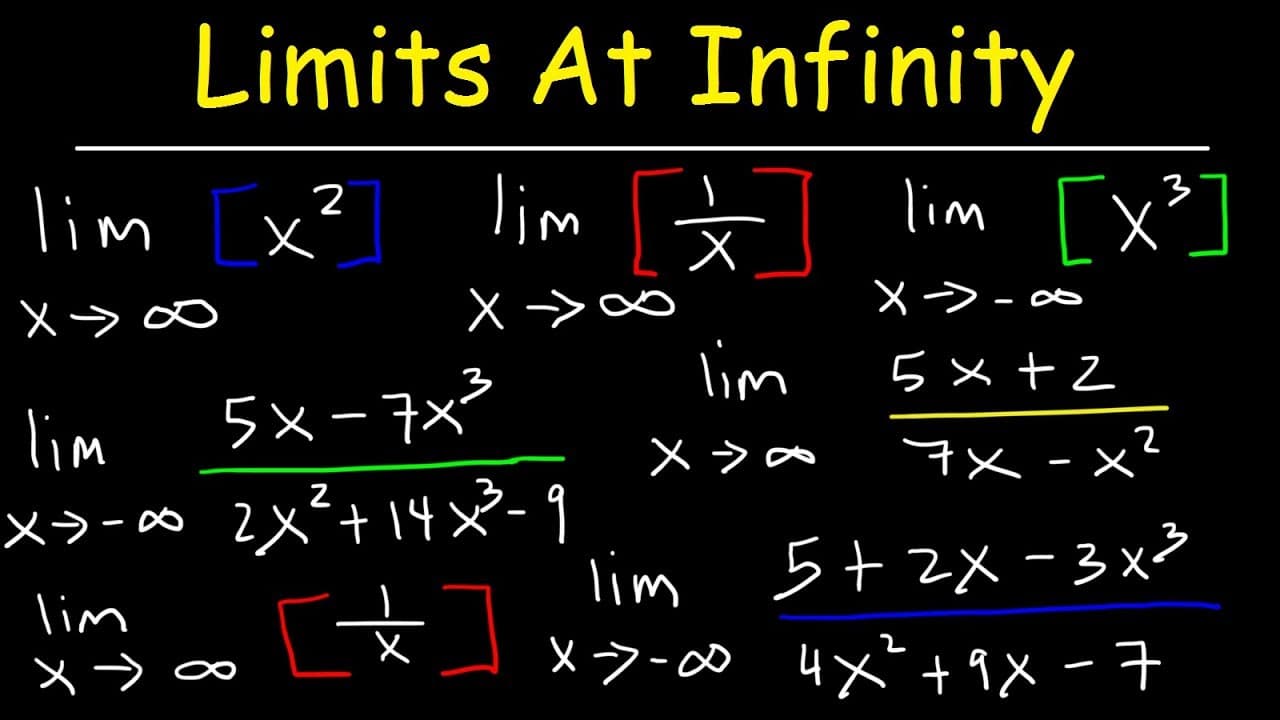
in this lesson we're going to talk about how to find a limit at infinity so what is the limit as x approaches infinity for the function x squared so if x became very large what would x squared become so let's say if x was a thousand x squared would turn into a larger value it's going to be one million so as x gets very large this turns into infinit... Read More
Key Insights
- ♾️ The limit as x approaches infinity or negative infinity for x squared is positive infinity, while the limit for positive x cubed is positive infinity as x approaches infinity and negative infinity as x approaches negative infinity.
- 🍉 In polynomial functions, you can ignore insignificant terms and find the limit based on the highest degree term.
- ❣️ Rational functions with bottom-heavy ratios, where the degree of the denominator exceeds the numerator, will always have a limit of zero as x approaches infinity.
- 🗂️ Rational functions with the same degree on top and bottom can have their limits found by dividing the coefficients.
Install to Summarize YouTube Videos and Get Transcripts
Explore YouTube Video Summarizer or Get YouTube Transcript Extractor
Questions & Answers
Q: How do you find the limit as x approaches negative infinity for a polynomial function?
For polynomial functions, you can ignore insignificant terms and find the limit based on the highest degree term. The limit as x approaches negative infinity of 5 + 2x - x cubed can be simplified to the limit of -x cubed, which gives a final answer of positive infinity.
Q: What is the limit as x approaches infinity for a rational function with a bottom-heavy ratio?
A rational function with a bottom-heavy ratio, where the degree of the denominator is higher than the numerator, will always have a limit of zero as x approaches infinity. For example, the limit as x approaches infinity for 1/x is zero.
Q: How do you find the limit as x approaches infinity for a rational function with the same degree on top and bottom?
If a rational function has the same degree on top and bottom, you can divide the coefficients to find the limit. For example, the limit as x approaches infinity for (5x + 2) / (7x - x squared) is 5/7.
Q: How do you find the limit as x approaches infinity for a rational function that is top-heavy?
For top-heavy rational functions, you can remove insignificant terms in the numerator and find the limit based on the highest degree term. The limit as x approaches infinity for 6x squared divided by 3x simplifies to 2 times infinity, which is positive infinity.
Summary & Key Takeaways
-
When finding the limit as x approaches infinity for functions like x squared or positive x cubed, the limit is positive infinity. When finding the limit as x approaches negative infinity, x squared gives a positive infinity while positive x cubed gives a negative infinity.
-
For polynomial functions, you can ignore insignificant terms and find the limit based on the highest degree term. For example, the limit as x approaches negative infinity of 5 + 2x - x cubed can be simplified to the limit of -x cubed, which gives a final answer of positive infinity.
-
Rational functions with bottom-heavy ratios where the degree of the denominator is higher than the numerator will always have a limit of zero as x approaches infinity. For example, the limit as x approaches infinity for 1/x is zero. If the degrees are the same, you can divide the coefficients to find the limit.
-
For rational functions that are top-heavy, you can remove insignificant terms in the numerator and find the limit based on the highest degree term. The limit as x approaches infinity for 6x squared divided by 3x simplifies to 2 times infinity, which is positive infinity.
Read in Other Languages (beta)
Share This Summary 📚
Summarize YouTube Videos and Get Video Transcripts with 1-Click
Try YouTube Summary with ChatGPT & Claude or YouTube Transcript Generator
Explore More Summaries from The Organic Chemistry Tutor 📚
Summarize YouTube Videos and Get Video Transcripts with 1-Click
Try YouTube Summary with ChatGPT & Claude or YouTube Transcript Generator