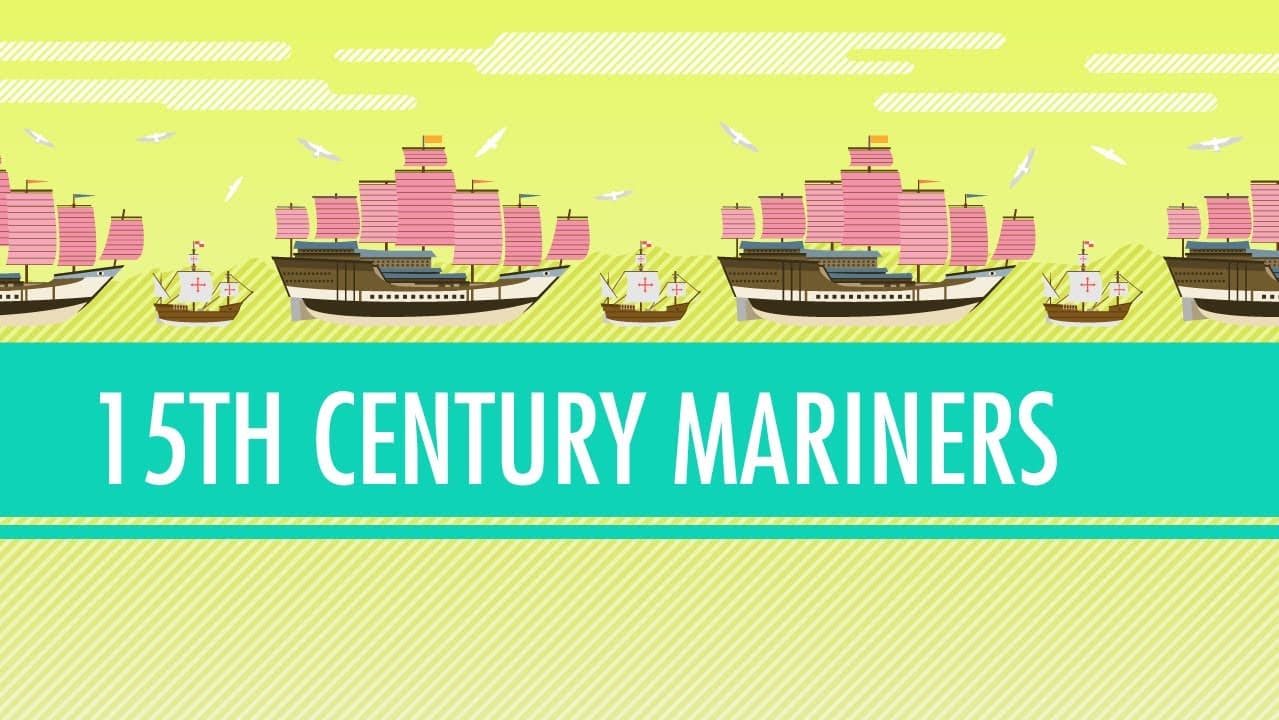
Columbus, Vasco da Gama, and Zheng He - 15th Century Mariners: Crash Course World History #21
TL;DR
Comparison of Columbus, Zheng He, and Vasco da Gama's maritime achievements.
Transcript
Hi, I’m John Green; this is Crash Course World History and today we’re going to do some compare and contrast, because that’s what passes for hip in world history. Right, so you’ve probably heard of Christopher Columbus who in 1492 sailed the ocean blue and discovered America, a place that had been previously discovered only by millions of people --... Read More
Key Insights
- Christopher Columbus is often credited with discovering America in 1492, but millions had already inhabited it.
- Zheng He, a Muslim eunuch, led seven major naval voyages for China, showcasing its naval superiority.
- Vasco da Gama connected Europe to the Indian Ocean trade network, driven by Portugal's need for resources.
- The Chinese treasure ships were massive, dwarfing Columbus's fleet, emphasizing China's naval capabilities.
- Portugal's exploration was motivated by the search for trade routes and mythical allies, like Prester John.
- Columbus used dead reckoning for navigation, relying on direction, speed, and time to traverse unknown waters.
- The Line of Demarcation divided new lands between Spain and Portugal, ignoring indigenous claims.
- Columbus's voyages had profound, albeit often negative, impacts on the Americas, unlike Zheng He's peaceful missions.
Install to Summarize YouTube Videos and Get Transcripts
Explore YouTube Video Summarizer or Get YouTube Transcript Extractor
Questions & Answers
Q: What was Zheng He's role in Chinese naval history?
Zheng He was a prominent Chinese admiral who led seven major naval expeditions between 1405 and 1433. His voyages showcased China's naval superiority and aimed to establish trade dominance in the Indian Ocean. He commanded a massive fleet, including treasure ships, and visited regions like Africa, India, and the Middle East, bringing back exotic goods and animals.
Q: What motivated Vasco da Gama's explorations?
Vasco da Gama's explorations were primarily motivated by Portugal's need to find a direct trade route to the Indian Ocean. This was driven by the lucrative spice trade and the desire to find the mythical Christian King Prester John to aid in a crusade. His successful navigation around Africa opened up new trade opportunities for Portugal.
Q: How did Columbus navigate during his voyages?
Columbus navigated using a method known as dead reckoning, which involved determining his position based on the direction he was traveling, his speed, and the time. This method relied heavily on estimations and basic tools like the hourglass. Despite the challenges, Columbus managed to reach the Caribbean, although he misjudged the size of the Earth and the distance to Asia.
Q: What was the significance of the Line of Demarcation?
The Line of Demarcation, established by Pope Alexander VI in 1494, was significant because it divided the newly discovered lands outside Europe between Spain and Portugal. This division ignored the presence and claims of indigenous peoples, highlighting the Eurocentric perspective of the time. It aimed to resolve territorial disputes between the two maritime powers.
Q: Why did Zheng He's voyages end?
Zheng He's voyages ended due to several factors, including the death of his patron, the Yongle Emperor, and a shift in priorities by his successors. The new emperors focused more on defending China from northern nomadic threats, leading to the construction of the Great Wall. This inward focus marked a move away from maritime exploration and trade.
Q: What were the main goals of Columbus's first voyage?
Columbus's main goals for his first voyage were to find a direct route to Asia for trade, particularly in spices, and to spread Christianity. He promised the Spanish monarchs riches and the conversion of natives. Although he failed to find Asia, his voyages initiated significant cultural and economic exchanges between the Old and New Worlds.
Q: How did the Portuguese control trade in the Indian Ocean?
The Portuguese controlled trade in the Indian Ocean by establishing a 'trading post empire.' They captured strategic coastal cities using well-armed ships and enforced a permit system called the cartaz. Merchants had to purchase these permits to trade in Portuguese-controlled ports, effectively allowing Portugal to profit from existing trade networks.
Q: What lasting impacts did Columbus's voyages have?
Columbus's voyages had lasting impacts by initiating the Columbian Exchange, which involved the transfer of crops, animals, and diseases between the Old and New Worlds. This exchange led to significant demographic, cultural, and economic changes. The voyages also paved the way for European colonization, profoundly affecting indigenous populations in the Americas.
Summary & Key Takeaways
-
The video compares the maritime achievements of Columbus, Zheng He, and Vasco da Gama, highlighting their motivations and impacts. Zheng He led impressive naval expeditions for China, while da Gama sought trade routes for Portugal. Columbus's voyages, though less successful in their goals, had lasting global effects.
-
Zheng He's voyages were notable for their size and scope, aiming to establish China's dominance in trade. In contrast, Vasco da Gama's expeditions were driven by Portugal's need for resources and a desire to find allies against Muslim powers. Columbus sought gold and conversions, leading to significant changes in the Americas.
-
The video dispels myths about Columbus's voyages and discusses the Line of Demarcation, which divided new territories between Spain and Portugal. Despite Columbus's mixed legacy, his voyages marked the beginning of global interconnectedness, overshadowing the more peaceful and technologically advanced missions of Zheng He and da Gama.
Read in Other Languages (beta)
Share This Summary 📚
Summarize YouTube Videos and Get Video Transcripts with 1-Click
Try YouTube Summary with ChatGPT & Claude or YouTube Transcript Generator
Explore More Summaries from CrashCourse 📚



Summarize YouTube Videos and Get Video Transcripts with 1-Click
Try YouTube Summary with ChatGPT & Claude or YouTube Transcript Generator