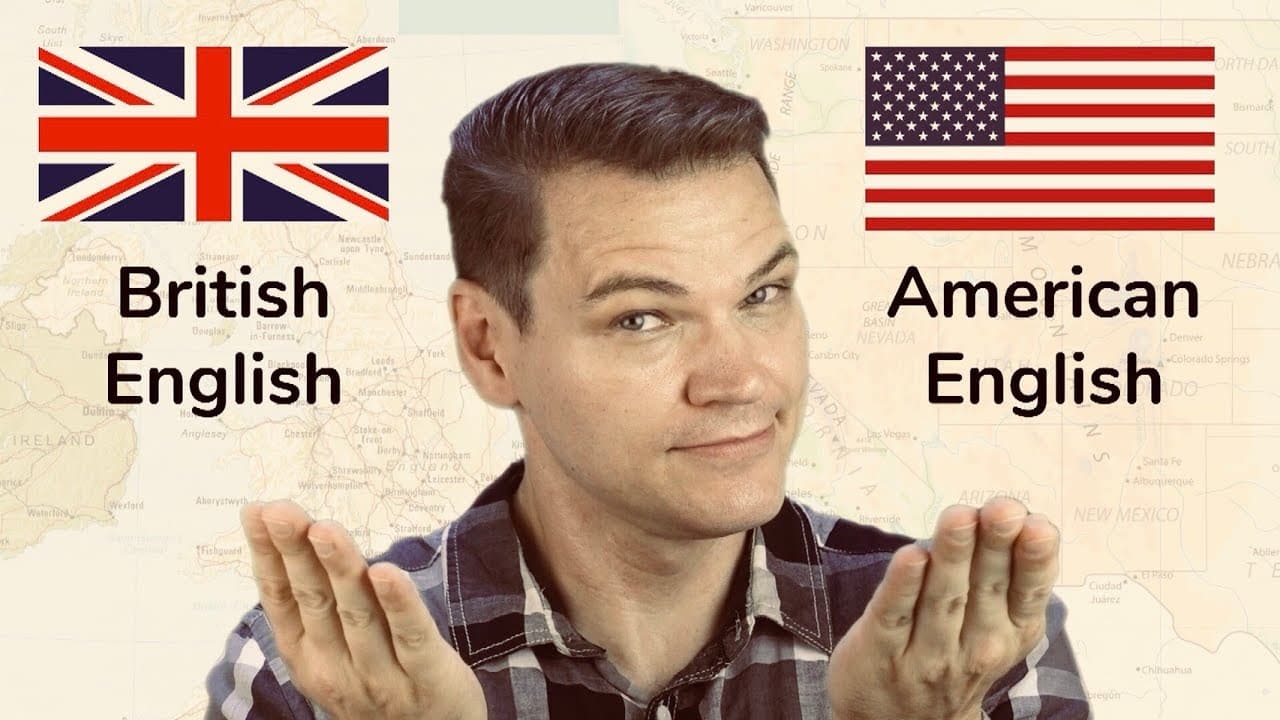
How Are British English and American English Different?
TL;DR
Explores vocabulary, accent, spelling, and grammar differences between British and American English.
Transcript
Hello everyone. Welcome to the Langfocus channel and my name is Paul. Today we'll be answering the question “How are British English and American English Different?” - one of the most commonly asked questions by learners of English. And hopefully native speakers of English will learn a thing or two from this video as well. The truth is that both Br... Read More
Key Insights
- British and American English have notable differences in vocabulary, with words like 'rubbish' in the UK and 'trash' in the US.
- Accents differ significantly; British English often omits the 'r' sound at the end of words, unlike American English.
- Spelling variations include 'colour' in British English and 'color' in American English, highlighting Noah Webster's influence.
- Grammar differences are minor but include variations in auxiliary verbs and past tense forms, like 'learnt' in the UK and 'learned' in the US.
- The intrusive 'r' is a unique feature of British English, where an 'r' sound is added between words ending and starting with a vowel.
- British English uses hard 't' sounds, while American English often uses a soft 't' or flap sound, as in 'butter'.
- Pronunciation of vowel sounds varies, such as the 'o' in 'stop' being unrounded in the US and rounded in the UK.
- Despite differences, native speakers of either variety can understand each other with minimal exposure to the other form.
Install to Summarize YouTube Videos and Get Transcripts
Explore YouTube Video Summarizer or Get YouTube Transcript Extractor
Questions & Answers
Q: What are some vocabulary differences between British and American English?
British and American English have several vocabulary differences. For instance, in the UK, people say 'rubbish' instead of 'trash' or 'garbage', which are used in the US. Similarly, British people might say 'flat' for an apartment, 'telly' for television, and 'lift' for elevator.
Q: How do British and American English differ in terms of accent?
Accents in British and American English differ significantly. British English often omits the 'r' sound at the end of words, a feature known as non-rhoticity, unlike American English, which is rhotic and pronounces the 'r' clearly. Additionally, the 't' sound is pronounced as a hard 't' in British English but as a flap in American English.
Q: What are some spelling differences between British and American English?
Spelling differences include the use of 'ou' in British English, as in 'colour', which becomes 'color' in American English. Other examples are 'centre' vs. 'center' and 'theatre' vs. 'theater'. These changes were largely influenced by Noah Webster's spelling reforms to better reflect pronunciation.
Q: Are there grammatical differences between British and American English?
Yes, there are minor grammatical differences. For example, British English uses 'shall' more frequently for future tense and advice, while American English prefers 'will'. There are also differences in past tense forms, such as 'learnt' in the UK versus 'learned' in the US, and auxiliary verbs like 'have got' versus 'have gotten'.
Q: What is the intrusive 'r' in British English?
The intrusive 'r' is a feature of British English where an 'r' sound is added between two words when the first word ends in a vowel and the second word begins with a vowel. For example, 'I saw a film' might be pronounced as 'I saw'r a film'. This phenomenon is not present in American English.
Q: How do vowel sounds differ between British and American English?
Vowel sounds differ, such as the 'o' in 'stop', which is an unrounded vowel /ɑ/ in American English and a rounded vowel /ɒ/ in British English. Similarly, the 'a' in words like 'half' is pronounced /hæf/ in American English and /hɑːf/ in British English, showing distinct pronunciation patterns.
Q: What role did Noah Webster play in American English spelling?
Noah Webster played a significant role in American English spelling by advocating for reforms that made spelling more phonetic. His changes include altering 're' endings to 'er', as in 'centre' to 'center', and dropping the 'u' in words like 'colour' to 'color'. These reforms aimed to simplify spelling and better reflect pronunciation.
Q: Can native speakers of British and American English understand each other easily?
Yes, native speakers of British and American English generally understand each other with minimal difficulty, especially when exposed to the standard forms of each variety. While there are differences in vocabulary, pronunciation, and grammar, these are not major obstacles, and most speakers can adapt quickly to the other variety.
Summary & Key Takeaways
-
The video discusses the differences between British and American English, focusing on vocabulary, accents, spelling, and grammar. It highlights how native speakers generally understand each other despite these differences, which can sometimes confuse learners.
-
Accents are a major point of difference, with British English often omitting the 'r' sound at the end of words, unlike American English. Vocabulary differences include 'rubbish' in the UK and 'trash' in the US.
-
Spelling variations are influenced by Noah Webster's reforms, like 'colour' vs. 'color'. Grammar differences are minor, with variations in auxiliary verbs and past tense forms, such as 'learnt' vs. 'learned'.
Read in Other Languages (beta)
Share This Summary 📚
Summarize YouTube Videos and Get Video Transcripts with 1-Click
Try YouTube Summary with ChatGPT & Claude or YouTube Transcript Generator
Explore More Summaries from Langfocus 📚





Summarize YouTube Videos and Get Video Transcripts with 1-Click
Try YouTube Summary with ChatGPT & Claude or YouTube Transcript Generator