Endianness Explained With an Egg - Computerphile
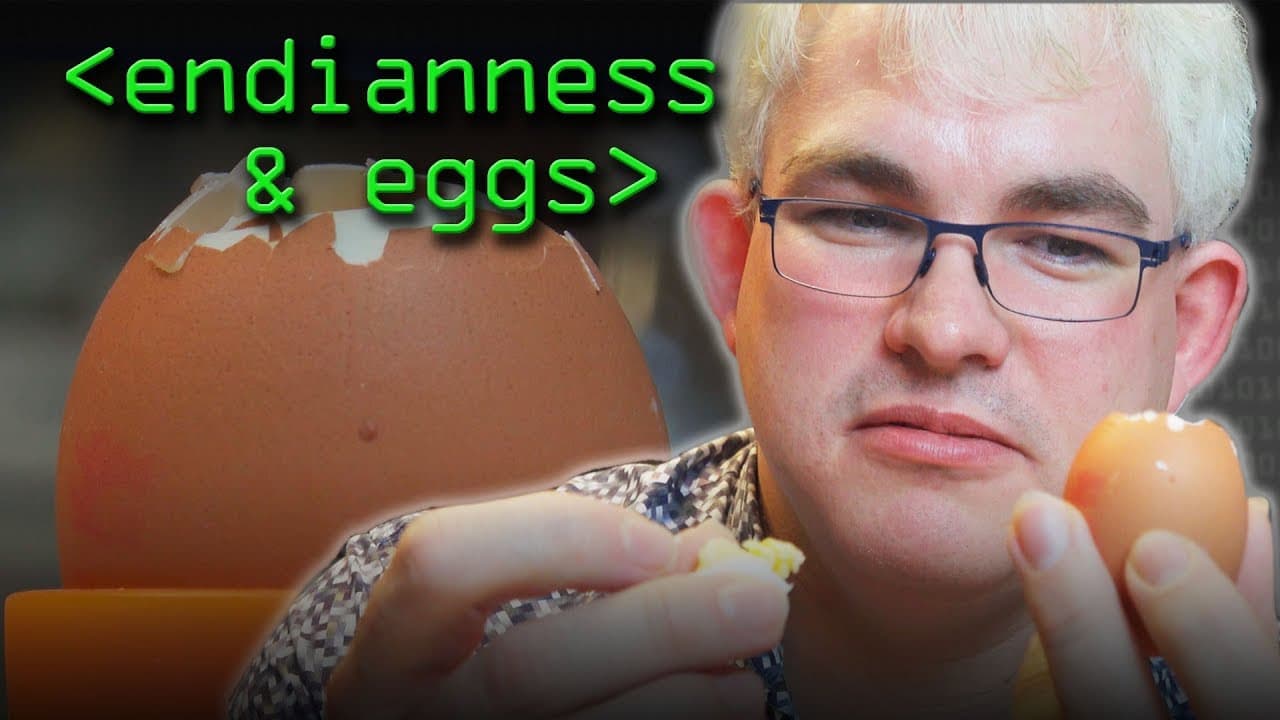
TL;DR
Endianness determines how a computer maps values larger than 1 byte into memory locations that each store 8 bits. A 32-bit value must be split into 4 bytes, which can be stored with the most significant byte first for big-endian or the least significant byte first for little-endian. Read on for the hexadecimal example and the Gulliver’s Travels egg analogy.
Transcript
Okay, so endianness it's, um, it's a simple problem really Computers these days arrange their memory in terms of bytes. So 8-bit values, eight binary digits, 8 bits arranged in the computer's memory and we have an individual address for those things, for each of those bytes. Now, the computers don't deal always with bytes. Sometimes they use 16-bit... Read More
Key Insights
- 😃 Endianness refers to how computers store multi-byte values in memory, with big-endian and little-endian being the main types.
- 🎰 The choice of endianness does not affect a computer's internal operations but becomes important in communication between different machines.
- 🍵 Different computer architectures and processors have different default endianness, but they can handle both types of byte ordering.
- 😅 The term "endianness" originated from the fictional egg-eating habits of characters in Jonathan Swift's novel, Gulliver's Travels.
- 🎨 Endianness can impact hardware design, debugging, and data transmission protocols.
- 😃 Big-endian systems start storing bytes from the most significant byte, while little-endian systems start from the least significant byte.
- 😃 The choice between big-endian and little-endian is often based on historical reasons, convenience, or specific hardware design considerations.
Install to Summarize YouTube Videos and Get Transcripts
Explore YouTube Video Summarizer or Get YouTube Transcript Extractor
Questions & Answers
Q: What is endianness in computer memory?
Endianness is the order used to store values larger than 1 byte across 8-bit memory locations. The two main arrangements described are big-endian and little-endian.
Q: Why is endianness needed?
Computers arrange memory as individually addressed bytes, but they also use 16-bit, 32-bit, and 64-bit values. Those larger values must be divided into bytes and mapped to multiple memory locations in a consistent order.
Q: How is a 32-bit value stored in byte-addressed memory?
A 32-bit value is divided into 4 bytes because each memory address holds 8 bits. Each byte is then assigned to one of four memory locations according to the computer’s byte order.
Q: What is the difference between big-endian and little-endian?
Big-endian stores the most significant byte first, while little-endian stores the least significant byte first. Either arrangement works when the computer consistently reads values in the same order in which they were stored.
Q: How is the hexadecimal value 0x00C0FFEE stored in big-endian order?
The value is split into the bytes 00, C0, FF, and EE. In big-endian order, those bytes are placed into successive memory locations in that same sequence.
Q: How is the hexadecimal value 0x00C0FFEE stored in little-endian order?
In little-endian order, the bytes are placed into successive memory locations as EE, FF, C0, and 00. This starts with the least significant byte rather than the most significant byte.
Q: What are the most significant and least significant bytes?
In the example, EE is the least significant byte because it contains bits 0 to 7. The 00 byte is the most significant because it contains bits 24 to 31.
Q: Why are byte orders called big-endian and little-endian?
The names reference Jonathan Swift’s Gulliver’s Travels, a novel published in the 1700s. In Lilliput, people are described as arguing over whether to eat an egg from its big end or little end.
Summary & Key Takeaways
-
Definition: Endianness is the order used to map values larger than 1 byte into individually addressed memory locations.
-
Number: Each memory address in the explanation stores 8 bits, which equals 1 byte.
-
Number: A byte represents a value between 0 and 255.
-
Number: A 32-bit value must be split into 4 bytes before being assigned to memory locations.
-
Definition: Each hexadecimal digit represents 4 bits, while two hexadecimal digits represent 1 byte.
-
Compare: Big-endian stores the most significant byte first, while little-endian stores the least significant byte first.
-
Number: The example 0x00C0FFEE becomes 00, C0, FF, EE in big-endian order.
-
Number: The example 0x00C0FFEE becomes EE, FF, C0, 00 in little-endian order.
-
Number: EE contains bits 0 to 7, making it the least significant byte in the example.
-
Number: The most significant byte contains bits 24 to 31 in the 32-bit example.
-
Who: Jonathan Swift wrote Gulliver’s Travels, whose Lilliput egg dispute inspired the endianness terminology.
-
When: Gulliver’s Travels is described as a book published in the 1700s.
Read in Other Languages (beta)
Share This Summary 📚
Summarize YouTube Videos and Get Video Transcripts with 1-Click
Try YouTube Summary with ChatGPT & Claude or YouTube Transcript Generator
Explore More Summaries from Computerphile 📚






Summarize YouTube Videos and Get Video Transcripts with 1-Click
Try YouTube Summary with ChatGPT & Claude or YouTube Transcript Generator