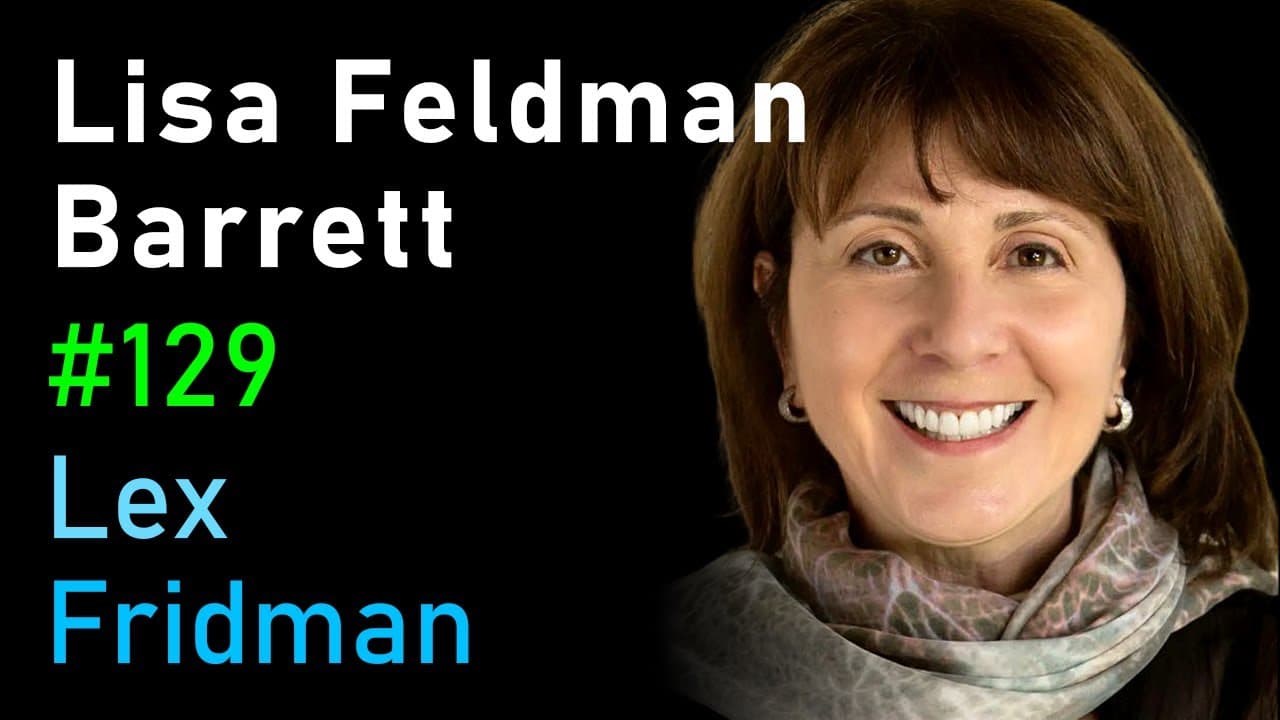
Lisa Feldman Barrett: Counterintuitive Ideas About How the Brain Works | Lex Fridman Podcast #129
TL;DR
Lisa Feldman Barrett argues that the brain predicts and corrects its model of the world, while constructing emotions from past experiences rather than relying on fixed, innate responses. In Lex Fridman Podcast #129, she also explores how intelligence can emerge from different brain structures, why diverse experiences keep internal models flexible, and how dreams reflect unconstrained internal models. Read on for her counterintuitive account of brains, emotions, and perception.
Transcript
the following is a conversation with lisa feldman barrett a professor of psychology at northeastern university and one of the most brilliant and bold thinkers and scientists i've ever had the pleasure of speaking with she is the author of a book that revolutionized our understanding of emotion in the brain called how emotions are made and she's com... Read More
Key Insights
- 🧠 The brain constantly predicts and corrects its model of the world, using past experiences to anticipate future events.
- ⚾ Emotions are not fixed and innate; they are constructed by the brain based on past experiences and predictions.
- 🧠 The brain requires both physical and social inputs to develop properly, and diversity of experiences is crucial for optimal brain functioning.
- 🔢 Dreams can be seen as the brain's unconstrained internal model, free from immediate input from the external world.
Install to Summarize YouTube Videos and Get Transcripts
Explore YouTube Video Summarizer or Get YouTube Transcript Extractor
Questions & Answers
Q: What are Lisa Feldman Barrett’s main ideas about how the brain works?
Barrett describes the brain as constantly predicting and correcting its model of the world. It draws on past experiences to anticipate events, guide action, and shape perception.
Q: Is prediction and correction the brain’s primary function?
Barrett presents prediction and correction as the brain’s main function. The brain uses prior experience to anticipate what will happen and then updates its internal model using incoming information.
Q: How does Lisa Feldman Barrett explain emotions?
Barrett argues that emotions are constructed by the brain rather than fixed and innate. The brain forms and continually updates emotion concepts and categories using past experiences and predictions.
Q: Can people change their internal model of reality?
Yes. Barrett says people can modify their internal models by gaining new experiences and learning from them, while exposure to diverse stimuli can help those models remain flexible and adaptive.
Q: Why are diverse experiences important for the brain?
The brain needs both physical and social inputs to develop properly. Diverse experiences give it material for forming and revising the internal models that support perception and adaptation.
Q: How does Lisa Feldman Barrett describe dreams?
Dreams can be understood as the brain’s unconstrained internal model. Unlike waking perception, that model operates without immediate input from the external world.
Q: Does intelligence have one definition or biological form?
Barrett suggests there is no single form or definition of intelligence. Different brain structures across species can produce intelligence in different ways.
Q: Would evolution produce the same intelligent life forms again on Earth?
Barrett says the answer is probably no because evolution is stochastic and driven partly by chance. Even if intelligence arose again, the resulting menu of life forms might differ from today’s humans, dolphins, birds, and other creatures.
Summary
Lisa Feldman Barrett, a professor of psychology at Northeastern University and author of "How Emotions are Made", discusses her new book "Seven and a Half Lessons About the Brain" and provides insights into the neuroscience of empathy, compassion, and love. She explains that the brain is constantly making predictions based on past experiences and that sensory perception is a result of inferring the causes of sensory data. Barrett also discusses the concept of free will and emphasizes the importance of cultivating experiences to shape our internal models of the world.
Questions & Answers
Q: Do you think there is other intelligent life out there in the universe?
Barrett believes that the probability suggests the existence of intelligent life in the universe. She finds the idea exciting and hopes it is true because it would be cool and sad if we were alone.
Q: Is the human brain more sophisticated than other animal brains?
Barrett explains that while the human brain can do impressive things, there are other animal brains, like an octopus brain, that are also fancy and capable of amazing abilities. The human brain can do certain things in abundance and has enhanced features due to its larger size.
Q: What is the difference between the human brain and ancestor brains?
Barrett points out that the human brain is not necessarily the fanciest brain and that different animal brains possess different miraculous abilities. The human brain can perform certain actions that other animals can't, but animals have their unique intelligent qualities as well.
Q: How does the brain coordinate with others?
Barrett explains that coordination is not unique to humans and that animals also engage in cooperative behaviors. However, humans possess enhanced structural features in their brains that allow for greater capacity to build civilizations and coordinate with others not just to manipulate the physical world but also to contribute to it in profound ways through the use of ideas and words.
Q: How do intelligence and menu of life forms evolve?
Barrett suggests that intelligence can evolve in various ways on Earth, resulting in a diverse range of creature forms. She mentions the stochastic and chance-driven aspects of evolution, but believes that the potential for rich complexity is vast. The evolving menu of life forms may not be the same as it is now, but it would still be equally interesting.
Q: Do you agree with Plato's idea of three brains in the human psyche?
Barrett disagrees with Plato's idea of three brains in the human psyche. While the metaphor of two horses and a charioteer was used to describe moral behavior, it is based on an outdated understanding of brain evolution. Molecular genetics research in the 1960s and 1970s has shown that the brain did not evolve in the suggested three-layered manner.
Q: How does the brain work in terms of prediction and perception?
Barrett explains that the brain is continuously predicting and making sense of the world. It receives sense data from the body and the senses, and uses past experiences to infer causes and make predictions about what will happen next. Perception is an active process of predicting and correcting based on received sense data, rather than a passive reaction to stimuli.
Q: What is the relationship between free will and the brain?
Barrett acknowledges that the existence of free will is a difficult question. While the brain is influenced by past experiences and predictions, individuals have the responsibility to cultivate new experiences that can change their internal model. This ability to change and choose experiences can be seen as a form of free will.
Q: Is anything real or is it all based on perception?
Barrett argues that the brain's wiring based on statistical regularities in the world and the body suggests that there is a physical reality. The brain needs input from the physical world to develop normally and create an internal model of the world. Sense data wires the brain and allows for prediction and adaptation.
Q: How does the brain develop and wire itself?
Barrett explains that the brain is born with incomplete sensory systems and needs specific input to develop normally. Expectable input from the world stimulates the development of sensory systems, allowing the brain to create internal models based on past experiences and predict future events.
Takeaways
Lisa Feldman Barrett provides a unique perspective on the brain, emphasizing its predictive nature and the importance of past experiences in shaping our understanding of the world. She challenges the idea of a three-layered brain, inviting a more nuanced understanding of brain evolution. Barrett also suggests that free will can be seen as the ability to choose and cultivate experiences that change our internal models. The brain's wiring is influenced by statistical regularities in the world, and sense data plays a crucial role in its development and perception of reality.
Summary & Key Takeaways
-
Lisa Feldman Barrett challenges the popular belief that the brain has three distinct parts and proposes a different model of brain evolution based on available scientific evidence.
-
The brain works by constantly predicting and correcting its model of the world, using past experiences to anticipate future events.
-
Emotions are not fixed and innate, but rather constructed by the brain based on past experiences and predictions. Emotion concepts and categories are continuously formed and updated.
Read in Other Languages (beta)
Share This Summary 📚
Summarize YouTube Videos and Get Video Transcripts with 1-Click
Try YouTube Summary with ChatGPT & Claude or YouTube Transcript Generator
Explore More Summaries from Lex Fridman Podcast 📚





Summarize YouTube Videos and Get Video Transcripts with 1-Click
Try YouTube Summary with ChatGPT & Claude or YouTube Transcript Generator