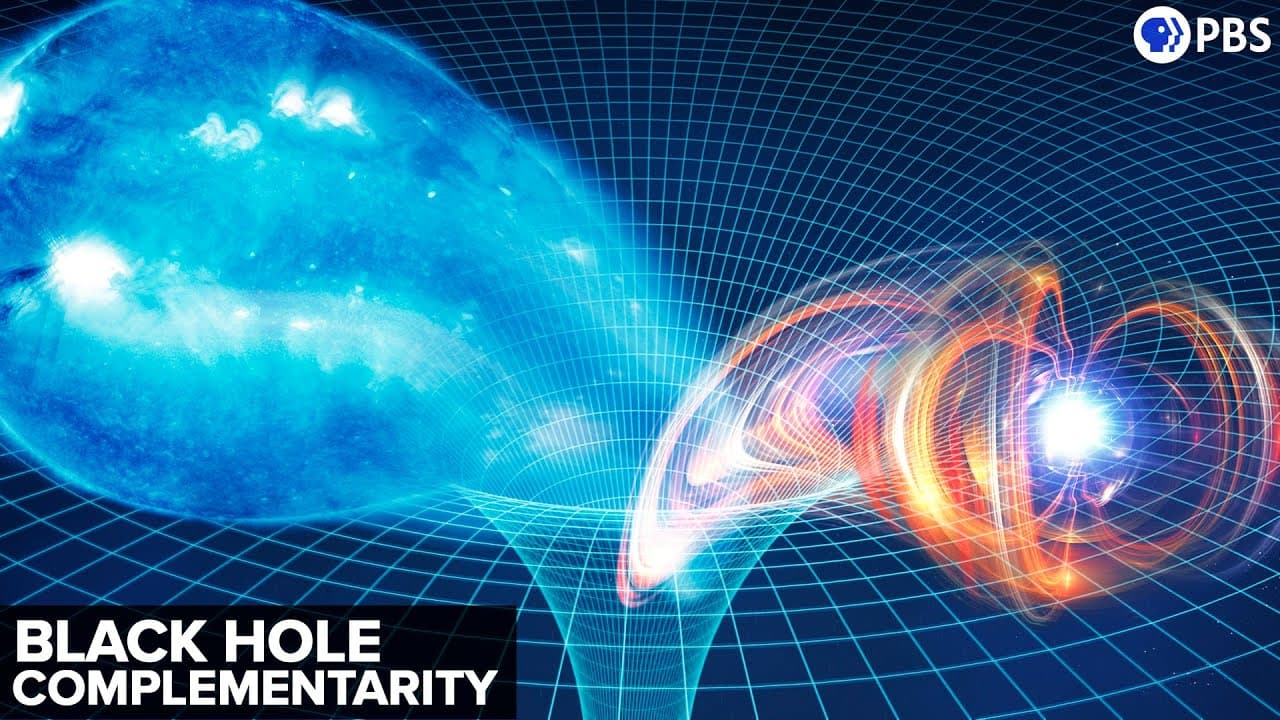
Can Black Holes Unify General Relativity & Quantum Mechanics?
TL;DR
Black holes challenge our understanding of physics, suggesting new theories.
Transcript
Hey Everyone. Before we get to the episode, just a heads up we have two new items at the merch store. There’s a link in the description Black holes are inevitable predictions of general relativity—our best theory of space, time and gravity. But they clash in multiple ways with quantum mechanics, our equally successful description of the subatom... Read More
Key Insights
- Black holes, predicted by general relativity, conflict with quantum mechanics, particularly in the black hole information paradox.
- The black hole information paradox suggests that black holes might violate either general relativity or quantum mechanics principles.
- Alice and Bob's gedankenexperiment demonstrates the paradox: whether a qubit is duplicated or annihilated when crossing a black hole's event horizon.
- Black hole complementarity, proposed by Leonard Susskind, suggests no contradiction exists because no observer can witness both states of a qubit.
- Penrose diagrams help visualize the paradox, showing how light and information behave near a black hole's event horizon.
- The concept of simultaneity in relativity suggests that observing both states of a qubit is impossible, supporting black hole complementarity.
- Different interpretations of black hole complementarity suggest that quantum information conservation may be observer-dependent.
- The holographic principle implies that black hole interiors and surfaces might be different representations of the same quantum system.
Install to Summarize YouTube Videos and Get Transcripts
Explore YouTube Video Summarizer or Get YouTube Transcript Extractor
Questions & Answers
Q: What is the black hole information paradox?
The black hole information paradox arises from the conflict between general relativity and quantum mechanics. It questions what happens to information when it enters a black hole. The paradox suggests that either information is duplicated or annihilated, violating fundamental principles of either general relativity or quantum mechanics.
Q: How does black hole complementarity propose to resolve the paradox?
Black hole complementarity, proposed by Leonard Susskind, suggests that no contradiction exists because no observer can witness both states of a qubit inside and outside a black hole. It argues that the impossibility of observing both states means there is no violation of unitarity, thus resolving the paradox.
Q: What role do Penrose diagrams play in understanding the paradox?
Penrose diagrams are used to visualize the behavior of light and information near a black hole's event horizon. They help illustrate how information appears frozen from an external observer's perspective, supporting the idea that simultaneity and observation are key to understanding the black hole information paradox and complementarity.
Q: What is the significance of simultaneity in the context of black holes?
Simultaneity in relativity suggests that observing both the interior and exterior states of a qubit is impossible, supporting black hole complementarity. It implies that the conservation of quantum information and the existence of quantum states may be relative to the observer, challenging traditional notions of existence and time.
Q: How does the holographic principle relate to black hole complementarity?
The holographic principle suggests that black hole interiors and surfaces are different representations of the same quantum system. This idea supports black hole complementarity by proposing that the interior and exterior descriptions of quantum information are equivalent, offering a unified perspective on the paradox.
Q: What are the different interpretations of black hole complementarity?
One interpretation suggests that quantum information conservation is observer-dependent, with no contradictions for individual observers. Another interpretation proposes that the interior and exterior descriptions of a black hole are equivalent, akin to holography, implying that different observers perceive the same quantum system in distinct ways.
Q: What is the potential impact of black hole complementarity on our understanding of physics?
Black hole complementarity challenges traditional views of existence, simultaneity, and quantum information conservation. It suggests that our understanding of the universe may be deeply observer-dependent, and that black holes offer a glimpse into a more comprehensive theory unifying general relativity and quantum mechanics.
Q: How does the concept of uncrossable horizons relate to black hole complementarity?
Uncrossable horizons, like those in black holes, prevent observers from witnessing both the interior and exterior states of a qubit. This concept supports black hole complementarity by suggesting that the inability to observe both states ensures no contradiction or violation of unitarity occurs, highlighting the importance of observation in relativity.
Summary & Key Takeaways
-
Black holes present a clash between general relativity and quantum mechanics, leading to the black hole information paradox. This paradox arises from the potential violation of fundamental principles when a qubit enters a black hole. Black hole complementarity offers a solution by suggesting that no observer can witness the qubit's dual states, thus no contradiction exists.
-
Penrose diagrams illustrate how information behaves near a black hole, with light and qubits appearing frozen at the event horizon. The impossibility of observing both states of a qubit supports black hole complementarity, which argues that the paradox is resolved by the nature of observation in relativity.
-
Black hole complementarity suggests that quantum information conservation is relative to observers, challenging our understanding of existence and simultaneity. The holographic principle extends this idea, proposing that black hole interiors and surfaces are different descriptions of the same quantum system, hinting at a deeper understanding of the universe.
Read in Other Languages (beta)
Share This Summary 📚
Summarize YouTube Videos and Get Video Transcripts with 1-Click
Try YouTube Summary with ChatGPT & Claude or YouTube Transcript Generator
Explore More Summaries from PBS Space Time 📚
Summarize YouTube Videos and Get Video Transcripts with 1-Click
Try YouTube Summary with ChatGPT & Claude or YouTube Transcript Generator