Products
Features
YouTube Video Summarizer
Summarize YouTube videos
Web & PDF Highlighter
Highlight web pages & PDFs
Chat with PDF
Ask any PDF questions with AI
Ask AI Clone
Chat with your highlights & memories
Audio Transcriber
Transcribe audio files to text
Glasp Reader
Read and highlight articles
Kindle Highlight Export
Export your Kindle highlights
Idea Hatch
Hatch ideas from your highlights
Integrations
Obsidian Plugin
Notion Integration
Pocket Integration
Instapaper Integration
Medium Integration
Readwise Integration
Snipd Integration
Hypothesis Integration
Apps & Extensions
Chrome Extension
Safari Extension
Edge Add-ons
Firefox Add-ons
iOS App
Android App
Discover
Discover
Ideas
Discover new ideas and insights
Articles
Curated articles and insights
Books
Book recommendations by great minds
Posts
Essays and notes from readers
Quotes
Inspiring quotes collection
Videos
Curated videos and summaries
Explore Glasp
Glasp Newsletter
Weekly insights and updates
Glasp Talk
Interview series with great minds
Glasp Blog
Latest news and articles
Glasp Use Cases
Learn how others use Glasp
Build & Support
Glasp API
Access Glasp's API for developers
MCP Connector
Connect Glasp to Claude & ChatGPT
Community
Glasp Reddit Community
Students
Student discount and benefits
FAQs
Frequently Asked Questions
AboutPricing
DashboardLog inSign up

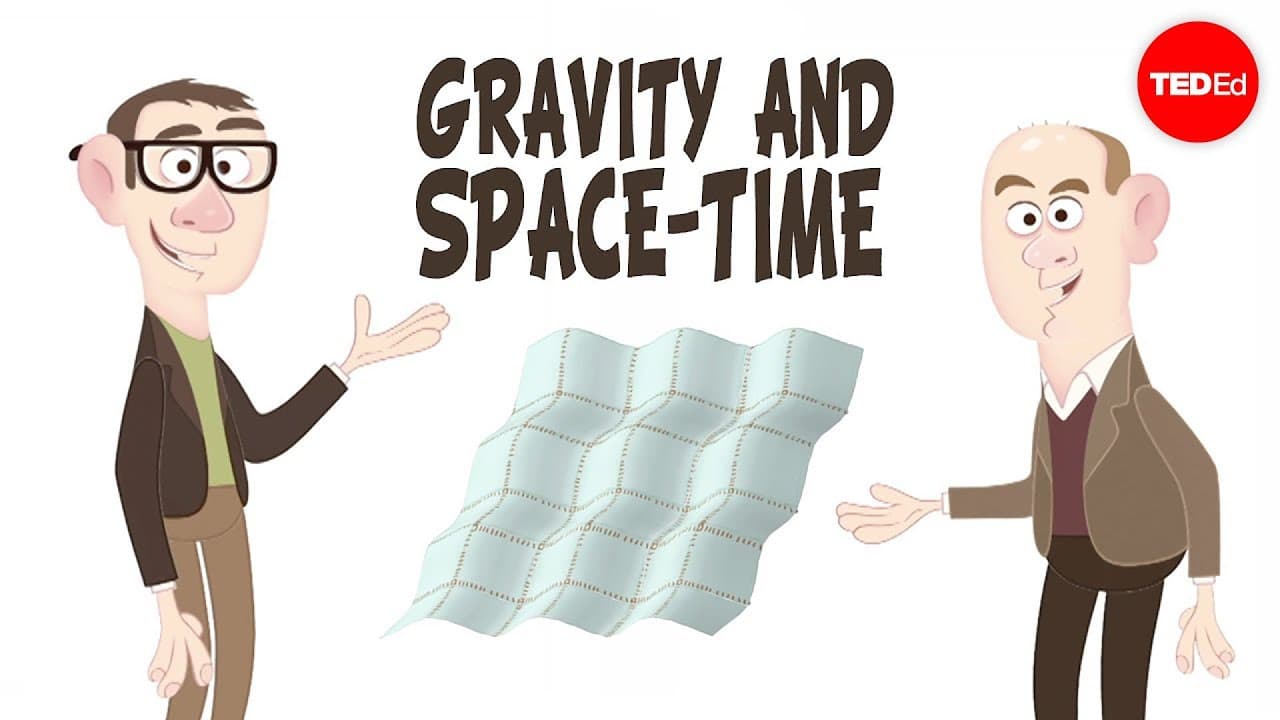
The fundamentals of space-time: Part 3 - Andrew Pontzen and Tom Whyntie
616.1K views
•
May 22, 2014
by
TED-Ed
YouTube video player
The fundamentals of space-time: Part 3 - Andrew Pontzen and Tom Whyntie

TL;DR

Gravity distorts space-time, creating curvature, waves, and challenging black hole theories.

Transcript

Gravity. It controls the universe. Everything attracts everything else. Ouch! Including you. Ow! In this final lesson, we'll explore what gravity means for space-time, or rather what space-time means for gravity. Until now, we've been dealing with things moving at constant speeds, with straight world lines in space-time. But once you add gravity, i... Read More

Key Insights

  • 🫥 Gravity distorts space-time, necessitating new world line representations and Lorentz transformations.
  • 👾 Mass and energy contribute to curving space-time, explaining the concept of gravity as described by Einstein.
  • 👾 Gravitational waves, effects of curved space-time, are being sought for validation.
  • 👾 Black holes challenge traditional space-time theories, requiring a quantum mechanics integration.
  • 🙂 Einstein's theory aligns predictions with observed phenomena like planetary orbits and light deflections.
  • 🥺 Space-time curvature due to mass and energy leads to gravitational effects like acceleration and collision.
  • 👋 Detection of gravitational waves could provide evidence supporting Einstein's theory.

Install to Summarize YouTube Videos and Get Transcripts

Explore YouTube Video Summarizer or Get YouTube Transcript Extractor

Questions & Answers

Q: How does gravity cause acceleration in space-time?

Gravity distorts space-time, altering the trajectory of objects and requiring a change in speed, leading to acceleration.

Q: What predictions did Einstein's theory make that previous theories couldn't explain?

Einstein's theory predicts phenomena like Mercury's orbit and light deflection, attributing gravity to curved space-time rather than separate concepts.

Q: How are gravitational waves formed, and why are they significant?

Gravitational waves are formed due to the curvature in space-time caused by massive objects, and their detection could provide crucial insights into Einstein's theory.

Q: Why do current theories on space-time collapse in the context of black holes?

The immense concentration of mass in black holes leads to extreme curvature in space-time, challenging existing theories and hinting at the need for a quantum mechanics-infused perspective.

Summary & Key Takeaways

  • Gravity causes acceleration, altering world lines in space-time and requiring Lorentz transformations.

  • Curved space-time due to mass and energy explains gravity according to Einstein.

  • Gravitational waves, predicted by Einstein's theory, are being studied for detection.


Read in Other Languages (beta)

English

Share This Summary 📚

Summarize YouTube Videos and Get Video Transcripts with 1-Click

Download browser extensions on:

Try YouTube Summary with ChatGPT & Claude or YouTube Transcript Generator

Explore More Summaries from TED-Ed 📚
Why is Vermeer's "Girl with the Pearl Earring" considered a masterpiece? - James Earle thumbnail
Why is Vermeer's "Girl with the Pearl Earring" considered a masterpiece? - James Earle
TED-Ed
Does time exist? - Andrew Zimmerman Jones thumbnail
Does time exist? - Andrew Zimmerman Jones
TED-Ed
Why do competitors open their stores next to one another? - Jac de Haan thumbnail
Why do competitors open their stores next to one another? - Jac de Haan
TED-Ed
The unexpected math behind Van Gogh's "Starry Night" - Natalya St. Clair thumbnail
The unexpected math behind Van Gogh's "Starry Night" - Natalya St. Clair
TED-Ed
Why are some people left-handed? - Daniel M. Abrams thumbnail
Why are some people left-handed? - Daniel M. Abrams
TED-Ed
How to build a fictional world - Kate Messner thumbnail
How to build a fictional world - Kate Messner
TED-Ed

Summarize YouTube Videos and Get Video Transcripts with 1-Click

Download browser extensions on:

Try YouTube Summary with ChatGPT & Claude or YouTube Transcript Generator

Apps & Extensions

  • Chrome Extension
  • Safari Extension
  • Edge Add-ons
  • Firefox Add-ons
  • iOS App
  • Android App

Key Features

  • YouTube Video Summarizer
  • Web & PDF Summarizer
  • Web & PDF Highlighter
  • Chat with PDF
  • Ask AI Clone
  • Audio Transcriber
  • Glasp Reader
  • Kindle Highlight Export
  • Idea Hatch

Integrations

  • Obsidian Plugin
  • Notion Integration
  • Pocket Integration
  • Instapaper Integration
  • Medium Integration
  • Readwise Integration
  • Snipd Integration
  • Hypothesis Integration

More Features

  • APIs
  • MCP Connector
  • Blog & Post
  • Embed Links
  • Image Highlight
  • Personality Test
  • Quote Shots

Company

  • About us
  • Blog
  • Community
  • FAQs
  • Job Board
  • Newsletter
  • Pricing
Terms

•

Privacy

•

Guidelines

© 2026 Glasp Inc. All rights reserved.