An alternative approach to nanotechnology | Alanur Heper | TEDxYouth@BursaKoleji
TL;DR
Exploring the production of nanoparticles through the innovative method of laser ablation, with potential applications in medicine and industry.
Transcript
hello everyone my name is Al um I'm 16 years old and I've been a part of the IB diplom program in Tusa College I've recently taken the cus PC exams and I'm a student who is specifically interested in the areas of chemistry and engineering and I recently had a chance to um do an experiment care an experiment and a research paper that was about the u... Read More
Key Insights
- 🛩️ Nanoparticles have unique properties due to their small size, making them valuable in various applications.
- 🪡 Laser ablation is an alternative method for synthesizing nanoparticles, reducing the need for chemical consumption.
- ❓ Antibacterial effects of nanoparticles offer a promising approach to combat bacteria resistance to antibiotics.
- 🥺 Using laser ablation to produce nanoparticles can lead to color changes in the liquid medium due to plasmon resonance.
- 😷 The development of nanoparticle-based wound dressing materials, such as hydrogels, shows potential in the medical field.
- ❓ Nanoparticles can be synthesized using various parameters in laser ablation, affecting the quantity and properties of the particles.
- 😂 Tea extract can be used as a capping agent in nanoparticle synthesis to prevent undesired aeration.
Install to Summarize YouTube Videos and Get Transcripts
Explore YouTube Video Summarizer or Get YouTube Transcript Extractor
Questions & Answers
Q: What are nanoparticles, and why are they significant?
Nanoparticles are tiny particles with unique properties, crucial for applications in medicine and industry due to their small size and specific characteristics.
Q: How can nanoparticles exhibit antibacterial effects?
Nanoparticles can disrupt bacterial cell membranes, generate reactive oxygen species, induce intracellular antibacterial effects, and penetrate bacterial cell membranes, leading to antibacterial effects.
Q: What are the two main approaches to synthesizing nanoparticles?
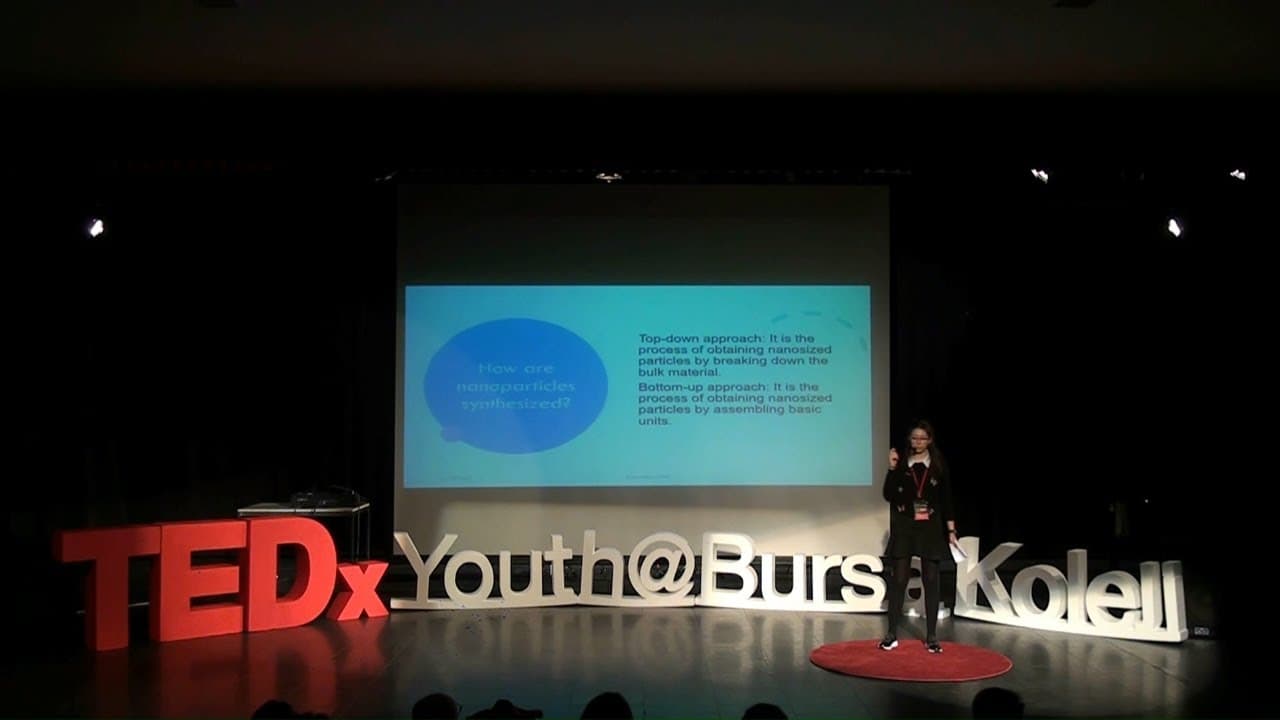
The top-down approach involves reducing larger materials, while the bottom-up approach produces nanoparticles from smaller particles, with laser ablation and chemical reduction being two common methods.
Q: What is the laser ablation method for synthesizing nanoparticles?
Laser ablation involves using a pulse laser on a target material in a liquid solvent to produce nanoparticles through plasma formation and rapid cooling, offering an innovative alternative to chemical reduction methods.
Summary & Key Takeaways
-
A 16-year-old student discusses his research paper on laser ablation, focusing on the production of nanoparticles.
-
Nanoparticles are extremely small particles with unique properties applicable in medicine and industry.
-
Laser ablation is a method used to synthesize nanoparticles in liquid, showcasing potential applications like wound dressing materials.
Read in Other Languages (beta)
Share This Summary 📚
Summarize YouTube Videos and Get Video Transcripts with 1-Click
Try YouTube Summary with ChatGPT & Claude or YouTube Transcript Generator
Explore More Summaries from TEDx Talks 📚





Summarize YouTube Videos and Get Video Transcripts with 1-Click
Try YouTube Summary with ChatGPT & Claude or YouTube Transcript Generator