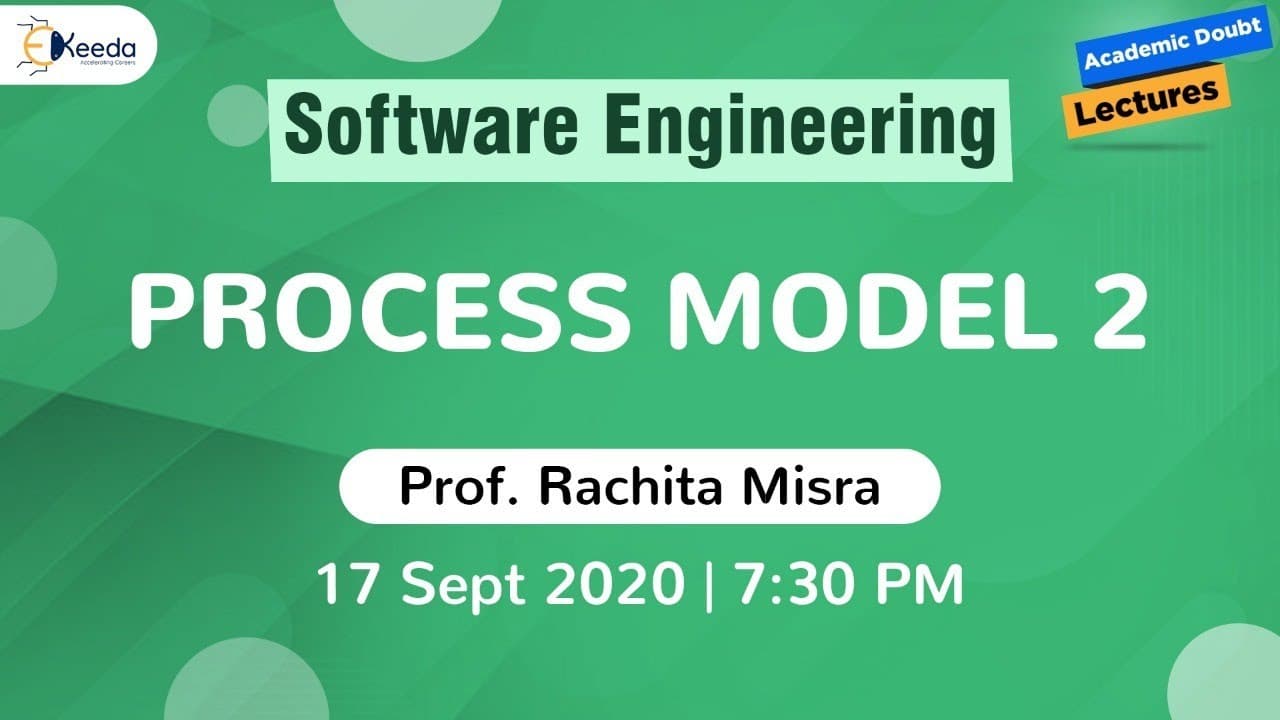
Software Engineering - Process Model 2 | 17 September | 7:30 PM
TL;DR
Process models in software engineering, such as the waterfall, iterative, incremental, prototype, and spiral models, play a crucial role in developing complex software projects.
Transcript
hello everyone this is our second session on the process models and we have to we will be looking into what we are did last class and we will delve a little bit more into the process models and we will go over the prescriptive models today so the topics that we will cover today we will start with the build and fix model and we will then go to the g... Read More
Key Insights
- 📽️ Process models in software engineering provide structure and guidance for developing software projects.
- 🏛️ The waterfall model is a classic linear sequential model, while iterative and incremental models focus on delivering functionality in small increments.
- 💦 The prototype model involves creating a working prototype to refine requirements and improve understanding.
- ✳️ The spiral model is risk-driven and progresses in cycles, allowing for iterative development and risk mitigation.
- 👻 Concurrent development models allow activities to exist concurrently in different states, enabling parallel development and better coordination.
- 🪡 Process models can be tailored to specific project needs and capabilities, providing flexibility in software development approaches.
- 😤 The choice of process model depends on factors such as project size, complexity, customer requirements, and team capabilities.
Install to Summarize YouTube Videos and Get Transcripts
Explore YouTube Video Summarizer or Get YouTube Transcript Extractor
Questions & Answers
Q: What is the purpose of process models in software engineering?
Process models provide a structured framework for developing software, ensuring that engineering practices are followed and the software is developed in a proper way. They guide activities such as requirement gathering, design, development, testing, deployment, and maintenance.
Q: How does the waterfall model differ from iterative and incremental models?
The waterfall model is a linear sequential model with well-defined phases, where each phase must be completed before moving to the next. Iterative and incremental models, on the other hand, involve developing functionality in small increments, allowing for feedback and changes throughout the development process.
Q: What is the main objective of the prototype model?
The prototype model aims to create a working prototype of the software to understand and refine requirements. The prototype is often used as a tool for communication and feedback between the development team and the customer.
Q: How does the spiral model differ from other process models?
The spiral model is risk-driven and progresses in cycles. It combines the iterative nature of prototyping with the systematic control aspect of linear sequential models. Each cycle involves risk analysis, planning, execution, and evaluation, allowing for the resolution of identified risks.
Summary & Key Takeaways
-
Process models are frameworks that guide the development of software, ensuring that engineering practices are followed and the software is developed in a proper way.
-
The waterfall model is a classic linear sequential model, while the iterative and incremental models focus on delivering functionality in small increments.
-
The prototype model involves creating a working prototype to understand and refine requirements, while the spiral model is risk-driven and progresses in cycles.
-
Concurrent development models allow activities to exist concurrently in different states, and each state triggers transitions to other states.
Read in Other Languages (beta)
Share This Summary 📚
Summarize YouTube Videos and Get Video Transcripts with 1-Click
Try YouTube Summary with ChatGPT & Claude or YouTube Transcript Generator
Explore More Summaries from Ekeeda 📚


Summarize YouTube Videos and Get Video Transcripts with 1-Click
Try YouTube Summary with ChatGPT & Claude or YouTube Transcript Generator