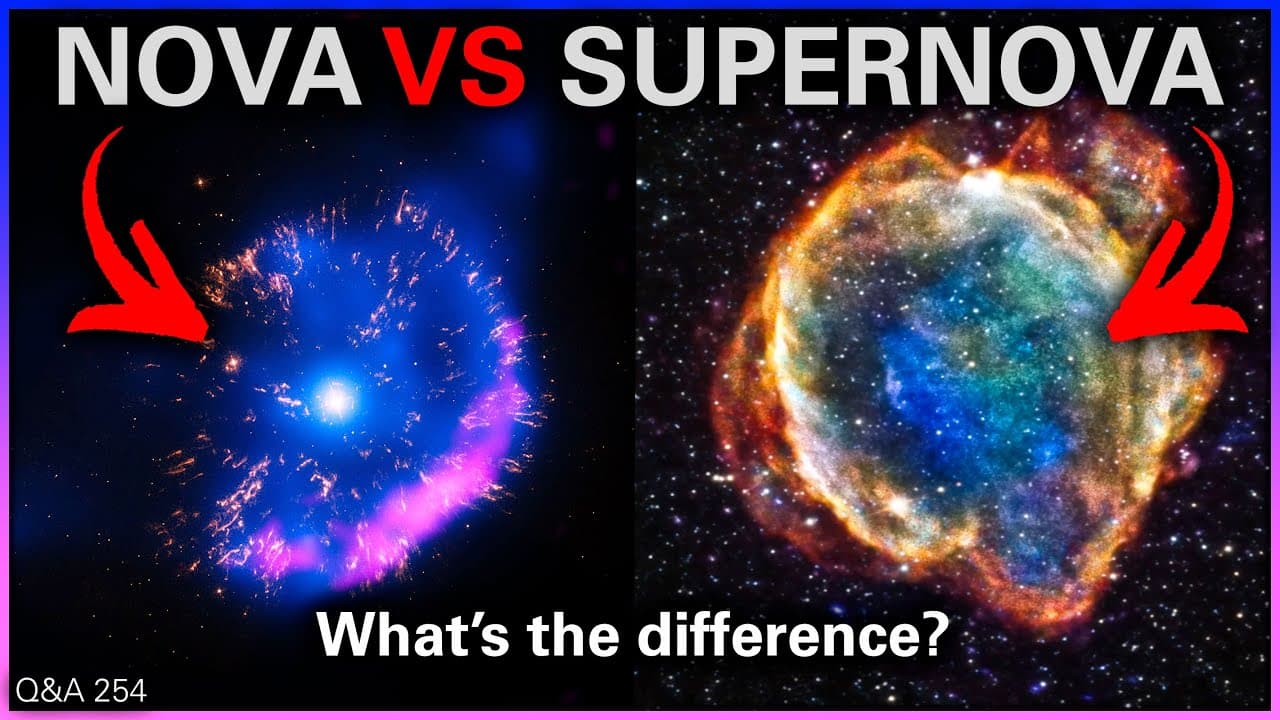
Supernova VS Nova, Orientation of the Moon, Gravitational Lensing of the CMB | Q&A 254
TL;DR
Exploring cosmic phenomena, from Moons with Moons to early Universe stars and beyond.
Transcript
what is the difference between a Nova and a supernova why does the Moon look upside down when you're in the Southern Hemisphere and is there any limit to the periodic table of elements all this and more in this week's question show Welcome to the question show your questions my answers as always wherever you are across my channel if a question Pops... Read More
Key Insights
- ❓ Gravitational lensing impacts cosmic microwave background radiation precision, prompting delensing methods.
- 🤩 Novas and Supernovas differ in origins from white dwarfs and massive star collapses, promising celestial spectacles.
- ☠️ Hubble constant discrepancies connect to galactic motions towards the Great Attractor, impacting expansion rate measurements.
- 🤩 Modern star growth is curtailed by radiation, material balance, and metallicity constraints, unlike early Universe massive stars.
- 🥮 Exploration of Moon moons yields theoretical yet unobserved configurations due to gravitational challenges and orbital dynamics.
- 👾 Mars expedition balancing risks, isolation, and unique experiences highlights the dedication of pioneering space explorers.
Install to Summarize YouTube Videos and Get Transcripts
Explore YouTube Video Summarizer or Get YouTube Transcript Extractor
Questions & Answers
Q: How does gravitational lensing impact the cosmic microwave background radiation?
Gravitational lensing affects CMB by distorting its pattern, requiring delensing methods for precise measurement.
Q: Explain the difference between Novas and Supernovas, detailing possible upcoming events.
Novas occur from white dwarf interaction, while Supernovas stem from massive star collapses, showcasing different celestial phenomena.
Q: Could the Hubble constant be affected by galactic movements towards the Great Attractor?
Galactic shifts influence the Hubble constant but don't resolve the tension between expansion rates, posing cosmological challenges.
Q: What limits the growth of stars in the modern universe compared to early Universe stars?
Factors like radiation, material balances, and metallicity constrain star growth today, unlike the massive early Universe stars.
Q: Are Moon moons plausible or observed in the cosmos?
While theoretically possible, no moon moons have been discovered due to gravitational constraints and the stability of orbital systems.
Q: Would you explore Mars if given the opportunity, considering the challenges and experiences?
Preferring safer space explorations like the Moon, going to Mars involves risks, isolation, and long-term challenges best suited for dedicated adventurers.
Q: Why were early Universe stars larger than those in the present universe?
The unknown factors influencing massive early Universe stars point to potential answers for the formation and limitations of star growth.
Q: Explain the idea of developing a Moon moon and its theoretical feasibility in orbital dynamics.
The concept of a moon moon faces gravitational constraints, making stable configurations rare in cosmic structures, warranting future exploration.
Summary & Key Takeaways
-
Gravitational lensing of cosmic microwave background radiation explained.
-
Distinction between Novas and Supernovas clarified, with insights into upcoming events.
-
Insights into the Deep Space Network, Southern Hemisphere astronomy perks, and the formation of early Universe stars.
Read in Other Languages (beta)
Share This Summary 📚
Summarize YouTube Videos and Get Video Transcripts with 1-Click
Try YouTube Summary with ChatGPT & Claude or YouTube Transcript Generator
Explore More Summaries from Fraser Cain / Universe Today Podcast 📚

Summarize YouTube Videos and Get Video Transcripts with 1-Click
Try YouTube Summary with ChatGPT & Claude or YouTube Transcript Generator