Limiting Reactant Practice Problem
TL;DR
This video explains how to determine the limiting reactant and excess reactant in a chemical reaction using moles and provides a step-by-step solution to a practice problem.
Transcript
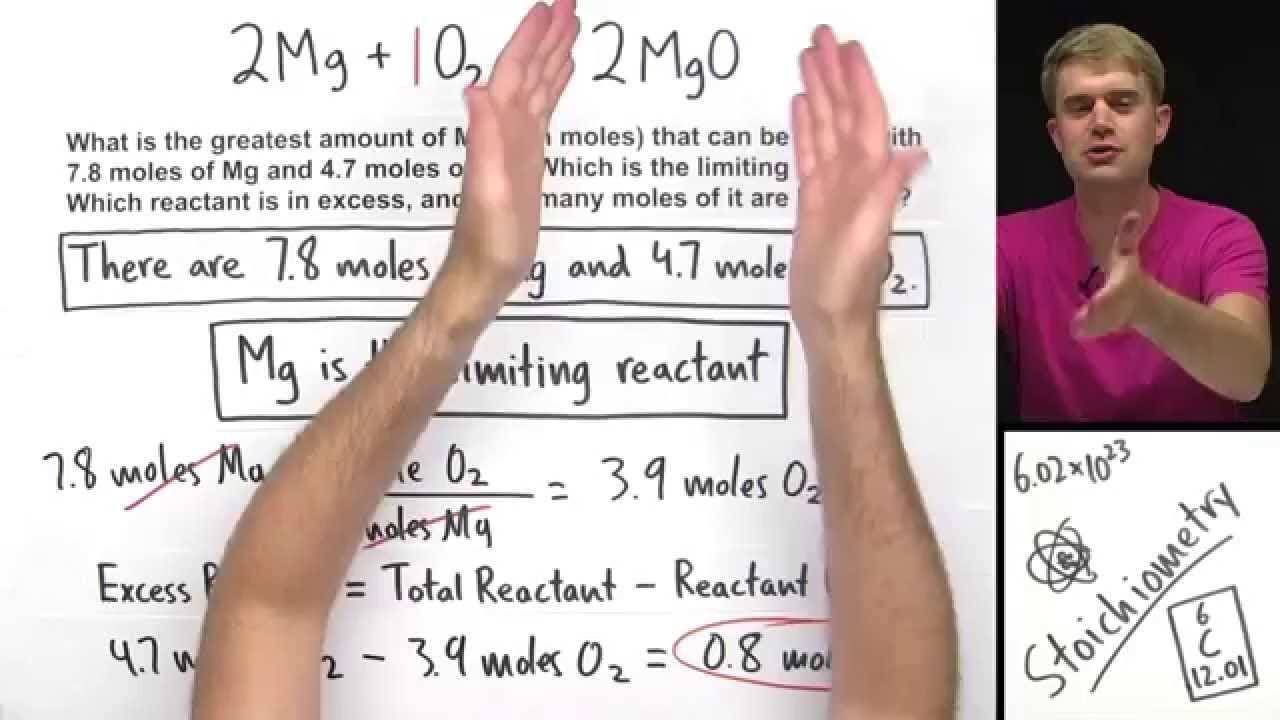
in this video we're going to work through a practice problem on the limiting reactant and excess reactant this problem is pretty straight forward so if you're just starting out learning limiting reactant this is a great place to begin we're going to use this equation to answer the following questions what is the greatest amount of MgO magnesium oxi... Read More
Key Insights
- 💁 The identification of the limiting reactant helps calculate the maximum amount of product that can be formed in a chemical reaction.
- 🥳 The stoichiometric coefficients in the balanced equation determine the ratio between reactants and products, essential for determining the limiting reactant.
- 🧑🏭 Calculations involving moles and conversion factors are crucial for solving problems related to limiting and excess reactants.
- ⛔ The excess reactant is the reactant that remains unreacted after the limiting reactant is completely consumed.
- 😒 Efficient use of reactants is crucial for maximizing product yield and reducing waste.
- 💁 The maximum amount of product that can be formed is determined by the stoichiometry of the reaction and the amount of limiting reactant.
- ⛔ Limiting reactants can change if the stoichiometric coefficients of the reactants are altered.
Install to Summarize YouTube Videos and Get Transcripts
Explore YouTube Video Summarizer or Get YouTube Transcript Extractor
Questions & Answers
Q: What is the purpose of determining the limiting reactant in a chemical reaction?
Determining the limiting reactant helps identify the reactant that will be completely consumed and determines the maximum amount of product that can be formed. It ensures efficient use of reactants and accurate prediction of product yield.
Q: How do you calculate the amount of excess reactant in a chemical reaction?
To calculate the amount of excess reactant, subtract the amount of reactant used from the total amount of that reactant initially present. The resulting value represents the excess reactant that remains unreacted.
Q: Can the limiting reactant change depending on the stoichiometry of the reaction?
Yes, the limiting reactant can change if the stoichiometric coefficients of the reactants are altered. The reactant with the smaller stoichiometric coefficient will become the limiting reactant.
Q: How does determining the limiting reactant affect the amount of product formed?
The limiting reactant determines the maximum amount of product that can be formed. If any reactant is in excess, it will not contribute to additional product formation. Therefore, the amount of limiting reactant determines the amount of product that can be produced.
Summary & Key Takeaways
-
The video focuses on solving a practice problem related to limiting reactants and excess reactants in a chemical reaction.
-
The problem involves determining the greatest amount of magnesium oxide that can be made with given amounts of magnesium and oxygen.
-
The video explains how to use moles to calculate the amounts of reactants required and determine the limiting reactant and excess reactant.
-
The solution includes finding the maximum amount of magnesium oxide that can be produced and the amount of excess reactant remaining.
Read in Other Languages (beta)
Share This Summary 📚
Summarize YouTube Videos and Get Video Transcripts with 1-Click
Try YouTube Summary with ChatGPT & Claude or YouTube Transcript Generator
Explore More Summaries from Tyler DeWitt 📚

Summarize YouTube Videos and Get Video Transcripts with 1-Click
Try YouTube Summary with ChatGPT & Claude or YouTube Transcript Generator