What Is UTF-8 and Why Is It So Important?
TL;DR
UTF-8 is a groundbreaking character encoding that efficiently represents over 100,000 characters, making it crucial for global communication. It solves compatibility issues by maintaining backward compatibility with ASCII while being space-efficient and user-friendly for diverse languages.
Transcript
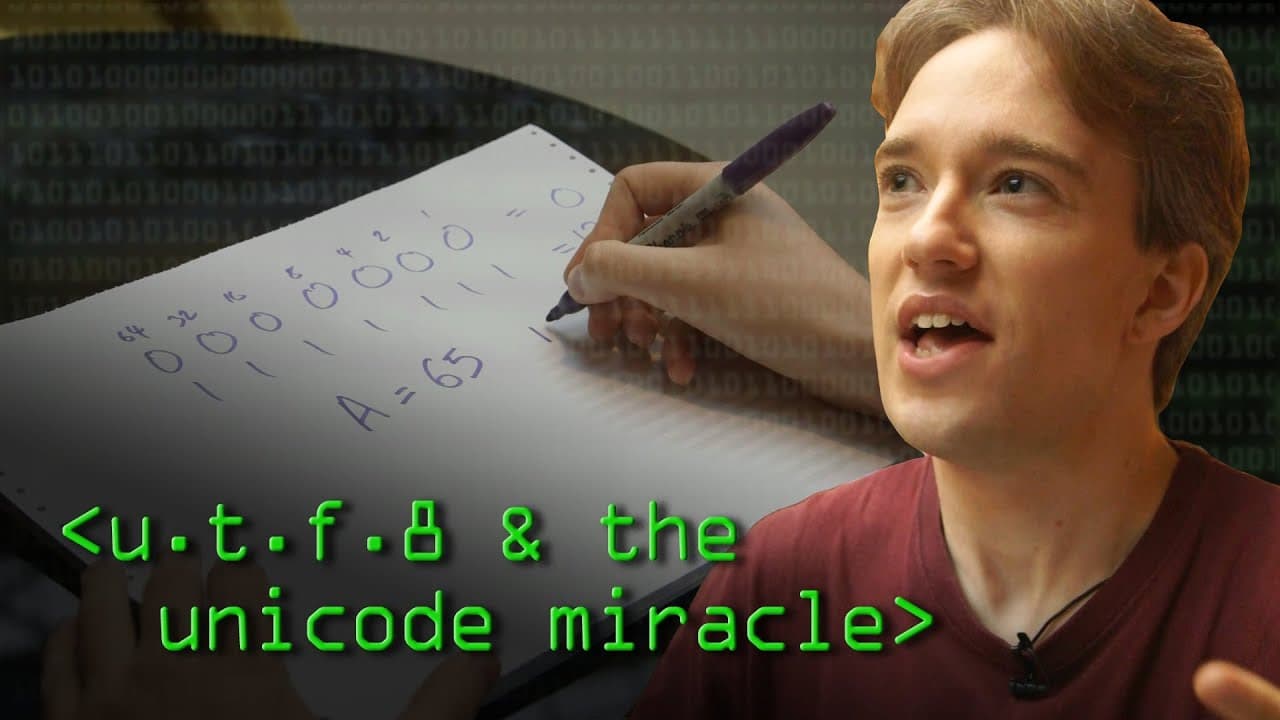
UTF-8 is perhaps the best hack, the best single thing that's used that can be written down on the back of a napkin, and that's how was it was put together. The first draft of UTF-8 was written on the back of a napkin in a diner and it's just such an elegant hack that solved so many problems and I absolutely love it. Back in the 1960s, we had telepr... Read More
Key Insights
- 🫦 ASCII, a 7-bit binary system, was the first widely adopted character encoding system.
- 📜 Different countries and languages developed their own incompatible encodings, causing issues when exchanging documents.
- 👻 The Unicode Consortium established a universal standard with over 100,000 characters, allowing representation of various languages and alphabets.
- 👾 UTF-8 encoding emerged as the most widely used and efficient solution, solving compatibility and space efficiency problems.
- 👾 UTF-8 avoids wasting space by eliminating zeros and ensures backward compatibility with ASCII systems.
- 👻 UTF-8 allows easy navigation within a string of characters without needing an index of character positions.
- 💦 The Unicode Consortium's work has made it possible for documents to be exchanged globally without garbled characters.
Install to Summarize YouTube Videos and Get Transcripts
Explore YouTube Video Summarizer or Get YouTube Transcript Extractor
Questions & Answers
Q: What is ASCII and why was it used as the standard for character encoding?
ASCII, or the American Standard Code for Information Interchange, is a 7-bit binary system that was chosen as the standard for character encoding in the mid-1960s. It allowed for the representation of letters, numbers, and punctuation marks using binary numbers.
Q: What challenges arose with the introduction of 8-bit computers?
With 8-bit computers, different countries and languages started using their own character encoding standards, which led to incompatibility issues. Systems from Nordic countries added additional characters, while Japan created multiple incompatible encodings.
Q: How did the Unicode Consortium solve the character encoding problem?
The Unicode Consortium established a standard by assigning unique numbers to over 100,000 characters used in various languages and alphabets. They did not choose binary digits but allowed for multiple methods of representation. UTF-8 emerged as the most widely adopted encoding for the web.
Q: Why is UTF-8 considered a "hack"?
UTF-8 is considered a hack because it creatively solves several problems. It efficiently encodes ASCII characters, avoids wasting space by eliminating zeros, maintains backward compatibility with ASCII systems, and allows easy navigation within a string of characters.
Summary & Key Takeaways
-
ASCII, a 7-bit binary system, was the initial standard for character encoding in the English-speaking world.
-
Different countries and languages developed their own incompatible encodings, leading to garbled characters when exchanging documents.
-
The Unicode Consortium created a universal standard with over 100,000 characters, solved the issues using UTF-8 encoding, which is backward-compatible and space-efficient.
Read in Other Languages (beta)
Share This Summary 📚
Summarize YouTube Videos and Get Video Transcripts with 1-Click
Try YouTube Summary with ChatGPT & Claude or YouTube Transcript Generator
Explore More Summaries from Computerphile 📚






Summarize YouTube Videos and Get Video Transcripts with 1-Click
Try YouTube Summary with ChatGPT & Claude or YouTube Transcript Generator