What factors influence the emergence of the control law for basketball shooting?
TL;DR
Basketball players minimize motor noise using near-minimum release speed.
Transcript
hi everyone this is rob gray from asu and the perception action podcast again with another review of a article from one of my favorite articles from 2020. in this article i want to talk about control laws and kind of what shapes how which control laws we use for a given action right so in the ecological approach to action we you know it's assumed i... Read More
Key Insights
- Control laws in sports are shaped by the information available, aspects of movement control, and error tolerance. These factors help athletes decide how to perform actions like shooting a basketball.
- Error tolerance is crucial in control laws, allowing athletes to maintain performance despite inevitable movement variability. This concept is illustrated through motor synergies in baseball pitching.
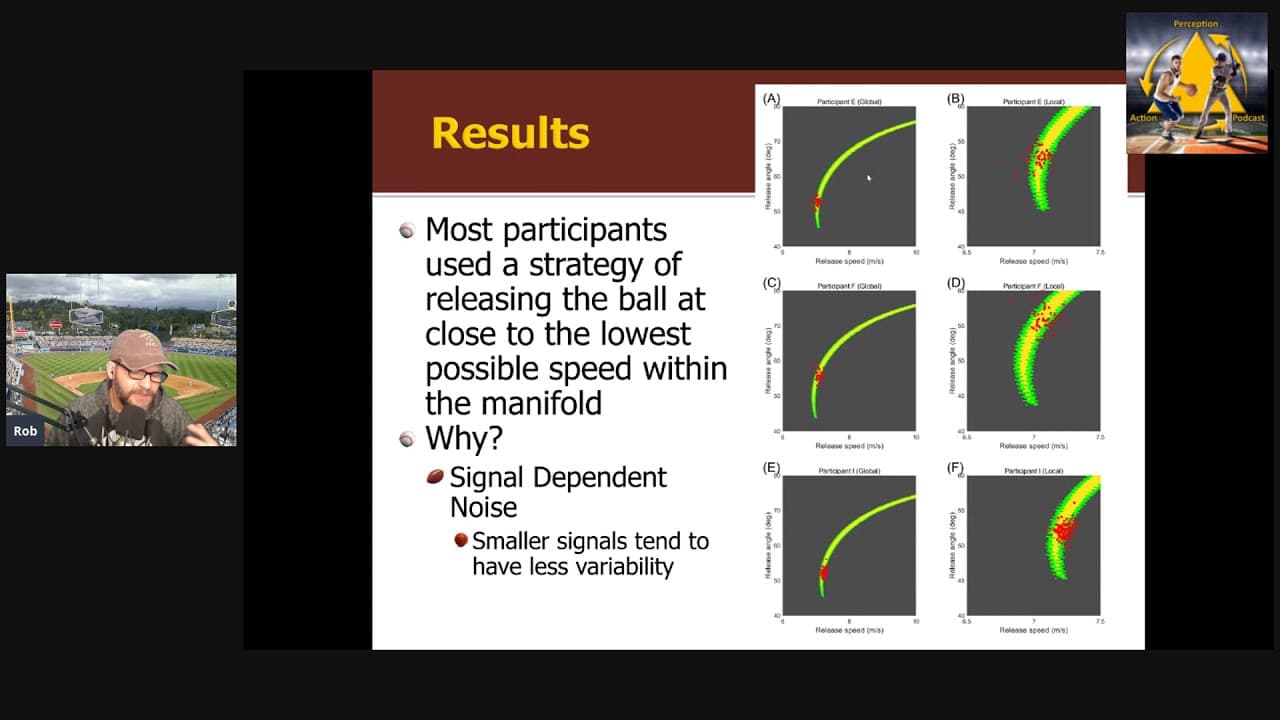
- In basketball free-throw shooting, players can use various speed and angle combinations to score. The study models these possibilities as a manifold, highlighting the degrees of freedom in shooting.
- The study found that most participants shot the ball at the lowest possible speed within the manifold, indicating a strategy that minimizes release speed to enhance consistency and error tolerance.
- Shooting at a lower speed reduces signal-dependent noise, as smaller signals generally have less variability. This leads to more consistent shooting performance.
- The study modeled error tolerance, showing that shooting at certain angles and speeds minimizes the impact of movement variability on the shot outcome.
- Participants with lower inherent variability had narrower shot clusters, while those with higher variability had wider clusters. This suggests individual differences in control law strategies.
- The research did not find evidence that players adjust control laws based on their inherent variability, raising questions for future studies on personalized strategies.
Install to Summarize YouTube Videos and Get Transcripts
Explore YouTube Video Summarizer or Get YouTube Transcript Extractor
Questions & Answers
Q: What is the main focus of the study discussed in the video?
The study focuses on understanding the factors that influence the emergence of control laws in basketball free-throw shooting. It examines how players minimize the effects of motor noise by adopting strategies that involve shooting at near-minimum release speeds, thereby enhancing consistency and error tolerance in their shots.
Q: How do control laws relate to movement variability in sports?
Control laws are strategies that athletes use to manage the degrees of freedom in their movements, aiming to achieve consistent outcomes despite inherent variability. In sports, these laws help athletes adapt to movement variability by establishing motor synergies, where different body parts compensate for each other, leading to more consistent performance outcomes.
Q: What role does error tolerance play in basketball shooting?
Error tolerance in basketball shooting refers to the ability to maintain consistent performance despite inevitable movement variability. By adopting control laws that are tolerant to errors, players can minimize the impact of slight variations in their shooting technique, ensuring that minor deviations do not lead to significant changes in the shot outcome.
Q: What strategy did the study find most participants used in free-throw shooting?
The study found that most participants used a strategy of shooting at the lowest possible release speed within the manifold of possible shot parameters. This strategy minimizes motor noise and enhances consistency by reducing signal-dependent variability, leading to better performance in free-throw shooting.
Q: Why is shooting at a lower speed beneficial in basketball?
Shooting at a lower speed is beneficial because it reduces signal-dependent noise, which is the variability associated with larger movement signals. By minimizing the speed, players decrease the variability in their motor output, resulting in more consistent and accurate shots, as smaller signals generally have less variability.
Q: How does the study model the possibilities in basketball shooting?
The study models the possibilities in basketball shooting by creating a manifold that represents the range of speed and angle combinations that can result in successful shots. This manifold illustrates the degrees of freedom available to players, allowing them to choose different combinations to achieve a successful outcome.
Q: Did the study find evidence of personalized control law strategies?
The study did not find evidence that players adjust their control laws based on their inherent variability. While individual differences in shot clusters were observed, there was no indication that players consciously or unconsciously chose different strategies to optimize their performance based on their variability.
Q: What future research questions does the study raise?
The study raises questions about whether players can or do adjust their control laws based on their inherent variability. Future research could explore personalized strategies in sports, investigating whether athletes can optimize their performance by selecting control laws that account for their unique movement variability and error tolerance.
Summary & Key Takeaways
-
The study explores the factors influencing control laws in basketball shooting, focusing on error tolerance and movement variability. By modeling free-throw shots, researchers identify strategies that minimize motor noise.
-
Participants in the study tended to shoot at the lowest possible speed, which enhances consistency by reducing signal-dependent noise. This strategy is linked to better performance in free-throw shooting.
-
While individual variability was observed, the study did not find evidence that players adjust their shooting strategies based on inherent variability, suggesting potential areas for future research.
Read in Other Languages (beta)
Share This Summary 📚
Summarize YouTube Videos and Get Video Transcripts with 1-Click
Try YouTube Summary with ChatGPT & Claude or YouTube Transcript Generator
Explore More Summaries from Rob Gray 📚
Summarize YouTube Videos and Get Video Transcripts with 1-Click
Try YouTube Summary with ChatGPT & Claude or YouTube Transcript Generator