Is Quantum Mechanics Deterministic or Uncertain?
TL;DR
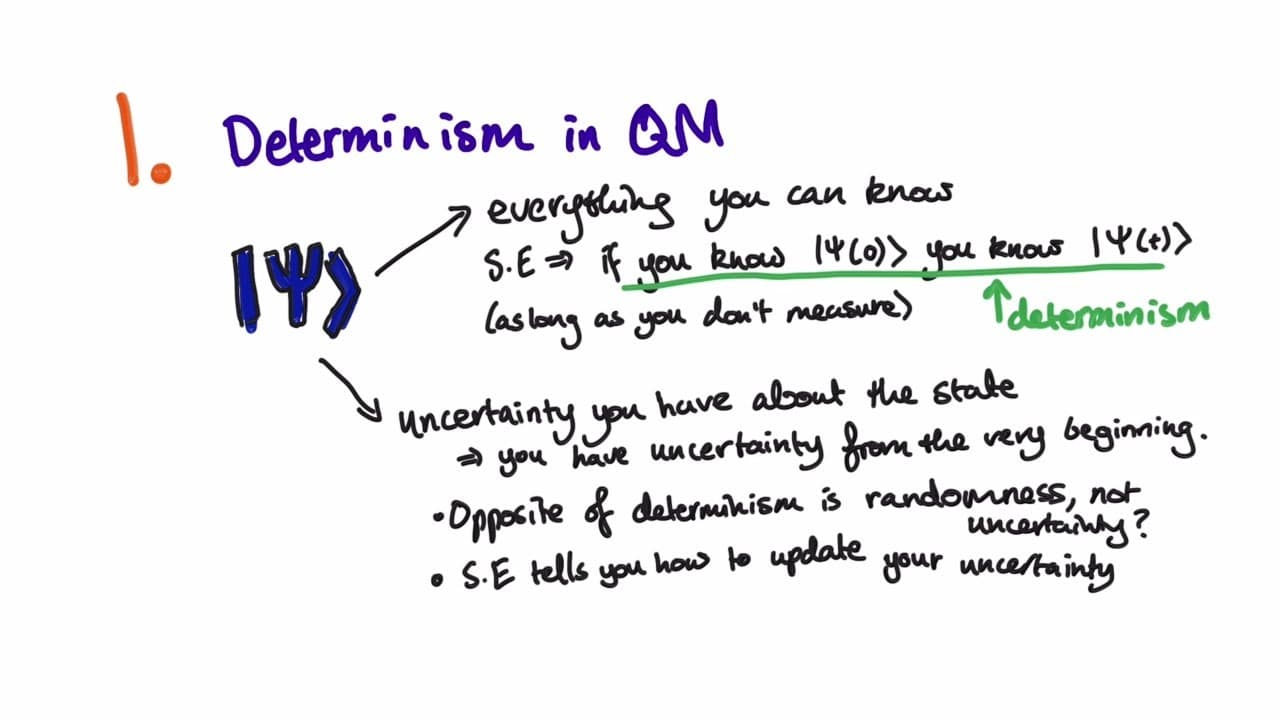
Quantum mechanics can be seen as deterministic or uncertain based on how one interprets the wavefunction. Some interpretations propose determinism up to measurement, while others, like Bohmian mechanics, view it as uncertain but not random. The many-worlds interpretation also supports a deterministic view by positing that all possible outcomes occur simultaneously.
Transcript
thank you so much for the comment so far I've really enjoyed reading them but best of all you guys made me think of things that I hadn't even thought of so the answers I talk about here include perspectives from you guys and I really do value that this is a dialogue so please do leave comments about what you think first on the question of determini... Read More
Key Insights
- 🦾 Determinism in quantum mechanics depends on the interpretation of the wavefunction and whether it represents uncertainty or the actual state.
- 🫵 Bohmian mechanics suggests that measurement outcomes are uncertain but not random, making it a deterministic view.
- 🌍 Many-worlds interpretation supports determinism by accepting all possible outcomes simultaneously, instead of measurement causing collapse.
- 🦾 Consistency in time evolution and agreement on the state among different observers are important aspects of quantum mechanics.
Install to Summarize YouTube Videos and Get Transcripts
Explore YouTube Video Summarizer or Get YouTube Transcript Extractor
Questions & Answers
Q: Can quantum mechanics be considered deterministic if the wavefunction represents uncertainty rather than the actual state?
The Schrodinger equation can be seen as updating our uncertainty about the state, which could be considered a formal form of determinism. However, the opposite of determinism is randomness, not uncertainty.
Q: Why is Bohmian mechanics considered deterministic despite uncertainty in measurement outcomes?
In Bohmian mechanics, the outcome of measurement is uncertain but not random. The underlying particle trajectories are predetermined, making it a deterministic interpretation.
Q: How does the many-worlds interpretation support determinism in quantum mechanics?
Many-worlds interpretation denies that measurement causes collapse and suggests that all possible outcomes exist simultaneously. This deterministic view allows for the coexistence of multiple worlds.
Q: How does the provided proof support the idea of a single state in quantum mechanics?
The proof demonstrates that different observers should agree on the single state of a system. If different observers have different states, it leads to contradictions, highlighting the importance of a consistent time evolution.
Summary & Key Takeaways
-
The wavefunction's interpretation determines whether quantum mechanics is deterministic or not, with some views suggesting determinism up to the point of measurement and others suggesting uncertainty from the beginning.
-
Bohmian mechanics, for example, sees the outcome of measurement as uncertain but not random, making it deterministic.
-
Many-worlds interpretation suggests determinism by accepting that all possible outcomes exist simultaneously instead of measurement causing collapse.
Read in Other Languages (beta)
Share This Summary 📚
Summarize YouTube Videos and Get Video Transcripts with 1-Click
Try YouTube Summary with ChatGPT & Claude or YouTube Transcript Generator
Explore More Summaries from Looking Glass Universe 📚





Summarize YouTube Videos and Get Video Transcripts with 1-Click
Try YouTube Summary with ChatGPT & Claude or YouTube Transcript Generator