Challenge: Which Particle Wins This Race? | Space Time | PBS Digital Studios
TL;DR
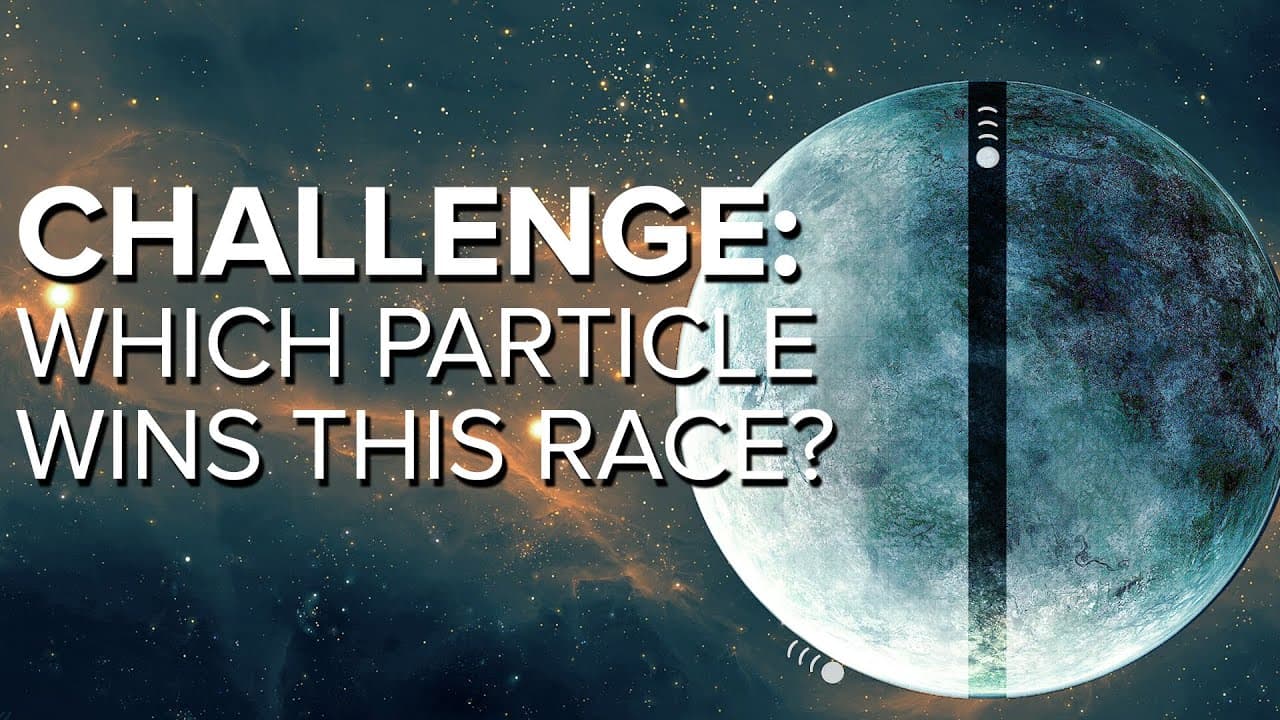
A physics challenge comparing two particles' travel times.
Transcript
Hey Space Timers. It's time for another T-shirt challenge question. And as you'll see, this one is a bit harder than the last one we did. This time around, you're going to need some math, and you'll need to be familiar with high school level physics. Let me give you some general background first, and then I'll set up the specifics for you. For the ... Read More
Key Insights
- The challenge involves comparing the travel times of two particles under Newtonian gravity: one orbiting a planet and another falling through it.
- Participants must use high school level physics and algebra to solve the problem, without relying on calculus.
- The gravitational force on a particle inside the planet depends only on the mass closer to the center than the particle itself.
- The challenge requires deriving an expression for gravitational force using Gauss's Law and drawing analogies with non-gravitational forces.
- Submissions must be sent via email with a specific subject line, and correct explanations are necessary for eligibility.
- A separate, more advanced challenge involves solving the problem using Einstein's general relativity.
- Participants are encouraged to discuss the challenge with friends but not on public forums until winners are announced.
- Five winners will be randomly selected from correct submissions to receive a PBS Digital Studios T-shirt.
Install to Summarize YouTube Videos and Get Transcripts
Explore YouTube Video Summarizer or Get YouTube Transcript Extractor
Questions & Answers
Q: What is the main challenge presented in the video?
The main challenge involves comparing the travel times of two particles under Newtonian gravity: one particle orbiting a planet and another falling through it. Participants must use high school level physics and algebra to derive the solution, focusing on gravitational forces and analogies with non-gravitational forces.
Q: What are the requirements for solving the challenge?
Participants need to use high school level physics and algebra to solve the challenge. They must derive expressions for gravitational forces using Gauss's Law and draw analogies with non-gravitational forces. Calculus is not required, and the solution should be based on physical reasoning and algebra.
Q: How should participants submit their answers?
Participants should submit their answers via email to [email protected] with the subject line 'Two-particle Newtonian gravity challenge.' Correct explanations must accompany the answers for eligibility. The email subject line is case-insensitive but must include the exact text, including the hyphen, for filtering purposes.
Q: What is the additional challenge mentioned in the video?
The additional challenge requires solving the problem using Einstein's general relativity. Participants must understand the Einstein equations in the presence of a spherically symmetric perfect fluid. This challenge involves finding metrics and geodesics and requires calculus, unlike the Newtonian challenge.
Q: Can participants enter both challenges?
No, participants can only enter one challenge, either the Newtonian or the Einsteinian. Entering both is discouraged as it undermines the challenge's difficulty. The honor system is in place to ensure fair participation, and participants are encouraged to choose the challenge that best suits their skills.
Q: How will winners be selected?
Winners will be selected randomly from among the correct submissions. Five winners from each challenge will receive a PBS Digital Studios T-shirt. Correct explanations must accompany the answers for eligibility, and participants are encouraged to ensure their submissions are complete and accurate.
Q: What is the role of Gauss's Law in the challenge?
Gauss's Law helps participants calculate the gravitational force on a particle inside the planet. It states that the gravitational force depends only on the mass closer to the center than the particle itself. This principle is crucial for deriving the necessary expressions without using calculus, relying instead on algebra.
Q: What are participants encouraged to do while solving the challenge?
Participants are encouraged to discuss the challenge with friends, as physics is considered a social activity. However, they should avoid posting solutions or discussing the challenge on public internet forums until after the winners are announced. This ensures a fair chance for all participants to solve the challenge independently.
Summary & Key Takeaways
-
The video presents a physics challenge comparing the travel times of two particles: one orbiting a planet and another falling through its center. Participants must use algebra and high school physics to derive the solution under Newtonian gravity. Correct submissions are eligible to win a PBS Digital Studios T-shirt.
-
The challenge requires understanding the gravitational force on a particle inside a planet, using Gauss's Law and drawing analogies with familiar non-gravitational forces. Participants must submit their answers via email with a specific subject line and correct explanations.
-
An additional challenge involves solving the problem using general relativity, requiring knowledge of Einstein's equations. Participants can only enter one challenge. Discussions are encouraged among friends but not on public forums until winners are announced. Winners will receive a T-shirt.
Read in Other Languages (beta)
Share This Summary 📚
Summarize YouTube Videos and Get Video Transcripts with 1-Click
Try YouTube Summary with ChatGPT & Claude or YouTube Transcript Generator
Explore More Summaries from PBS Space Time 📚
Summarize YouTube Videos and Get Video Transcripts with 1-Click
Try YouTube Summary with ChatGPT & Claude or YouTube Transcript Generator