How to Prove a Figure Is a Parallelogram
TL;DR
To prove a figure is a parallelogram, demonstrate that either both pairs of opposite sides are parallel, both pairs of opposite sides are congruent, or that the diagonals bisect each other. You can also prove congruence between triangles formed by these sides or angles. These criteria ensure that the figure meets the definition of a parallelogram.
Transcript
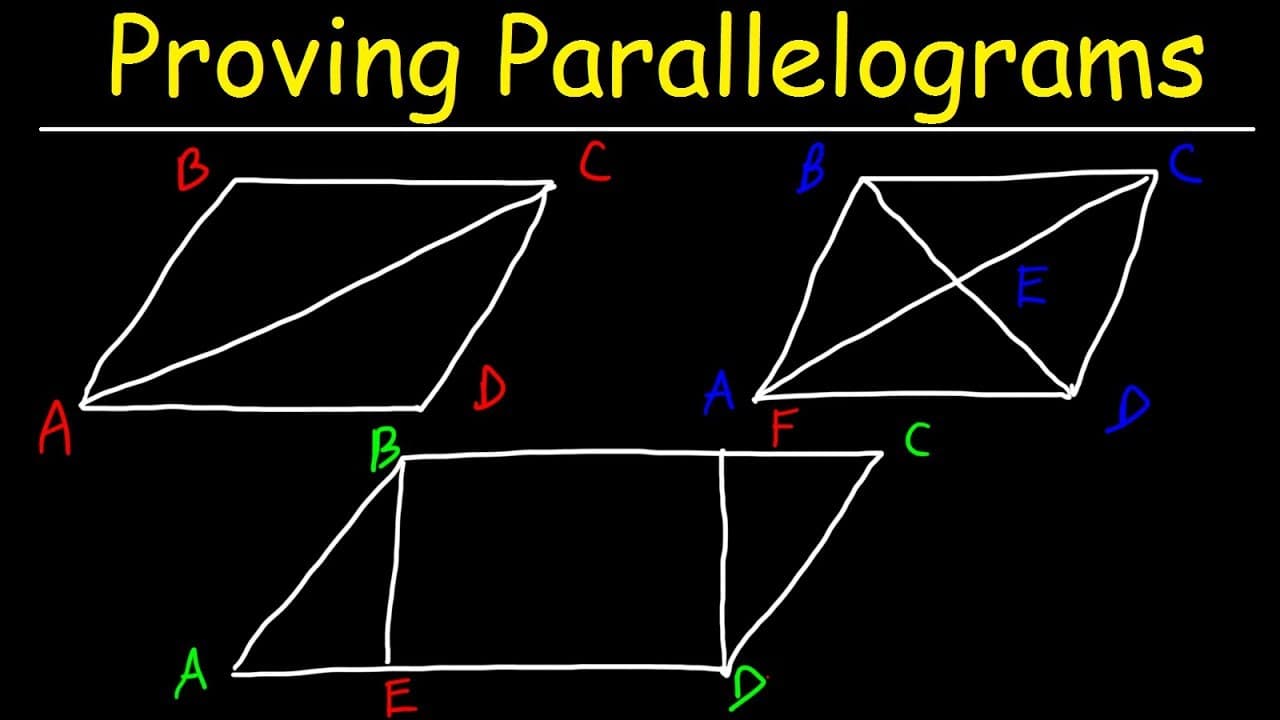
in this tutorial we're going to focus on proven parallelograms now let's go over some basic rules so one way you can prove that a figure is a parallelogram if you can show both lines are parallel so if you can show that b c and a d are parallel and the other opposite sides are parallel as well then that's one way to prove that it's a parallelogram ... Read More
Key Insights
- 🙃 There are multiple ways to prove that a figure is a parallelogram, including showing parallel lines, congruent opposite sides, congruent parallel and congruent sides, congruent opposite angles, or bisecting diagonals.
- 😒 Each method requires the use of specific properties and postulates from geometry.
- 🥳 Proofs involving congruent triangles are commonly used in establishing congruence between corresponding parts of a parallelogram.
- 🙃 The given information about a figure's sides, angles, and midpoints can be used to guide the proof process.
Install to Summarize YouTube Videos and Get Transcripts
Explore YouTube Video Summarizer or Get YouTube Transcript Extractor
Questions & Answers
Q: What are the four methods to prove a figure is a parallelogram?
The four methods are showing parallel lines, congruent opposite sides, congruent parallel and congruent sides, congruent opposite angles, or bisecting diagonals.
Q: How do you prove that two lines are parallel in order to prove a parallelogram?
To prove two lines are parallel, you must show that the corresponding angles are congruent or that the slopes of the lines are equal.
Q: Can a figure be a parallelogram if only the opposite angles are congruent?
No, a figure must satisfy additional conditions, such as congruent opposite sides or bisecting diagonals, to be classified as a parallelogram.
Q: Why is congruence in triangles important when proving a parallelogram?
Congruence in triangles allows us to establish that corresponding sides and angles are congruent, which is crucial in proving that a figure is a parallelogram.
Summary & Key Takeaways
-
Proving a figure is a parallelogram can be done by showing parallel lines, congruent opposite sides, congruent parallel and congruent sides, congruent opposite angles, or bisecting diagonals.
-
Example 1: Given AB congruent to DC and angle BAC congruent to angle DCA, the proof starts by showing congruence in triangles ABC and CDA, ultimately proving that ABDC is a parallelogram.
-
Example 2: Given AE as the midpoint of AC and angle EAD congruent to angle ECB, the proof uses congruent triangles AED and CEB to show that AC bisects BD and BD bisects AC, concluding that ABCD is a parallelogram.
-
Example 3: Given BEDF as a parallelogram, angle AEB congruent to angle GFD, and AE congruent to FG, the proof shows congruence in triangles ABE and CDF, thus proving that ABCD is a parallelogram.
Read in Other Languages (beta)
Share This Summary 📚
Summarize YouTube Videos and Get Video Transcripts with 1-Click
Try YouTube Summary with ChatGPT & Claude or YouTube Transcript Generator
Explore More Summaries from The Organic Chemistry Tutor 📚


Summarize YouTube Videos and Get Video Transcripts with 1-Click
Try YouTube Summary with ChatGPT & Claude or YouTube Transcript Generator