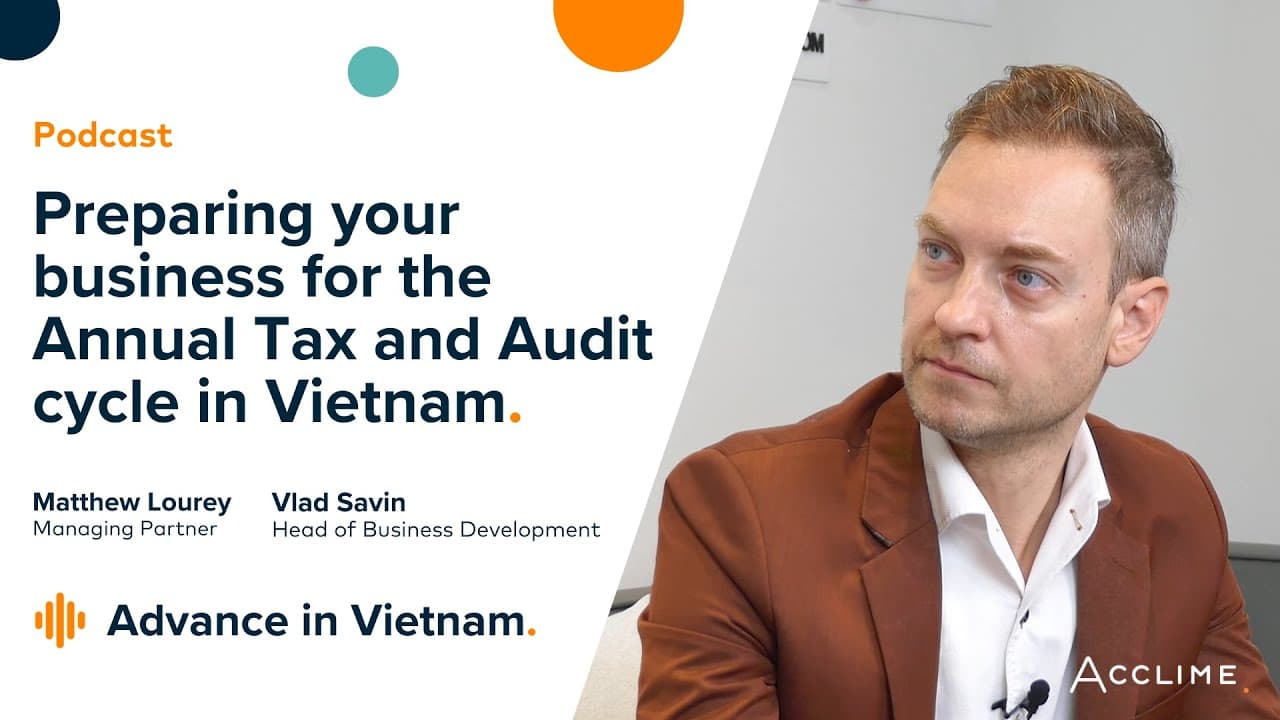
Preparing your Business for the Annual Tax and Audit cycle in Vietnam
TL;DR
Companies in Vietnam must prepare for annual tax finalizations and audits by March.
Transcript
hello and welcome to climes podcast series advancing Vietnam with me Vlad Savin as your host in this episode I'm discussing with Matthew low managing partner at CL Vietnam about the crucial topic for businesses operating in Vietnam preparing for their annual tax finalizations and for the year and AIT Matthew welcome again to our advancing Vietnam p... Read More
Key Insights
- All companies in Vietnam must finalize their taxes by March, with foreign companies requiring an audit for compliance.
- Quarterly tax payments must align with annual tax obligations to avoid penalties and ensure compliance.
- Engaging auditors early, ideally by October or November, is crucial to avoid last-minute issues and ensure smooth audits.
- Challenges include lack of planning, differences in accounting principles, and failure to finalize taxes due to audit delays.
- Ongoing compliance throughout the year, rather than a year-end rush, helps manage risks and ensures accurate tax finalizations.
- Vietnamese tax audits are primarily compliance-focused, and companies should not overly rely on them for governance.
- Late tax lodgments can lead to penalties and hinder profit repatriation, affecting a company’s financial flexibility.
- Transfer pricing documentation must align with tax filings to avoid compliance issues during inspections.
Install to Summarize YouTube Videos and Get Transcripts
Explore YouTube Video Summarizer or Get YouTube Transcript Extractor
Questions & Answers
Q: What are the key deadlines for annual tax finalization in Vietnam?
The key deadlines for annual tax finalization in Vietnam are December 31 for the year-end and March 31 for finalizing and lodging tax returns. Companies must ensure their quarterly tax payments align with their annual obligations to avoid penalties. Foreign companies must also complete audits by these deadlines for compliance.
Q: Why is early engagement with auditors important for companies in Vietnam?
Early engagement with auditors, ideally by October or November, is crucial for companies in Vietnam to ensure a smooth audit process. This helps avoid last-minute issues, such as unverified year-end balances, which can lead to audit qualifications and delays in tax finalization. Engaging auditors early ensures that potential issues are identified and addressed well in advance.
Q: What are the common challenges companies face during tax finalizations in Vietnam?
Common challenges during tax finalizations in Vietnam include lack of planning, differences in accounting principles, and failure to finalize taxes due to audit delays. Companies often struggle with unverified year-end balances and discrepancies in audit opinions, leading to penalties and compliance issues. Proper planning and early auditor engagement can mitigate these challenges.
Q: How can companies manage risks associated with tax compliance in Vietnam?
Companies can manage risks associated with tax compliance in Vietnam by maintaining ongoing compliance throughout the year, rather than treating it as a year-end process. This includes regular external reviews, ensuring accurate documentation, and aligning quarterly tax payments with annual obligations. Engaging auditors early and addressing potential issues proactively also helps manage risks effectively.
Q: What are the consequences of late tax lodgments in Vietnam?
Late tax lodgments in Vietnam can lead to penalties, interest on late payments, and increased scrutiny from tax authorities. Companies may also face difficulties in repatriating profits, as non-compliance can hinder the approval process for dividend payments. Late lodgments flag companies for higher risk profiles, increasing the likelihood of tax audits and inspections.
Q: How does the Vietnamese tax audit process differ from international standards?
The Vietnamese tax audit process is primarily compliance-focused, driven by tax-based accounting standards. It is not designed for governance or international risk management. Companies should not overly rely on Vietnamese audits for risk management but should conduct separate audits, such as IFRS audits, for international standards. The process is detailed and documentation-heavy, requiring strict adherence to local regulations.
Q: What role does transfer pricing documentation play in tax compliance in Vietnam?
Transfer pricing documentation is crucial for tax compliance in Vietnam. Companies must submit a summarized version of their transfer pricing compliance with their annual tax returns. Discrepancies between filed summaries and actual documentation can lead to compliance issues during inspections. Ensuring alignment between transfer pricing documentation and tax filings is essential to avoid penalties and scrutiny.
Q: What advice is given to companies preparing for annual tax finalizations in Vietnam?
Companies preparing for annual tax finalizations in Vietnam are advised to engage auditors early, ensure accurate documentation, and maintain ongoing compliance throughout the year. Early auditor engagement helps avoid last-minute issues and ensures smooth audits. Companies should focus on risk management and external reviews to ensure compliance with Vietnamese tax regulations.
Summary & Key Takeaways
-
Businesses in Vietnam must prepare for annual tax finalizations and audits, with deadlines typically by March. Foreign companies require audits for compliance. Early engagement with auditors is crucial to avoid last-minute issues. Companies should maintain ongoing compliance throughout the year to manage risks effectively.
-
Challenges in tax finalizations include lack of planning and differences in accounting principles. Companies often fail to finalize taxes due to audit delays. Late lodgments can result in penalties and hinder profit repatriation. Transfer pricing documentation must align with tax filings to avoid compliance issues.
-
Vietnamese tax audits focus on compliance, not governance. Companies should not overly rely on them for risk management. Instead, ongoing compliance and external reviews are essential. The Vietnamese tax framework requires detailed documentation, and companies must adhere to process-driven approaches for successful compliance.
Read in Other Languages (beta)
Share This Summary 📚
Summarize YouTube Videos and Get Video Transcripts with 1-Click
Try YouTube Summary with ChatGPT & Claude or YouTube Transcript Generator
Explore More Summaries from Acclime Vietnam 📚



Summarize YouTube Videos and Get Video Transcripts with 1-Click
Try YouTube Summary with ChatGPT & Claude or YouTube Transcript Generator