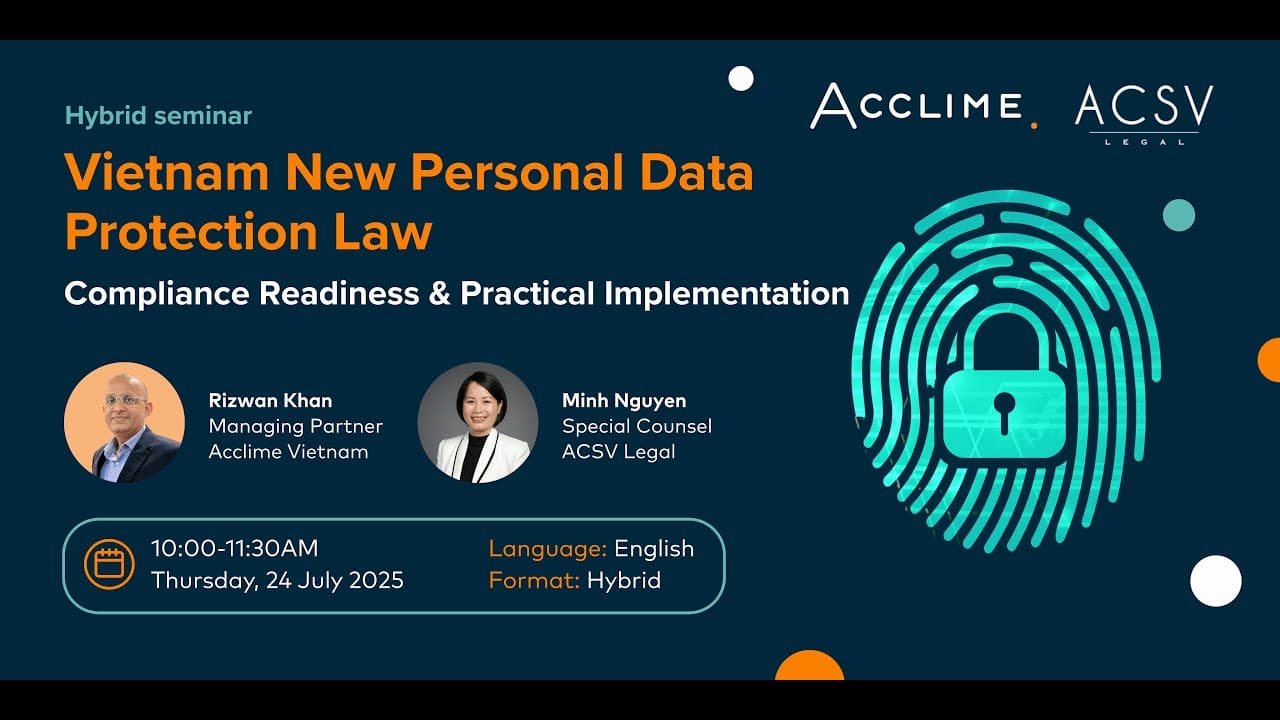
How to Comply with Vietnam's New Data Protection Law
TL;DR
Vietnam's new Personal Data Protection Law, effective from January 2026, introduces stricter privacy requirements and penalties. Businesses must prepare by aligning their data practices with the law's provisions. Key actions include understanding legal definitions, implementing compliance strategies, and preparing for cross-border data transfer rules. Early preparation is essential to avoid penalties.
Transcript
Good morning ladies and gentlemen. Sa moing away. Uh I hope that uh you're fine. Uh today we are going to start our seminar on uh Vietnam new personal data protection law. So those who are familiar with the matter in 2023 there was a decree 13 that was on uh personal data privacy and protection and now the law has been introduced uh that is that ha... Read More
Key Insights
- Vietnam's Personal Data Protection Law takes effect on January 1, 2026, building on Decree 13/2023.
- The law introduces stricter requirements and broader definitions for data privacy.
- Businesses must prepare for compliance by understanding legal definitions and obligations.
- Key compliance actions include obtaining consent and ensuring lawful data processing.
- Cross-border data transfer rules require careful attention and preparation.
- Compliance audits will be a critical part of ensuring adherence to the new law.
- A privacy-first culture is essential for aligning with the new legal framework.
- Early action is crucial to avoid costly penalties and operational risks.
Install to Summarize YouTube Videos and Get Transcripts
Explore YouTube Video Summarizer or Get YouTube Transcript Extractor
Questions & Answers
Q: How to prepare for Vietnam's new data protection law?
To prepare for Vietnam's new data protection law, businesses should start by understanding the key provisions and differences from Decree 13/2023. Implementing compliance strategies, such as obtaining consent and ensuring lawful processing, is crucial. Additionally, preparing for cross-border data transfer rules and compliance audits is essential. Early action is critical to avoid penalties.
Q: What are the key differences between the new law and Decree 13/2023?
The new Personal Data Protection Law builds on Decree 13/2023 by introducing stricter requirements and broader definitions for data privacy. It emphasizes consent, data subject rights, and lawful processing. The law also sets tougher penalties for non-compliance, making early preparation essential for businesses.
Q: What are the penalties for non-compliance with the new law?
Penalties for non-compliance with Vietnam's new data protection law can include fines up to 5% of the violator's revenue or 3 billion VND, whichever is higher. Specific violations, such as illegal data processing or cross-border data transfer, may attract severe penalties. Businesses must ensure compliance to avoid these costly penalties.
Q: How does the new law impact cross-border data transfers?
The new law introduces specific rules for cross-border data transfers, requiring businesses to conduct impact assessments and ensure compliance with legal requirements. This includes understanding the data processing activities and obtaining necessary consents. Preparing for these rules is vital to avoid penalties associated with non-compliance.
Q: What compliance actions should businesses take?
Businesses should take several compliance actions, including understanding the new legal definitions, obtaining consent, ensuring lawful data processing, and preparing for cross-border data transfer rules. Implementing a privacy-first culture and aligning current data practices with the new legal framework are also essential steps.
Q: Why is early action important for compliance?
Early action is important because the new law introduces stricter requirements and penalties. Preparing in advance allows businesses to align their data practices with legal provisions, avoid costly penalties, and mitigate operational risks. Early preparation ensures a smoother transition to compliance with the new data protection law.
Q: What is the role of a data protection officer under the new law?
Under the new law, a data protection officer (DPO) plays a crucial role in overseeing compliance with data protection requirements. The DPO is responsible for ensuring lawful processing, obtaining consents, and managing data subject rights. They also coordinate with authorities during compliance audits and impact assessments.
Q: How can businesses build a privacy-first culture?
Building a privacy-first culture involves educating employees on data protection principles, implementing robust data governance policies, and ensuring transparency in data processing activities. Businesses should prioritize data subject rights and lawful processing, fostering an environment where privacy is integral to operations and decision-making.
Summary & Key Takeaways
-
Vietnam's new Personal Data Protection Law, effective January 2026, demands businesses align their data practices with stricter privacy requirements. Key actions include understanding legal definitions and preparing for compliance audits. Early preparation is crucial to mitigate penalties.
-
The law builds on Decree 13/2023, introducing broader definitions and tougher penalties. Businesses must focus on consent, data subject rights, and lawful processing to ensure compliance. Cross-border data transfer rules require particular attention.
-
Legal clarity and strategic guidance are provided through expert insights, helping businesses build a privacy-first culture. Compliance readiness involves assessing current data practices and preparing for the new legal framework's demands.
Read in Other Languages (beta)
Share This Summary 📚
Summarize YouTube Videos and Get Video Transcripts with 1-Click
Try YouTube Summary with ChatGPT & Claude or YouTube Transcript Generator
Explore More Summaries from Acclime Vietnam 📚





Summarize YouTube Videos and Get Video Transcripts with 1-Click
Try YouTube Summary with ChatGPT & Claude or YouTube Transcript Generator