Registering a Foreign Owned Business in Vietnam. How does it work?

TL;DR
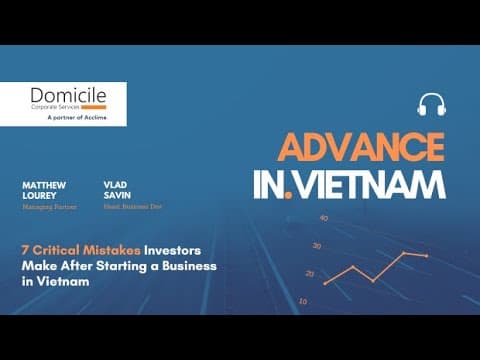
Podcast discusses steps for foreign business registration in Vietnam.
Transcript
hello and welcome to domicile corporate services podcast series advanced in Vietnam with me Vlad Xavi and Matthew Lally throughout the following episodes we'll look into answering relevant questions about doing business in Vietnam what are the opportunities and challenges faced by investors entering the market or existing players in major industrie... Read More
Key Insights
- Vietnam encourages foreign-owned businesses, but the registration process involves extensive paperwork and specific steps unique to the jurisdiction.
- Determining the correct business lines is crucial as companies can only engage in licensed activities, and some lines may have restrictions.
- The process involves obtaining an Investment Registration Certificate (IRC) and an Enterprise Registration Certificate (ERC), with the IRC being the more time-consuming and costly part.
- Essential documents for registration include investor documents, a bank statement, and a fixed place of business, which cannot be an apartment.
- Companies must have a permanent address and cannot use virtual offices or lawyer's offices as a registered address.
- Charter capital must be transferred into a Direct Investment Capital Account within 90 days of company establishment.
- Statutory roles in a Vietnamese entity include the legal representative, general director, and chief accountant, each with specific responsibilities.
- Foreign-owned companies must undergo annual audits and have additional registration requirements compared to locally owned companies.
Install to Summarize YouTube Videos and Get Transcripts
Explore YouTube Video Summarizer or Get YouTube Transcript Extractor
Questions & Answers
Q: What are the initial steps for registering a foreign-owned company in Vietnam?
The initial steps include determining the business lines to ensure compliance with licensing requirements, and obtaining the Investment Registration Certificate (IRC) and the Enterprise Registration Certificate (ERC). The IRC is crucial as it covers foreign investment approval, while the ERC serves as the certificate of incorporation.
Q: What documents are required for establishing a company in Vietnam?
Essential documents include investor documents like the company's memorandum, articles of incorporation, and notarized documents. A bank statement showing the capacity to pay charter capital and a lease or pre-lease agreement for a fixed business address are also required.
Q: Can a company use a virtual office as its registered address in Vietnam?
No, a company cannot use a virtual office as its registered address in Vietnam. It must have a fixed place of business with a permanent address. Service offices providing a fixed desk are acceptable, but residential apartments cannot be used for commercial purposes.
Q: What is charter capital and how is it managed in Vietnam?
Charter capital is the paid-up capital representing share capital. It must be transferred into a Direct Investment Capital Account within 90 days of the company's establishment. This account is essential for managing funds across borders, including foreign loans and dividends.
Q: Who are the key statutory roles in a Vietnamese company?
The key statutory roles include the legal representative, who represents the company's civil capacity, the general director, who operates the business, and the chief accountant, responsible for tax and accounting compliance. These roles are crucial for the company's operations and legal compliance.
Q: What are the post-establishment requirements for a company in Vietnam?
Post-establishment requirements include paying the business license fee, registering a chief accountant, opening bank accounts, registering tax codes, choosing VAT methods, and registering the chart of accounts and labor. These steps are essential for legal compliance and operational readiness.
Q: How do foreign-owned companies differ from locally owned ones in Vietnam?
Foreign-owned companies have additional requirements like annual audits and a more complex registration process due to the need for an IRC. They also face restrictions on certain business lines. However, structurally, they operate similarly to locally owned companies, with the same legal and operational frameworks.
Q: What are the risks of using nominee structures in Vietnam?
Nominee structures are not legally recognized in Vietnam, posing significant risks. The Vietnamese name on the company's ownership list is considered the legal owner, potentially leading to ownership disputes. Additionally, transferring funds across borders can be problematic without proper legal recognition of ownership.
Summary & Key Takeaways
-
The podcast discusses the process of registering a foreign-owned business in Vietnam, highlighting the importance of understanding local requirements and procedures. It emphasizes the need for proper documentation and the determination of business lines to ensure compliance with Vietnamese regulations.
-
Key steps in the registration process include obtaining the Investment Registration Certificate and the Enterprise Registration Certificate. The podcast also covers the importance of having a fixed business address and the restrictions on using virtual offices or residential apartments as company addresses.
-
The discussion outlines the roles of the legal representative, general director, and chief accountant in a Vietnamese company. It also explains the concept of charter capital, the importance of the Direct Investment Capital Account, and the differences between foreign and locally owned companies regarding audits and registration processes.
Read in Other Languages (beta)
Share This Summary 📚
Summarize YouTube Videos and Get Video Transcripts with 1-Click
Try YouTube Summary with ChatGPT & Claude or YouTube Transcript Generator
Explore More Summaries from Acclime Vietnam 📚




Summarize YouTube Videos and Get Video Transcripts with 1-Click
Try YouTube Summary with ChatGPT & Claude or YouTube Transcript Generator