Stanford ENGR108: Introduction to Applied Linear Algebra | 2020 | Lecture 48-VMLS linear quadrt ctrl
TL;DR
The linear quadratic control problem can be solved using constrained least squares, resulting in a trade-off between input and output objectives.
Transcript
our next application of constrained least squares is linear quadratic control like portfolio optimization this is a topic where there are multiple entire courses you could take on nothing but just this one topic it's also something like portfolio optimization that's that's widely used so let's look what what this is the setting is we have a linear ... Read More
Key Insights
- 🎮 Linear quadratic control can be applied to linear dynamical systems where the dynamics are described by matrices A, B, and C.
- 🔠 The problem involves choosing inputs and states over a time horizon to minimize output deviations and input energy.
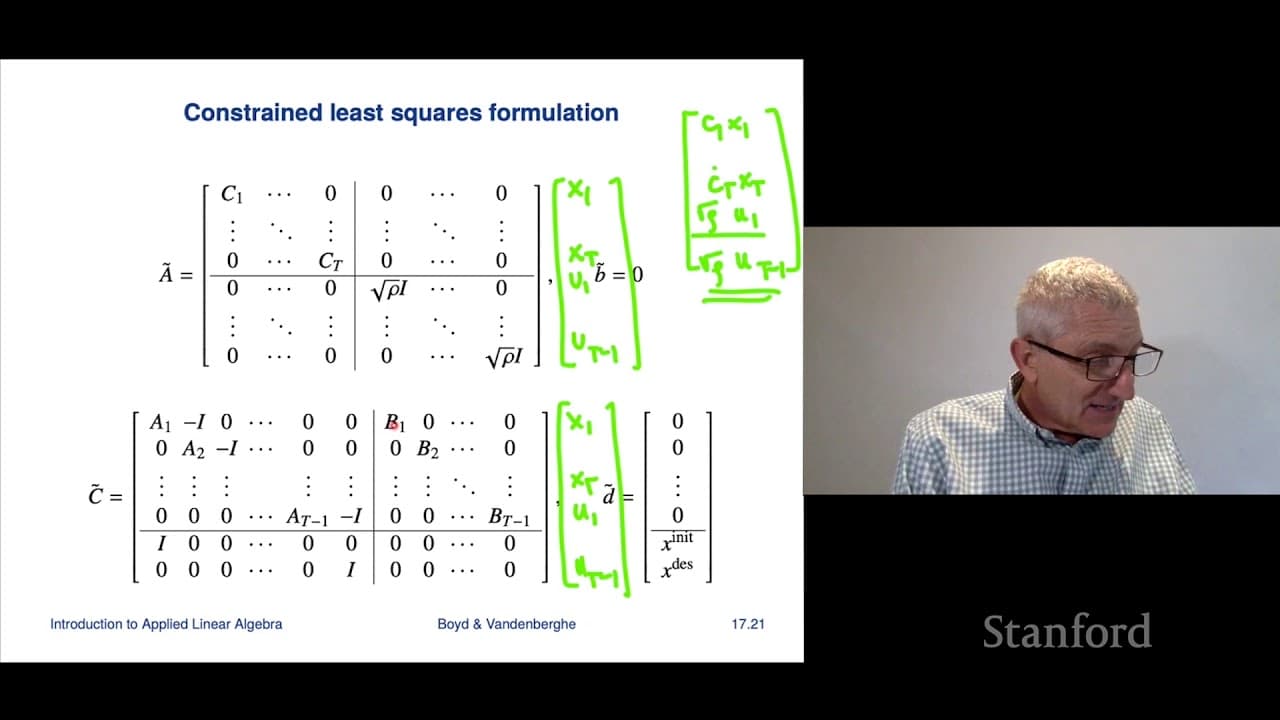
- 🎮 The constrained least squares formulation reduces the linear quadratic control problem to a computationally tractable optimization problem.
- 🎮 The trade-off between output and input objectives can be controlled by adjusting the parameter "rho".
- 🎮 Linear state feedback control is a common implementation of linear quadratic control that uses a gain matrix to determine inputs based on the state.
- 🎮 The solution to the linear quadratic control problem provides optimal trajectories and inputs for the system.
- 🚙 The problem is widely used in various applications, such as control of cars, space vehicles, and engines.
Install to Summarize YouTube Videos and Get Transcripts
Explore YouTube Video Summarizer or Get YouTube Transcript Extractor
Questions & Answers
Q: What is the goal of linear quadratic control?
The goal is to choose a sequence of inputs to minimize both the sum of output deviations from a desired state and the norm squared of inputs.
Q: How is the linear quadratic control problem formulated as a constrained least squares problem?
The problem is formulated by constructing matrices and vectors that represent the dynamics, initial and final state constraints, and the objectives. These matrices and vectors are used to solve a constrained least squares problem.
Q: What is the significance of the parameter "rho" in linear quadratic control?
The parameter "rho" determines the trade-off between input and output objectives. By adjusting "rho", one can prioritize minimizing output deviations or minimizing input energy.
Q: How is linear state feedback control related to linear quadratic control?
Linear state feedback control is a widely used implementation of linear quadratic control. It involves multiplying the state vector by a gain matrix to determine the inputs, where the gain matrix is derived from solving the constrained least squares problem.
Summary & Key Takeaways
-
Linear quadratic control involves choosing a sequence of inputs to minimize the sum of output deviations from a desired state and the norm squared of inputs.
-
The problem can be formulated as a constrained least squares problem by constructing matrices and vectors.
-
The solution to the problem leads to a trade-off between input and output objectives, with the trade-off controlled by a parameter called "rho".
Read in Other Languages (beta)
Share This Summary 📚
Summarize YouTube Videos and Get Video Transcripts with 1-Click
Try YouTube Summary with ChatGPT & Claude or YouTube Transcript Generator
Explore More Summaries from Stanford Online 📚



Summarize YouTube Videos and Get Video Transcripts with 1-Click
Try YouTube Summary with ChatGPT & Claude or YouTube Transcript Generator