Stanford CS224W: ML with Graphs | 2021 | Lecture 19.3 - Design Space of Graph Neural Networks
TL;DR
This content discusses the design space and task space of graph neural networks, providing guidelines for gene design, task categorization, and model transfer across tasks.
Transcript
uh hi everyone my name is dasha and i'm the height here of this course and it's really amazing experience to work with you guys and i hope you learned a lot from the course today i'm excited to present my recent research design space of graph neural networks so in this lecture we cover some key questions for gn design specifically we want to answer... Read More
Key Insights
- 📈 Batch normalization is generally useful for improving the performance of graph neural networks, as it helps with gradient updates and optimization.
- 📈 Dropout is not always necessary for graph neural networks, as they tend to underfit rather than overfit.
- 🧍 The selection of activation functions can impact performance, with prelu activation standing out as a potential choice.
- 🍹 Aggregation functions, particularly the sum aggregator, are beneficial for expressive node feature encoding.
- 📈 The optimal number of layers in graph neural networks is highly dependent on the task and may vary significantly.
- ❓ Incorporating skip connections in gene layers enables hierarchical node representation and improves performance.
- ☠️ Learning configurations such as batch size, learning rate, optimizer, and number of epochs should be carefully chosen based on the specific task.
- 👾 The proposed task space and task similarity metric can guide the transfer of the best gene models across different tasks, improving performance.
Install to Summarize YouTube Videos and Get Transcripts
Explore YouTube Video Summarizer or Get YouTube Transcript Extractor
Questions & Answers
Q: Why is finding a good gene design for a specific graph neural network task challenging?
Finding a good gene design is challenging because there are numerous possible architectures, and the best design for one task may not perform well for another task. It is impractical to conduct parameter research for each new task, making it difficult for domain experts to utilize graph neural networks effectively.
Q: What are the different aspects covered in gene design space?
The gene design space covers intra-layer design, inter-layer connectivity, and learning configurations. Intra-layer design includes choices such as batch normalization, dropout, activation functions, and aggregation functions. Inter-layer connectivity involves adding preprocessed and post-process layers in addition to graph neural network layers. Learning configurations include batch size, learning rate, optimizer, and the number of epochs for training.
Q: How does the content propose to measure the similarity between different graph neural network tasks?
The content proposes a quantitative task similarity metric. It selects anchor models and characterizes tasks based on the ranking of these anchor models' performance. Tasks with similar rankings are considered similar. By computing the similarity between rankings of different tasks, a quantitative measure of task similarity can be obtained.
Q: How does the content evaluate gene designs in a more rigorous manner?
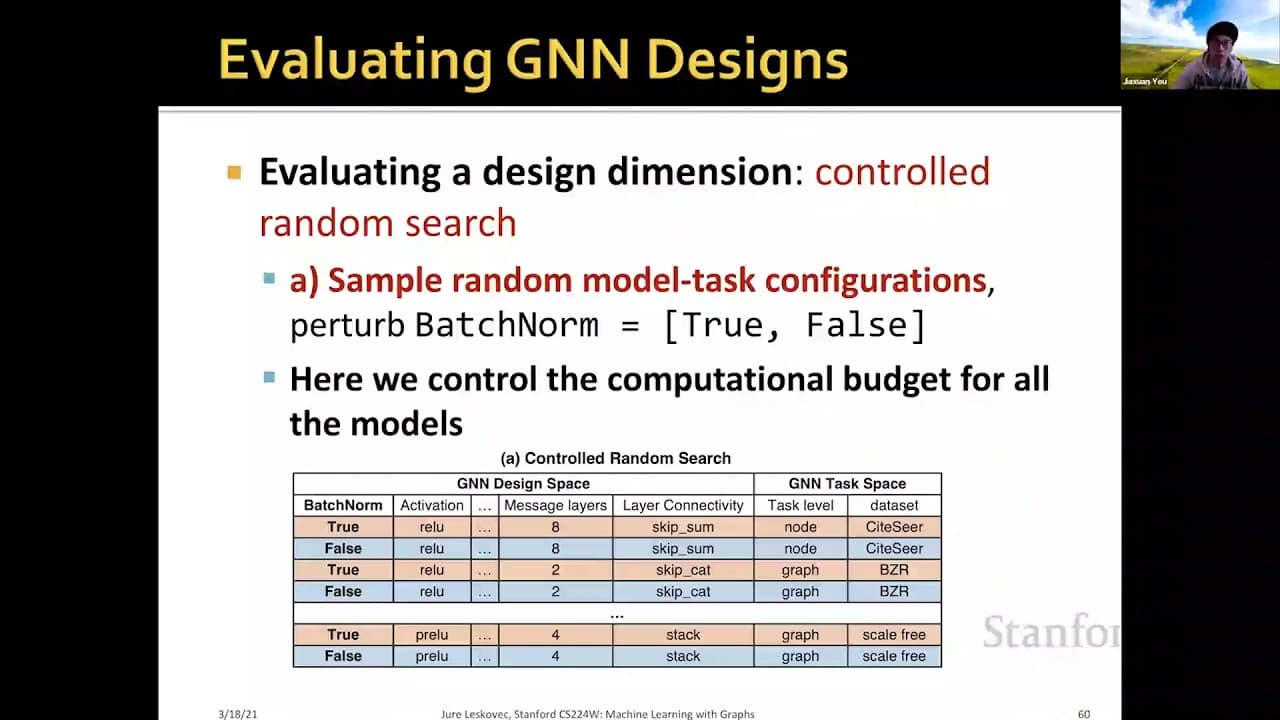
The content introduces a controlled random search approach to evaluate gene designs. Instead of comparing individual models, it samples random multi-task configurations from the entire design space and perturbs the batch normalization dimension. By ranking the models based on their performance, a more convincing evaluation of gene designs can be achieved.
Summary & Key Takeaways
-
The content introduces the concept of gene design space and task space for graph neural networks.
-
It discusses the challenges in finding a good gene design for a specific task and the importance of studying the design space as a whole.
-
The content covers the intra-layer design, inter-layer connectivity, and learning configurations in gene design, providing guidelines for each aspect.
-
It also introduces the task space and proposes a quantitative task similarity metric to measure the similarity between different tasks.
-
The content explains how to evaluate gene designs and presents key insights regarding different design choices and their impact on performance.
-
It concludes by discussing the transferability of gene designs across tasks and introduces the release of a code platform called Graph Gene.
Read in Other Languages (beta)
Share This Summary 📚
Summarize YouTube Videos and Get Video Transcripts with 1-Click
Try YouTube Summary with ChatGPT & Claude or YouTube Transcript Generator
Explore More Summaries from Stanford Online 📚




Summarize YouTube Videos and Get Video Transcripts with 1-Click
Try YouTube Summary with ChatGPT & Claude or YouTube Transcript Generator