Acid Conjugate Base Multiple Choice Question (AP Chemistry)
TL;DR
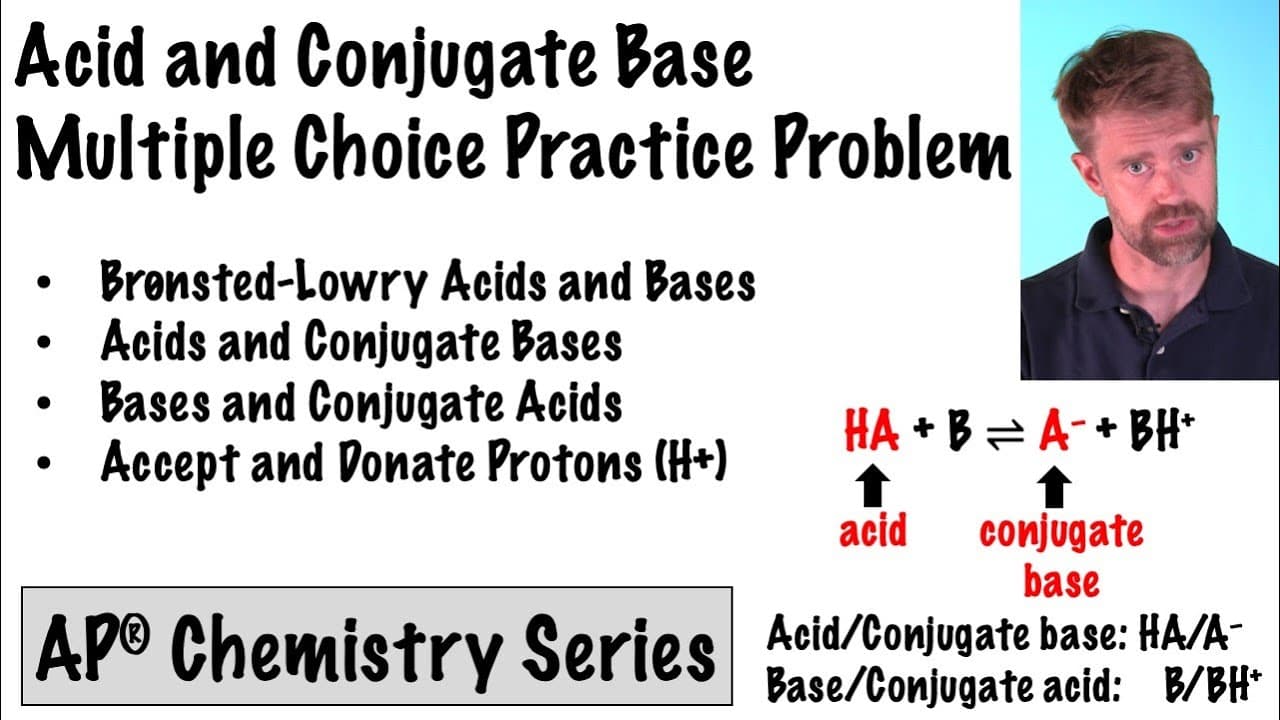
Learn about Bronsted-Lowry acids and bases, and how they form conjugate acid-base pairs that differ by only one proton.
Transcript
identify the Bronsted-Lowry acid conjugate base pair so here's a background a Bronsted-Lowry acid is defined as a compound that donates a proton or an h plus and a bronze that allowry base is a compound that accepts a proton or an h plus we'll show how this works with a weak acid in equilibrium here's the acid h a it's and it donates an h plus to B... Read More
Key Insights
- 🉑 Bronsted-Lowry acids donate protons, while bases accept protons.
- ⚾ Acid conjugate base pairs differ by only one proton.
- ⚾ Conjugate base can act as a base by accepting a proton and reform the original acid.
- ⚾ Common mistakes include confusing compounds that differ by more than one proton as acid conjugate base pairs.
- 😄 The correct answer should be a pair that differs by only one proton, such as choice D in the given options.
- ⚾ Nitric acid is not an acid conjugate base pair because it does not differ by only one proton.
- ⚾ Water's conjugate acid and conjugate base are not considered a pair as they differ by two protons.
Install to Summarize YouTube Videos and Get Transcripts
Explore YouTube Video Summarizer or Get YouTube Transcript Extractor
Questions & Answers
Q: What is a Bronsted-Lowry acid and base?
A Bronsted-Lowry acid is a compound that donates a proton (H+), while a Bronsted-Lowry base is a compound that accepts a proton.
Q: How does a weak acid in equilibrium form a conjugate base?
When a weak acid donates a proton to a base, it forms a conjugate base and a positively charged species. The acid loses the proton and becomes negatively charged.
Q: Why is the conjugate base important in the reaction?
The conjugate base can accept a proton from the positively charged species, effectively acting as a base. It can also reform the original acid when the reaction reverses.
Q: How do acid conjugate base pairs differ by only one proton?
In acid conjugate base pairs, the acid loses one proton to become its conjugate base, while the base gains one proton to become its conjugate acid.
Summary & Key Takeaways
-
Bronsted-Lowry acids are compounds that donate protons, while Bronsted-Lowry bases are compounds that accept protons.
-
A weak acid in equilibrium donates a proton (H+) to a base, forming a conjugate base and a positively charged species.
-
Acid conjugate base pairs differ by only one proton, and can both donate and accept protons.
Read in Other Languages (beta)
Share This Summary 📚
Summarize YouTube Videos and Get Video Transcripts with 1-Click
Try YouTube Summary with ChatGPT & Claude or YouTube Transcript Generator
Explore More Summaries from Tyler DeWitt 📚



Summarize YouTube Videos and Get Video Transcripts with 1-Click
Try YouTube Summary with ChatGPT & Claude or YouTube Transcript Generator