GCSE Chemistry - Moles, Concentration & Volume Calculations #29
TL;DR
An explanation of the equation linking moles, concentration, and volume in chemistry calculations with step-by-step examples.
Transcript
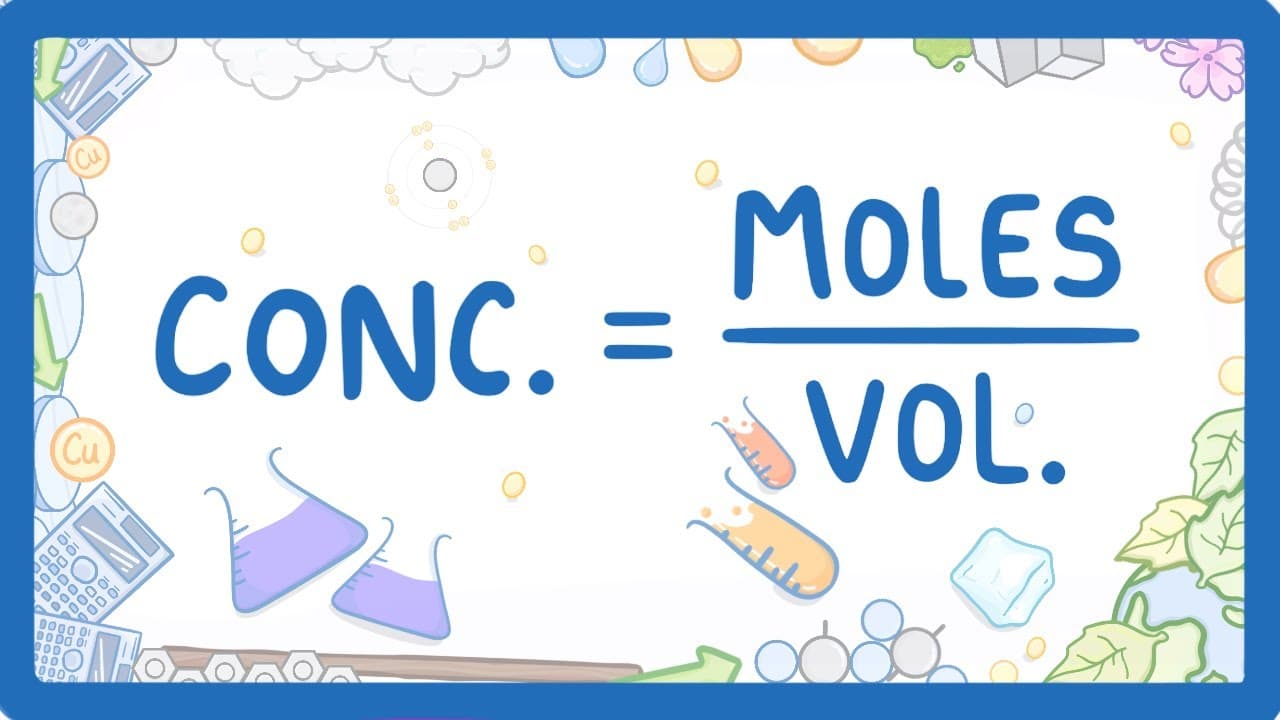
in this video we're going to be looking at this equation here which links the number of moles of an aqueous substance to its concentration and its volume and you need to remember that we measure volume in decimeters cubed and concentration in moles per decimeter cubed which we normally write as moles so mol and then a slash decimeters cubed because... Read More
Key Insights
- 🎍 The equation linking moles, concentration, and volume in chemistry calculations involves dividing, multiplying, and using molar ratios.
- 🧊 Volume is measured in decimeters cubed, while concentration is measured in moles per decimeter cubed (written as mol/dm³).
- 🧊 Converting volume from centimeters cubed to decimeters cubed involves dividing by 1000.
- 🎍 The molar ratio between substances is determined by the coefficients in a balanced chemical equation.
- 🔊 Calculating the concentration of an unknown substance requires finding its moles first and using the given volume.
- 👤 The use of clear units and conversions is essential in chemistry calculations.
- 👻 Understanding the relationship between moles, concentration, and volume allows for solving various problems in chemistry.
Install to Summarize YouTube Videos and Get Transcripts
Explore YouTube Video Summarizer or Get YouTube Transcript Extractor
Questions & Answers
Q: How do you calculate the number of moles when given the volume and concentration?
To find the number of moles, divide the volume in decimeters cubed by 1000, then multiply it by the concentration in moles per decimeter cubed.
Q: How can you determine the concentration when given the volume and number of moles?
Divide the number of moles by the volume in decimeters cubed to obtain the concentration in moles per decimeter cubed.
Q: How do you find the molar ratio between two substances?
The molar ratio is based on the coefficients in a balanced chemical equation. The numbers in front of the substances indicate the ratio between their moles.
Q: Can you explain how to calculate an unknown concentration using the molar ratio?
First, determine the number of moles for the known substance. Then, use the molar ratio to find the moles of the unknown substance. Finally, divide the moles of the unknown substance by the given volume to calculate the concentration.
Key Insights:
- The equation linking moles, concentration, and volume in chemistry calculations involves dividing, multiplying, and using molar ratios.
- Volume is measured in decimeters cubed, while concentration is measured in moles per decimeter cubed (written as mol/dm³).
- Converting volume from centimeters cubed to decimeters cubed involves dividing by 1000.
- The molar ratio between substances is determined by the coefficients in a balanced chemical equation.
- Calculating the concentration of an unknown substance requires finding its moles first and using the given volume.
- The use of clear units and conversions is essential in chemistry calculations.
- Understanding the relationship between moles, concentration, and volume allows for solving various problems in chemistry.
- Step-by-step examples help demonstrate the application of the equation in different situations.
Summary & Key Takeaways
-
The video introduces the equation that relates the number of moles of a substance to its concentration and volume.
-
It explains how to calculate the number of moles when given the concentration and volume, or find the concentration when the number of moles and volume are known.
-
The video also demonstrates a more complex scenario where the molar ratio between two substances is used to find the unknown concentration.
Read in Other Languages (beta)
Share This Summary 📚
Summarize YouTube Videos and Get Video Transcripts with 1-Click
Try YouTube Summary with ChatGPT & Claude or YouTube Transcript Generator
Explore More Summaries from Cognito 📚

Summarize YouTube Videos and Get Video Transcripts with 1-Click
Try YouTube Summary with ChatGPT & Claude or YouTube Transcript Generator