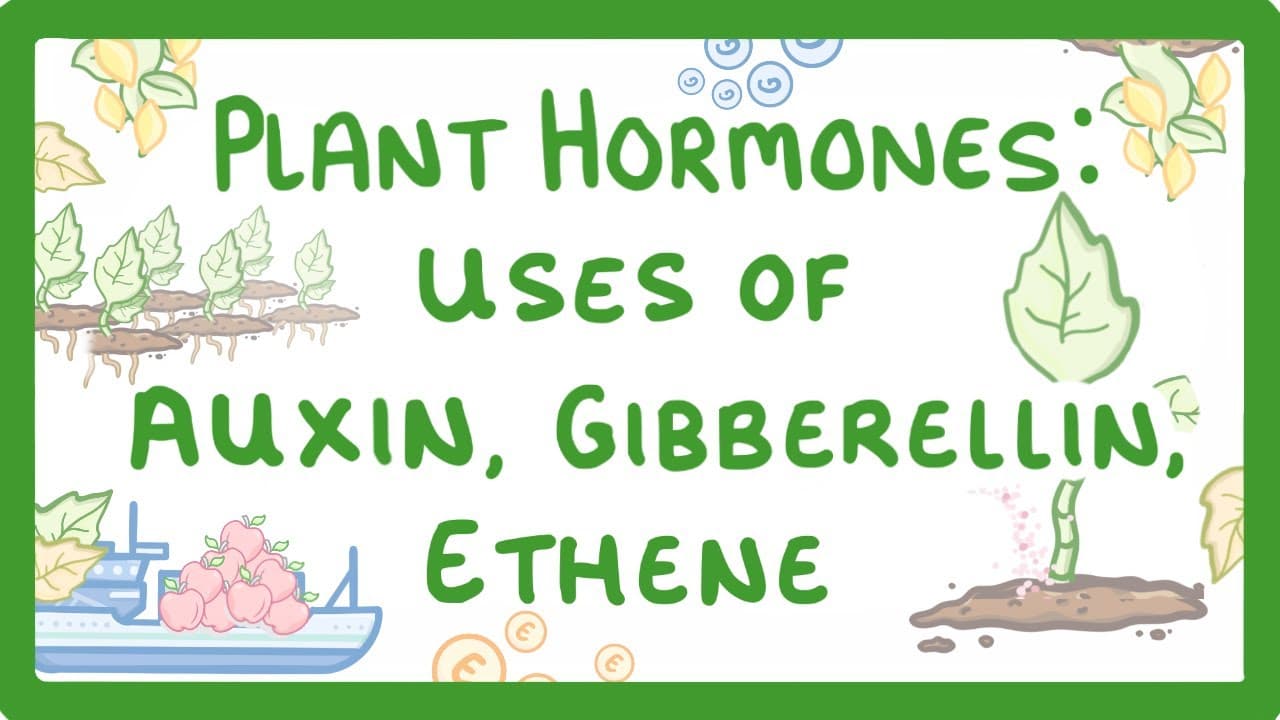
GCSE Biology - Plant Hormones - Uses of Auxin, Gibberellin and Ethene #53
TL;DR
Plant hormones auxin, gibberellin, and ethene have key commercial applications.
Transcript
Oh in today's video we're gonna look at how three plant hormones aux-in gibberellin and Ethan can be used commercially to bring about changes in plants start with auctions were a judge type of growth hormone because they stimulate plants to grow if we purposely add organs to plant cells we can stimulate growth for example if we had ... Read More
Key Insights
- Auxins are growth hormones that can stimulate plant growth, assist in cloning through tissue culture, and aid in root development from cuttings.
- Auxins can also be used as selective weed killers, targeting broad-leaved weeds while sparing narrow-leaved crops like cereals.
- Gibberellin helps control seed dormancy, allowing farmers to induce germination out of season and optimize crop yields.
- Gibberellin can induce flowering on demand, increasing flower production and size, which is beneficial for horticultural practices.
- Larger fruits, especially seedless varieties, can be grown using gibberellin, enhancing commercial fruit production.
- Ethene is essential for controlling fruit ripening, allowing fruits to be picked unripe, transported, and ripened upon reaching markets.
- Ethene works by activating enzymes that promote ripening, ensuring fruits are market-ready at the right time.
- Blocking ethene's effects during transport prevents premature ripening, preserving fruit quality until it reaches consumers.
Install to Summarize YouTube Videos and Get Transcripts
Explore YouTube Video Summarizer or Get YouTube Transcript Extractor
Questions & Answers
Q: How do auxins assist in plant cloning?
Auxins stimulate plant cell growth, making them crucial in plant cloning. By adding auxins to plant cells in a tissue culture, they promote cell division and elongation, leading to the growth of new plant clones. This method is particularly useful in producing large numbers of identical plants, ensuring uniformity and quality.
Q: What is the role of gibberellin in controlling seed dormancy?
Gibberellin plays a crucial role in breaking seed dormancy, which is the period when seeds remain inactive despite favorable conditions. By applying gibberellin, farmers can induce germination at specific times, allowing for multiple crop cycles per year and ensuring synchronized growth of plants, optimizing agricultural productivity.
Q: How does ethene influence fruit ripening?
Ethene is a plant hormone that accelerates fruit ripening by stimulating enzymes responsible for this process. By controlling ethene exposure, fruits can be picked unripe, transported over long distances, and then ripened upon reaching their destination. This ensures fruits are fresh and ready for sale, reducing waste and spoilage.
Q: Why are auxins effective as selective weed killers?
Auxins are effective selective weed killers because they target broad-leaved plants, which are common weeds, without affecting narrow-leaved crops like cereals. By disrupting the growth patterns of broad-leaved plants, auxins effectively kill these weeds while sparing valuable crops, enhancing agricultural efficiency and yield.
Q: How does gibberellin affect flowering in plants?
Gibberellin can induce flowering in plants by mimicking the conditions required for flower development. It allows farmers to control the timing and abundance of flowering, producing more or larger flowers on demand. This is particularly beneficial in horticulture, where flower production is essential for ornamental and commercial purposes.
Q: What are the benefits of using gibberellin on seedless fruit varieties?
Gibberellin is beneficial for seedless fruit varieties as it promotes larger fruit growth. Seedless fruits naturally tend to be smaller, but applying gibberellin encourages cell division and elongation, resulting in bigger, commercially viable fruits. This enhances the market value and appeal of seedless fruits, benefiting producers and consumers alike.
Q: How is ethene used during fruit transportation?
During fruit transportation, ethene's effects are often blocked to prevent premature ripening. Fruits are picked unripe and transported over long distances. Once they reach their destination, exposure to ethene triggers the ripening process, ensuring the fruits are fresh and ready for sale, maintaining quality and reducing spoilage.
Q: What is the significance of controlling plant hormone application in agriculture?
Controlling plant hormone application is crucial in agriculture as it allows for precise regulation of plant growth, flowering, and fruiting. This control enhances crop yield, quality, and timing, ensuring efficient resource use and maximizing profitability. It also enables the production of uniform and high-quality agricultural products, meeting market demands.
Summary & Key Takeaways
-
The video explores the commercial applications of plant hormones, focusing on auxin, gibberellin, and ethene. Auxin is used to stimulate growth, aid cloning, and control weeds. Gibberellin influences dormancy, flowering, and fruit growth. Ethene regulates fruit ripening, ensuring optimal market readiness.
-
Auxins can stimulate plant growth and are used in cloning and root development. They also serve as selective weed killers. Gibberellin helps manage dormancy, induce flowering, and increase fruit size. Ethene controls ripening, allowing fruits to be transported unripe and ripened on demand.
-
Commercially, auxins enhance growth and weed control, gibberellin optimizes crop cycles and fruit production, and ethene ensures timely ripening. These hormones are vital for maximizing agricultural efficiency, enabling controlled growth, and improving yield and quality of various plant products.
Read in Other Languages (beta)
Share This Summary 📚
Summarize YouTube Videos and Get Video Transcripts with 1-Click
Try YouTube Summary with ChatGPT & Claude or YouTube Transcript Generator
Explore More Summaries from Cognito 📚



Summarize YouTube Videos and Get Video Transcripts with 1-Click
Try YouTube Summary with ChatGPT & Claude or YouTube Transcript Generator