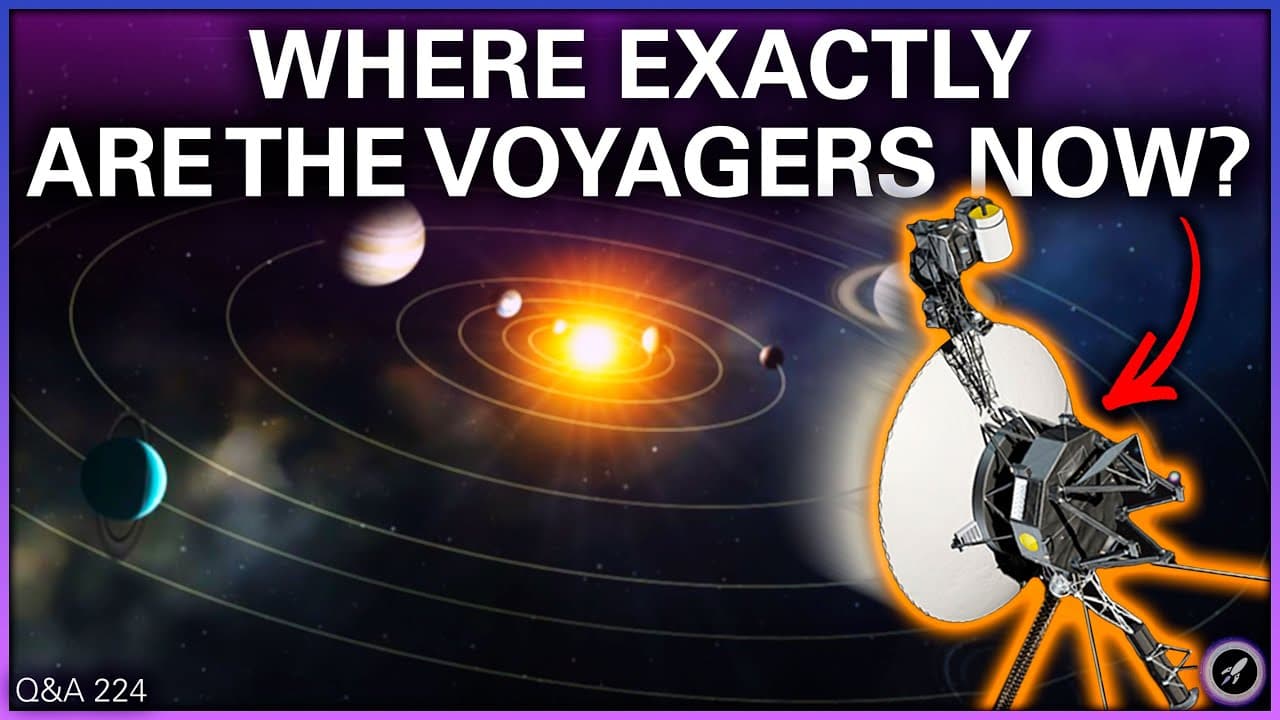
How to Find The Voyagers, Deorbiting the ISS, Non-Rotational Artificial Gravity | Q&A 224
TL;DR
Space exploration insights including Voyager spacecraft location, lunar radar dishes, and artificial gravity in constant acceleration.
Transcript
where should we look to see the Voyager spacecraft could we turn craters on the moon into giant radar dishes and is the best kind of artificial gravity constant acceleration all this and more in this week's question show welcome to the question show your questions my answers now as always wherever you are across my channel if a question Pops in you... Read More
Key Insights
- 📌 Voyager spacecraft locations can be pinpointed by turning telescopes towards their specific constellations.
- 🧫 Utilizing lunar craters as giant radar dishes for telescopes would require significant effort in smoothing and reflective material application.
- 🛰️ Artificial gravity through constant acceleration presents challenges yet offers potential benefits for future space missions.
- 👻 Solar gravitational lensing at 650 astronomical units allows for powerful magnification of distant objects.
- 😄 Smart telescopes like Unistellar and Vaespa offer ease of use and automated celestial observations.
- 🚁 Large helicopters for Mars missions can enhance geological exploration and provide valuable aerial perspectives.
- 🔬 Robotic testing on Mars offers limited capabilities compared to bringing back samples for more comprehensive laboratory analysis.
Install to Summarize YouTube Videos and Get Transcripts
Explore YouTube Video Summarizer or Get YouTube Transcript Extractor
Questions & Answers
Q: How can we determine where the Voyager spacecraft are located in space?
Voyager spacecraft locations can be determined by pointing telescopes at their specific constellations, allowing for signal transmission and reception despite their vast distances in space.
Q: Is it feasible to turn lunar craters into large radar dishes for telescope purposes?
While lunar craters have parabolic shapes suitable for telescope purposes, the smoothing and reflective material application required may be challenging for creating giant radar dishes.
Q: What is the concept of artificial gravity in space exploration?
Artificial gravity can be achieved through constant acceleration, simulating gravity similar to Earth's 1g force, but current technology limits its practical implementation.
Q: How would the solar gravitational lens be utilized for gravitational lensing?
By remaining within the cone of focus at the solar gravitational lens point, observations can continuously benefit from the natural magnification provided by the sun's gravity.
Summary & Key Takeaways
-
Voyager spacecraft locations can be determined by pointing telescopes at specific constellations.
-
Lunar craters can potentially be turned into giant radar dishes with effort and reflective material.
-
Artificial gravity through constant acceleration is a potential method in space exploration for future missions.
Read in Other Languages (beta)
Share This Summary 📚
Summarize YouTube Videos and Get Video Transcripts with 1-Click
Try YouTube Summary with ChatGPT & Claude or YouTube Transcript Generator
Explore More Summaries from Fraser Cain / Universe Today Podcast 📚


Summarize YouTube Videos and Get Video Transcripts with 1-Click
Try YouTube Summary with ChatGPT & Claude or YouTube Transcript Generator