How Is the Access Matrix Implemented in Operating Systems?
TL;DR
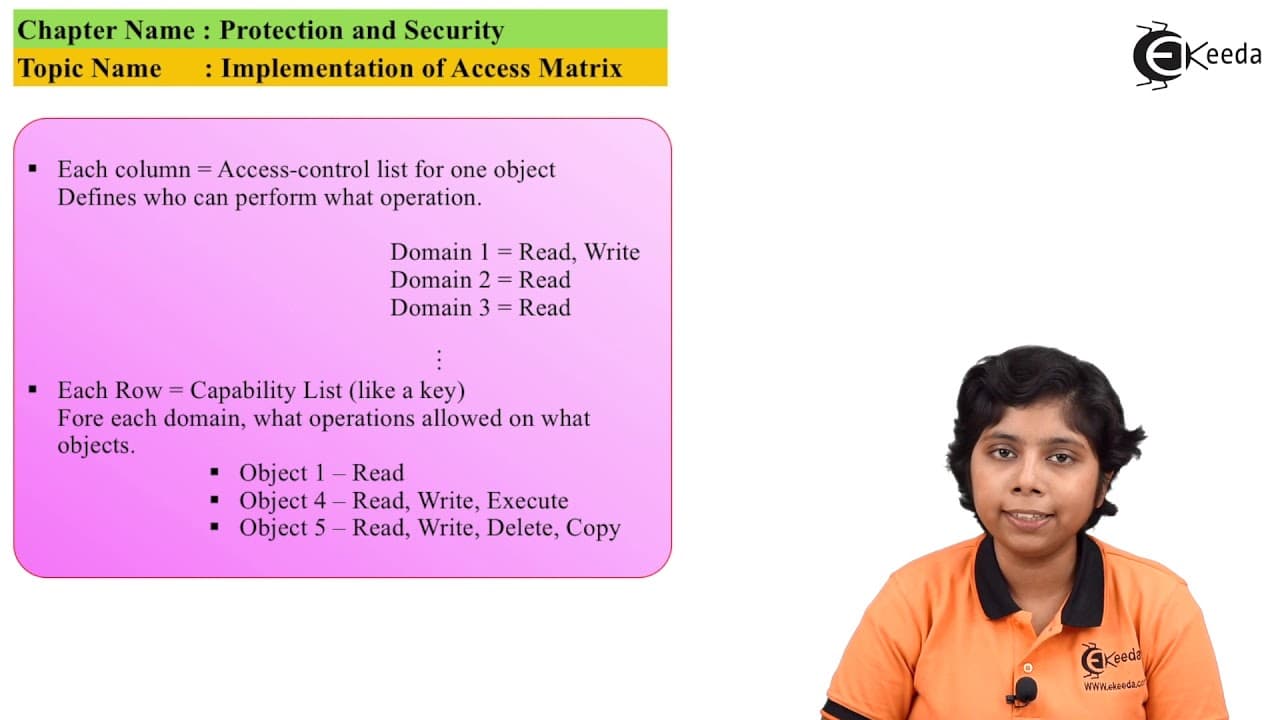
The access matrix is implemented through several methods: the global table combines object names, domain names, and access rights but suffers from large memory use; the access list provides domain-linked access rights but is less scalable; the capability list allows indirect access for users with distinct tagging; and the locking key mechanism enhances security by pairing capabilities with access keys. Each method has strengths and weaknesses, and they may be combined for optimal protection.
Transcript
click the bell icon to get latest videos from akira hello friends today we will discuss about that how access matrix is implemented in many different ways like the global table access list capability list and at last lock and key mechanism and lastly we will compare among this implementation this which is wise to be chosen and if there is any combi... Read More
Key Insights
- ♿ Access matrix is a mechanism used in operating systems to control access rights to objects.
- 👂 Different implementation techniques, such as the global table, access list, capability list, and locking key mechanism, offer varying degrees of efficiency and complexity.
- 🌐 The global table simplifies the selection of objects and domains but has memory requirements and scalability issues.
- ♿ The access list allows direct access to domains but requires searching and results in larger processes.
- 😒 The capability list provides indirect access and uses tag bits and memory separation for distinguishing capabilities from normal objects.
- 🔐 The locking key mechanism combines locks and keys with capabilities, but it requires searching and has implementation challenges.
- 👂 A combination of access list, capability list, and locking key mechanism can be used in operating systems to provide better protection.
Install to Summarize YouTube Videos and Get Transcripts
Explore YouTube Video Summarizer or Get YouTube Transcript Extractor
Questions & Answers
Q: What is the purpose of the global table in the access matrix implementation?
The global table combines object names, domain names, and access rights into a table. It allows efficient selection of objects and their domains but has drawbacks like large memory requirements and the need for extra I/O.
Q: How does the access list implementation work?
The access list maintains access rights with each object and its domain. When a process requests access to an object, the access list is searched for a matching domain and access rights. However, it suffers from scalability issues and requires searching for each access request.
Q: How are capabilities and normal objects differentiated in the capability list implementation?
Tag bits are used to differentiate capabilities from normal objects. A capability bit is set for objects that can only be defined by the operating system, making them distinguishable from other objects like integers or data structures. Memory separation is also used to provide finer-grained protection.
Q: What is the purpose of the locking key mechanism?
The locking key mechanism combines locks and keys with capability lists to grant access rights. A set of unique lock and key patterns is associated with each capability. When a user requests access, the key is matched with the locks in the capability list to determine access.
Summary & Key Takeaways
-
The video explains the concept of the access matrix and its sparse nature, which requires additional implementation techniques for efficient use.
-
The global table implementation combines object names, domain names, and access rights into a table, but it has drawbacks such as large memory requirements and the need for extra I/O.
-
The access list implementation maintains access rights with each object and its domain, but it requires searching and has scalability issues.
-
The capability list implementation associates domains with lists of objects and their access rights, providing indirect access for users. It uses tag bits and memory separation to differentiate capabilities from normal objects.
-
The locking key mechanism combines locks and keys with capability lists to grant access rights, but it requires searching and has implementation challenges.
Read in Other Languages (beta)
Share This Summary 📚
Summarize YouTube Videos and Get Video Transcripts with 1-Click
Try YouTube Summary with ChatGPT & Claude or YouTube Transcript Generator
Explore More Summaries from Ekeeda 📚




Summarize YouTube Videos and Get Video Transcripts with 1-Click
Try YouTube Summary with ChatGPT & Claude or YouTube Transcript Generator