What Are Design Matrices in Linear Models?
TL;DR
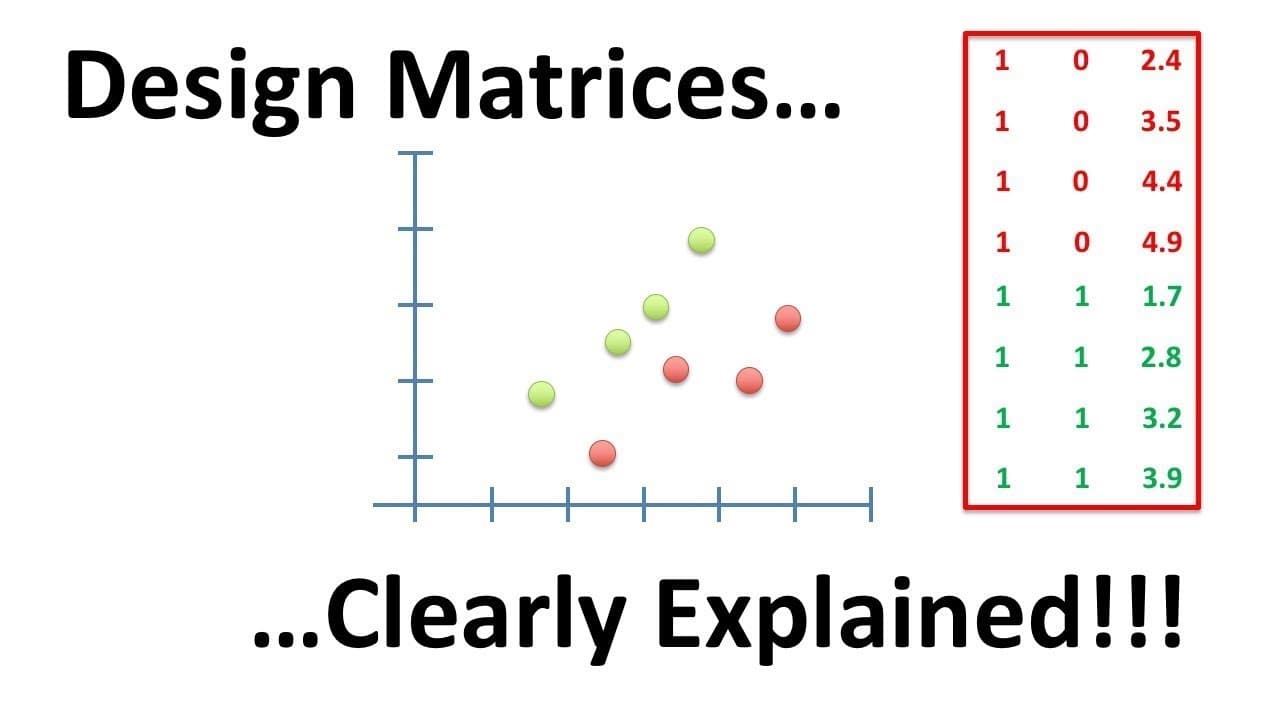
Design matrices are essential for structuring statistical analyses in general linear models. They use ones and zeros to turn on or off specific terms in equations, allowing for the incorporation of multiple factors to analyze complex relationships. By doing so, design matrices enhance the accuracy and significance of predictions in statistical modeling.
Transcript
stat Quest is getting bigger watch out hello and welcome to stat Quest stat Quest is brought to you by the friendly folks in the genetics department at the University of North Carolina at Chapel Hill today we're going to be talking about General linear models and this is part three of a series that we're doing on this this time we're going to focus... Read More
Key Insights
- 🍉 Design matrices activate specific terms in equations for statistical analysis.
- 🥺 Incorporating multiple factors in models can lead to more accurate predictions.
- 🆘 P-values help assess the significance of models in statistical analysis.
- 🪡 Batch effects can impact data analysis and need to be considered in statistical modeling.
- 👨🔬 The complexity of design matrices can vary based on the research question.
- 🧑🏭 Using simple models for comparison highlights the benefit of incorporating additional factors in analysis.
- 🎨 Statistical modeling with design matrices is crucial for understanding complex relationships in data.
Install to Summarize YouTube Videos and Get Transcripts
Explore YouTube Video Summarizer or Get YouTube Transcript Extractor
Questions & Answers
Q: What is the purpose of design matrices in general linear models?
Design matrices in general linear models help control which terms are active in equations, allowing for the analysis of various factors' effects on outcomes.
Q: How do design matrices differ in t-tests and linear regression?
In t-tests, design matrices focus on mean differences, while in linear regression, they incorporate slope and intercept terms based on data values.
Q: Why is incorporating multiple factors important in statistical modeling?
Incorporating multiple factors, such as batch effects or mutant control differences, allows for a more comprehensive analysis of data and can lead to significant findings.
Q: How do p-values help interpret the significance of statistical models?
Low p-values indicate that the model with additional factors is better at predicting outcomes, showing the importance of considering various variables in statistical analysis.
Summary & Key Takeaways
-
General linear models use design matrices for statistical analysis.
-
Design matrices contain ones and zeros to activate specific terms in equations.
-
By incorporating multiple factors, complex statistical relationships can be analyzed.
Read in Other Languages (beta)
Share This Summary 📚
Summarize YouTube Videos and Get Video Transcripts with 1-Click
Try YouTube Summary with ChatGPT & Claude or YouTube Transcript Generator
Explore More Summaries from StatQuest with Josh Starmer 📚





Summarize YouTube Videos and Get Video Transcripts with 1-Click
Try YouTube Summary with ChatGPT & Claude or YouTube Transcript Generator