Find the Volume of Any Shape Using Calculus
TL;DR
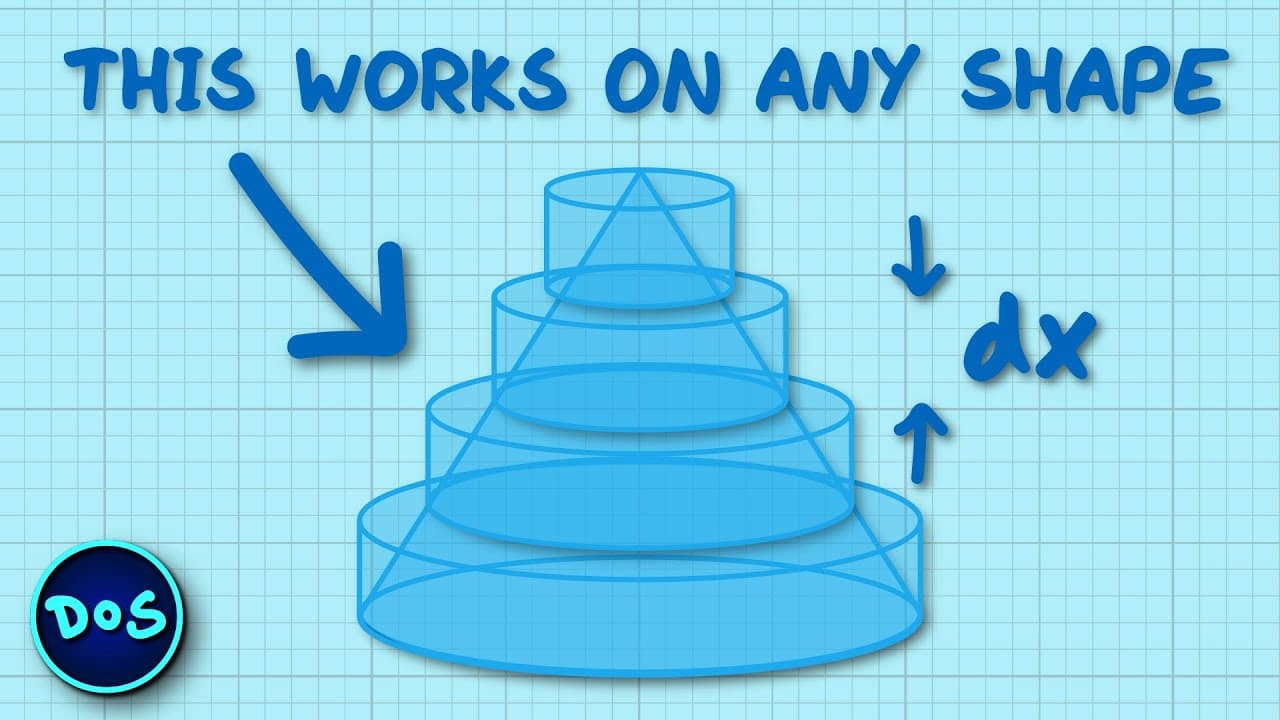
Learn how to use calculus to derive the volumes of different shapes like cones and pyramids.
Transcript
if somebody asks you what the volume was of these different shapes could you give them an answer off the top of your head probably not maybe for the cylinder because that's just the base times the height you know the base is PI R squared just the area of a circle times by the height but how about a cone or a pyramid or a sphere you could go and loo... Read More
Key Insights
- 🔇 Calculus can be utilized to accurately derive the volumes of geometric shapes like cones by employing disk approximations and integration techniques.
- 😑 Understanding the relationship between variables such as radius and height is crucial in formulating accurate volume expressions for complex shapes.
- 🧑🏭 Representing shape variables in terms of the minimizing factor, like height, simplifies the integration process and ensures precise volume calculations.
- 🤗 Using calculus to derive volumes offers learners a hands-on approach to understanding mathematical concepts and deriving equations, fostering a deeper appreciation for the subject.
Install to Summarize YouTube Videos and Get Transcripts
Explore YouTube Video Summarizer or Get YouTube Transcript Extractor
Questions & Answers
Q: How can calculus be used to derive the volume of a cone?
Calculus is employed by approximating the cone with disks, expressing the volume in terms of height, and performing integration to shrink the disks infinitely small, yielding the accurate volume calculation.
Q: Why is it important to represent the shape's variables in terms of the minimizing factor?
Representing variables like radius in terms of height facilitates integration and accurate volume derivation, ensuring that the calculus process accounts for all dimensions of the shape being analyzed.
Q: What challenges did the presenter face when deriving the volume expression for a cone?
The presenter encountered complexities when expressing the relationship between radius and height, highlighting the need for a clear understanding of these variables to avoid unnecessary algebraic complications during the derivation process.
Q: How does the application of calculus in deriving volumes enhance understanding and appreciation of mathematical concepts?
By deriving equations instead of simply memorizing them, learners gain a deeper insight into the mathematical principles behind geometric shapes, fostering a greater appreciation for the utility and elegance of calculus in problem-solving.
Summary & Key Takeaways
-
The video demonstrates how to derive the volume of shapes like cones by approximating with disks and then shrinking them infinitely small using calculus.
-
By setting up a sum, expressing it in terms of height, and integrating, the volume of the cone can be derived accurately.
-
Understanding the relationship between radius and height is essential in successfully deriving the volume of geometric shapes with calculus.
Read in Other Languages (beta)
Share This Summary 📚
Summarize YouTube Videos and Get Video Transcripts with 1-Click
Try YouTube Summary with ChatGPT & Claude or YouTube Transcript Generator
Explore More Summaries from Domain of Science 📚





Summarize YouTube Videos and Get Video Transcripts with 1-Click
Try YouTube Summary with ChatGPT & Claude or YouTube Transcript Generator