How to Solve Ideal Gas Law Problems in Physics
TL;DR
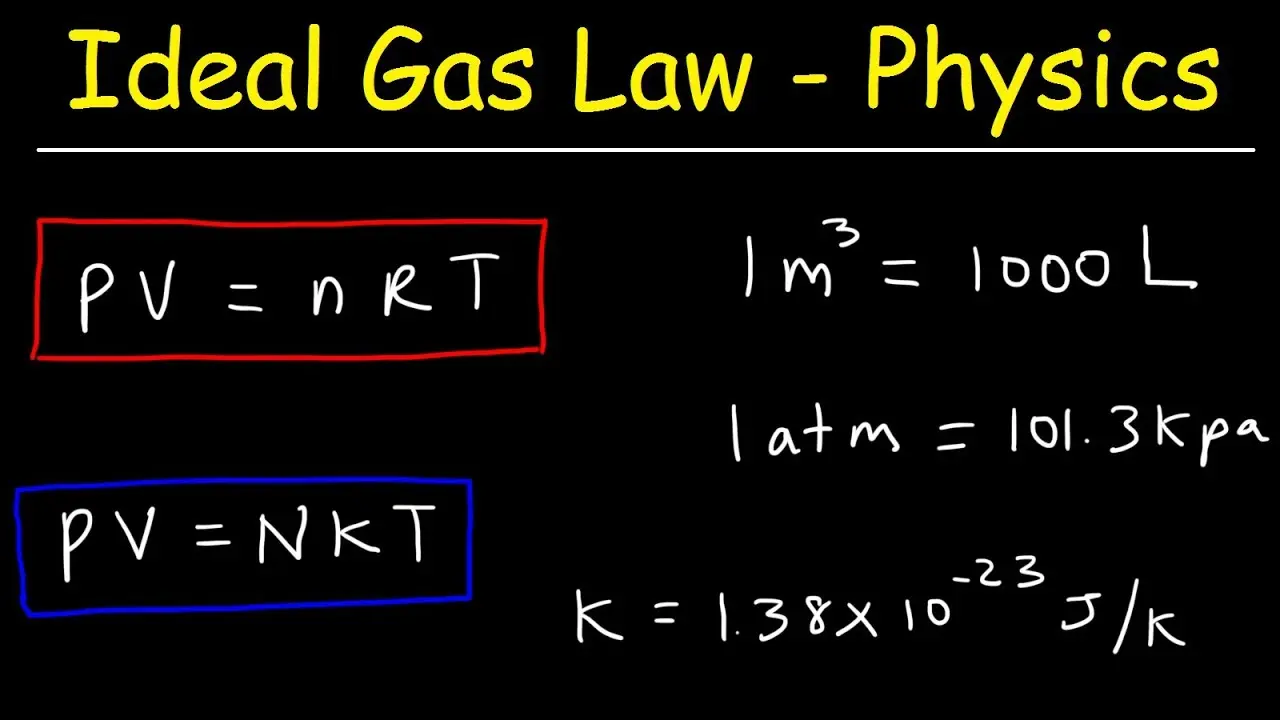
To solve ideal gas law problems in physics, use the equation PV = nRT with pressure in pascals and volume in cubic meters. For example, if a container has a pressure of 85 kPa at 300 K and a volume of 0.1 m³, the number of moles of gas can be calculated using R = 8.3145. Understanding these conversions is crucial for accurate calculations.
Transcript
in this video we're going to talk about how to solve ideal gas law problems but in a typical physics course as opposed to a chemistry course so let's consider this problem we have a 0.1 cubic meter container and the pressure inside this container is 85 kilopascals at 300 kelvin how many moles of gas are in this container now the formula that we nee... Read More
Key Insights
- 🫢 The ideal gas law equation, pv = nrt, is used in physics courses.
- 🤒 Pressure in physics is measured in pascals or newtons per square meter, while in chemistry it is typically in atmospheres.
- 🤒 Volume in physics is measured in cubic meters, while in chemistry it is usually in liters.
- 🫢 The gas constant, R, is 8.3145 in physics, while in chemistry it is often 0.082 06 liters times atm per mole per kelvin.
- 👌 STP refers to standard temperature and pressure, with a temperature of 0 degrees Celsius (273 K) and a pressure of 1 atm (101.3 kPa).
- 🫢 One mole of gas occupies a volume of 22.4 liters at STP.
- #️⃣ Avogadro's number, NA, is the number of molecules per mole and is approximately 6.02 x 10^23.
Install to Summarize YouTube Videos and Get Transcripts
Explore YouTube Video Summarizer or Get YouTube Transcript Extractor
Questions & Answers
Q: How do you use the ideal gas law formula in physics courses?
In physics, the pressure should be in pascals and the volume in cubic meters, instead of atmospheres and liters used in chemistry. The gas constant is 8.3145 and the temperature should be in kelvin.
Q: What are the units and values used for pressure and volume conversions?
Pressure can be in pascals or newtons per square meter. To convert pascals to kilopascals, divide by 1000. To convert volume, one cubic meter is equal to 1000 liters.
Q: How do you calculate the volume of gas at STP?
At standard temperature and pressure (STP), one mole of gas occupies a volume of 22.4 liters. To calculate the volume in cubic meters, divide the number of moles by 22.4 and then convert liters to cubic meters.
Q: How can you calculate the number of molecules using the ideal gas law equation?
By rearranging the ideal gas law equation to pv = nRT, where R is Boltzmann's constant (1.38 x 10^-23 J/K), you can find the number of molecules by dividing the given pressure and volume by Boltzmann's constant and temperature.
Summary & Key Takeaways
-
The video discusses the use of the ideal gas law equation, pv = nrt, in physics courses instead of chemistry courses.
-
It explains the different units of pressure (pascals or newtons per square meter) and gas constant (8.3145) used in physics.
-
The video provides examples of solving problems involving the number of moles of gas and volume at different temperatures and pressures.
Read in Other Languages (beta)
Share This Summary 📚
Summarize YouTube Videos and Get Video Transcripts with 1-Click
Try YouTube Summary with ChatGPT & Claude or YouTube Transcript Generator
Explore More Summaries from The Organic Chemistry Tutor 📚

Summarize YouTube Videos and Get Video Transcripts with 1-Click
Try YouTube Summary with ChatGPT & Claude or YouTube Transcript Generator