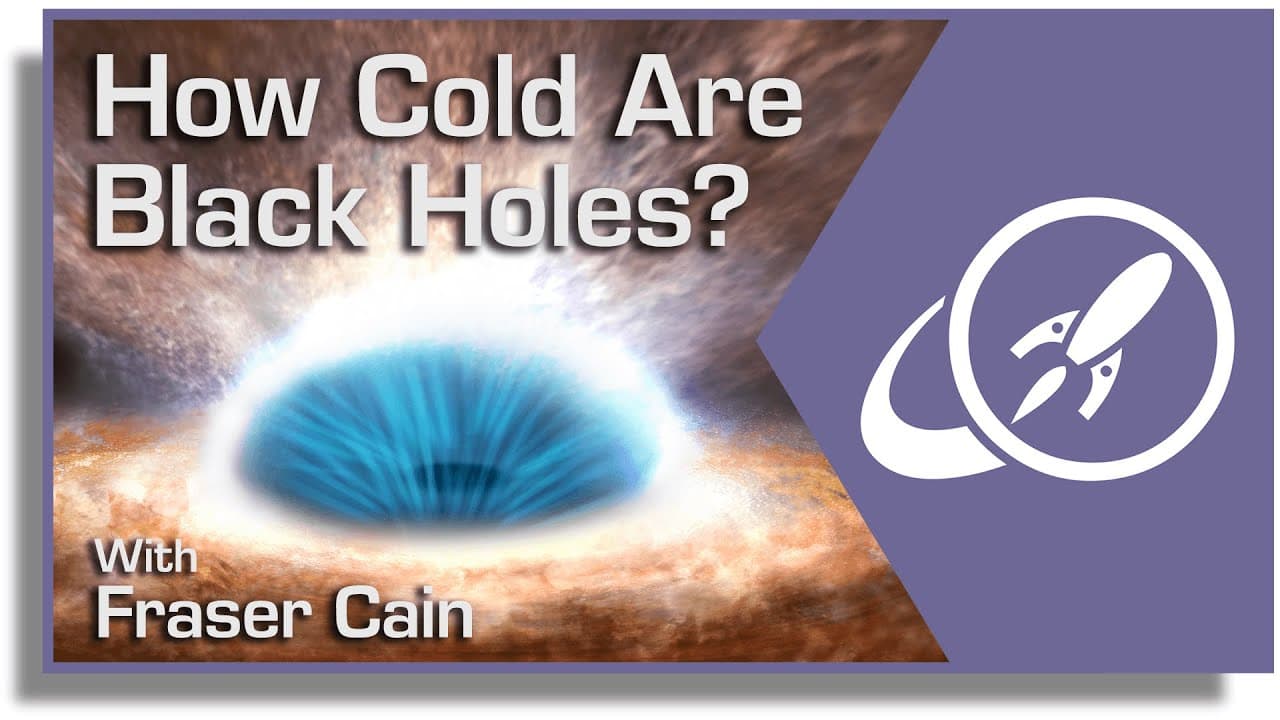
How Cold Are Black Holes? Taking the Temperature of Event Horizons
TL;DR
Black holes have a temperature due to Hawking Radiation, with smaller black holes being hotter.
Transcript
Today we’re going to have the most surreal conversation. I’m going to struggle to explain it, and you’re going to struggle to understand it. And only Stephen Hawking is going to really, truly, understand what’s actually going on. But that’s fine, I’m sure he appreciates our feeble attempts to wrap our brains around this mind bending concept. All ri... Read More
Key Insights
- 🖤 Black holes have a temperature due to Hawking Radiation.
- 🖤 The temperature of a black hole is inversely proportional to its mass.
- ◾ Smaller black holes have higher temperatures and eventually evaporate.
- 😚 Black holes lose mass as they emit energy.
- 🖤 Astronomers are searching for explosions from primordial black holes.
- 🖤 Black holes can emit energy despite absorbing all incoming energy.
- ⬛ Smaller black holes are hotter than larger ones.
Install to Summarize YouTube Videos and Get Transcripts
Explore YouTube Video Summarizer or Get YouTube Transcript Extractor
Questions & Answers
Q: How can black holes have a temperature if they absorb all matter and energy?
Black holes have a temperature due to Hawking Radiation, where virtual particles are created at their event horizon, some of which escape as photons, giving the black hole a temperature.
Q: What determines the temperature of a black hole?
The temperature of a black hole is inversely proportional to its mass and size of the event horizon. Smaller black holes have higher temperatures than larger ones.
Q: Can black holes lose mass due to their temperature?
Yes, as black holes emit energy through Hawking Radiation, they lose mass and eventually evaporate, with smaller black holes evaporating faster than they absorb energy.
Q: Why are astronomers searching for black hole explosions?
Astronomers are searching for explosions from primordial black holes formed after the Big Bang, which are starting to release energy after billions of years of evaporation.
Summary & Key Takeaways
-
Black holes, despite absorbing all energy, have a temperature due to Hawking Radiation.
-
The temperature is related to the size of the black hole's event horizon.
-
Smaller black holes have higher temperatures and eventually evaporate.
Read in Other Languages (beta)
Share This Summary 📚
Summarize YouTube Videos and Get Video Transcripts with 1-Click
Try YouTube Summary with ChatGPT & Claude or YouTube Transcript Generator
Explore More Summaries from Fraser Cain 📚




Summarize YouTube Videos and Get Video Transcripts with 1-Click
Try YouTube Summary with ChatGPT & Claude or YouTube Transcript Generator