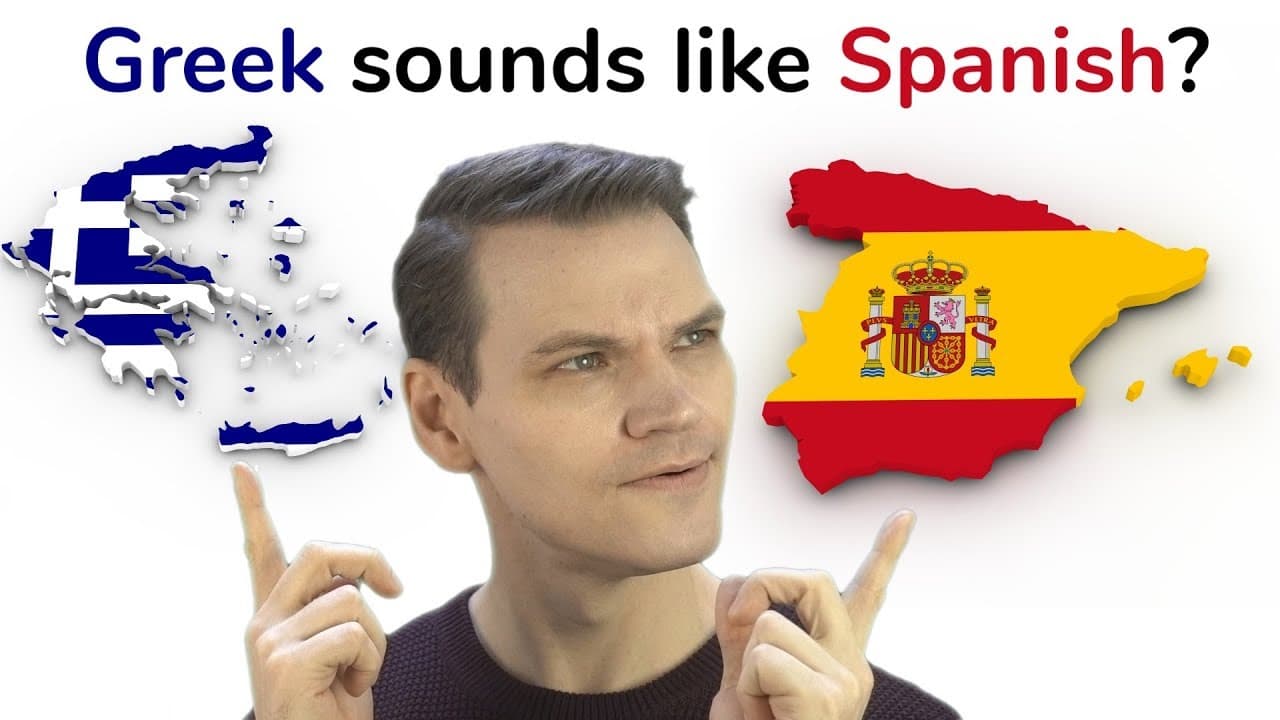
Why Does Greek Sound Like Spanish?!
TL;DR
Greek and Spanish sound similar due to phonological similarities.
Transcript
Hello everyone, welcome to the Langfocus Channel, and my name is Paul. Today we'll be looking at why Greek sounds like Spanish. What? Greek Sounds like Spanish?! If you've never noticed it yourself, than I'm sure that idea sounds ridiculous. I mean, they're both Indo-European languages and share a common ancestor language, but Greek essentially for... Read More
Key Insights
- Greek and Spanish share similar phonological characteristics, particularly in their consonant inventories, which makes them sound alike to many listeners.
- Both languages have the same set of five vowels and lack phonemic distinction between short and long vowels, contributing to their similar sound.
- The syllable structure in both languages is marked by a prevalence of open syllables, ending in vowels, which influences their rhythm and sound.
- Rhotic sounds in Greek and Spanish are partly similar, with both languages using the alveolar tap, though Greek occasionally uses trills.
- Syllable timing in Spanish is consistent, while Greek is often seen as between syllable-timed and stress-timed, affecting rhythm perception.
- Vocabulary similarities exist due to shared Indo-European roots, but phonological similarities are more significant in making the languages sound alike.
- Diphthongs in Greek and Spanish are similar, with both languages having combinations of the five basic vowels, though not entirely identical.
- Verb conjugations in both languages exhibit some similarities, particularly in present tense forms, affecting the overall sound of the languages.
Install to Summarize YouTube Videos and Get Transcripts
Explore YouTube Video Summarizer or Get YouTube Transcript Extractor
Questions & Answers
Q: What makes Greek and Spanish sound similar?
Greek and Spanish sound similar primarily due to their phonological features. Both languages share similar consonant inventories and have the same set of five vowels. Additionally, they both have a syllable structure with a prevalence of open syllables, ending in vowels, which contributes to their rhythmic similarity.
Q: How do Greek and Spanish vowels compare?
Greek and Spanish vowels are identical in terms of phonetics, with both languages having the same set of five vowels: a, e, i, o, u. Neither language has a phonemic distinction between short and long vowels, which further contributes to their similar sound.
Q: What role do rhotic sounds play in the similarity between Greek and Spanish?
Rhotic sounds contribute to the similarity between Greek and Spanish. Both languages use the alveolar tap, and Greek sometimes uses trills. This similarity in rhotic sounds, along with other phonological features, adds to the perception that the languages sound alike.
Q: How does syllable timing affect the sound of Greek and Spanish?
Syllable timing affects the sound of Greek and Spanish by influencing their rhythm. Spanish is a syllable-timed language, meaning each syllable is more or less the same length. Greek is often seen as between syllable-timed and stress-timed, with some vowel reduction, affecting its rhythmic perception.
Q: Are there vocabulary similarities between Greek and Spanish?
Yes, there are vocabulary similarities between Greek and Spanish due to shared Indo-European roots. However, these similarities are less significant in making the languages sound alike compared to their phonological similarities. Shared cognate vocabulary does exist, but it's the sounds of these words that contribute to the perceived similarity.
Q: What is the significance of open syllables in Greek and Spanish?
Open syllables, which end in vowels, are significant in Greek and Spanish as they contribute to the languages' rhythm and sound. The prevalence of open syllables in both languages influences their overall phonological structure, making them sound more similar to each other.
Q: How do diphthongs in Greek and Spanish compare?
Diphthongs in Greek and Spanish are similar, as both languages combine the five basic vowels in various ways. While not entirely identical, these diphthongs contribute to the overall phonological similarity between the two languages, affecting their sound and rhythm.
Q: Do verb conjugations in Greek and Spanish sound similar?
Yes, verb conjugations in Greek and Spanish exhibit some similarities, particularly in present tense forms. The endings of these verbs often sound alike, contributing to the overall sound resemblance between the two languages. This similarity in conjugation patterns further enhances their phonological likeness.
Summary & Key Takeaways
-
Greek and Spanish are perceived as sounding similar due to shared phonological features, including consonant and vowel similarities. Both languages have five vowels and a similar syllable structure marked by open syllables, contributing to their rhythmic likeness.
-
Rhotic sounds in Greek and Spanish are partly similar, with both languages using the alveolar tap. Greek sometimes uses trills, adding to the perception of similarity. Syllable timing varies, with Spanish being syllable-timed and Greek often seen as in-between.
-
Vocabulary similarities exist, but phonology plays a more crucial role in the perceived similarity of the languages. Diphthongs and verb conjugations in both languages exhibit similarities, further contributing to their overall sound resemblance.
Read in Other Languages (beta)
Share This Summary 📚
Summarize YouTube Videos and Get Video Transcripts with 1-Click
Try YouTube Summary with ChatGPT & Claude or YouTube Transcript Generator
Explore More Summaries from Langfocus 📚


Summarize YouTube Videos and Get Video Transcripts with 1-Click
Try YouTube Summary with ChatGPT & Claude or YouTube Transcript Generator