Lecture 10.3 - Graphon Filters are Generative Models for Graph Filters
TL;DR
Graph filters approximate graphon filters as node count increases.
Transcript
we saw that for convergent graph sequences graph filters converge asymptotically to earthling filters that suggests the use of finite breast filters to approximate ortho filters we now discuss the conditions under which graph filters can approximate growth from filters and how good that approximation is for different values of n in the last few lec... Read More
Key Insights
- Graph filters can asymptotically approximate graphon filters, especially as the number of nodes increases, making them more similar.
- The eigenvalues of graph sequences converge to those of the graphon, allowing graph filters to approximate graphon filters under certain conditions.
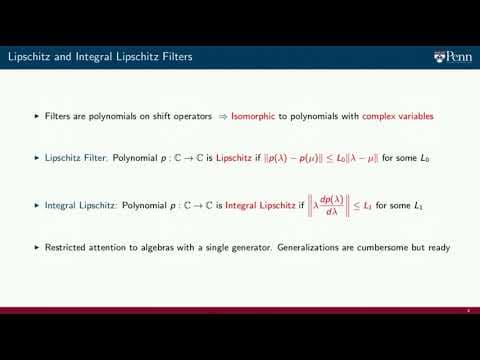
- Low-pass Lipschitz filters help in approximating graphon filters by focusing on eigenvalues above a threshold, simplifying discrimination.
- High-pass filters with low variability around zero improve approximation by matching graph eigenvalues to graphon eigenvalues more effectively.
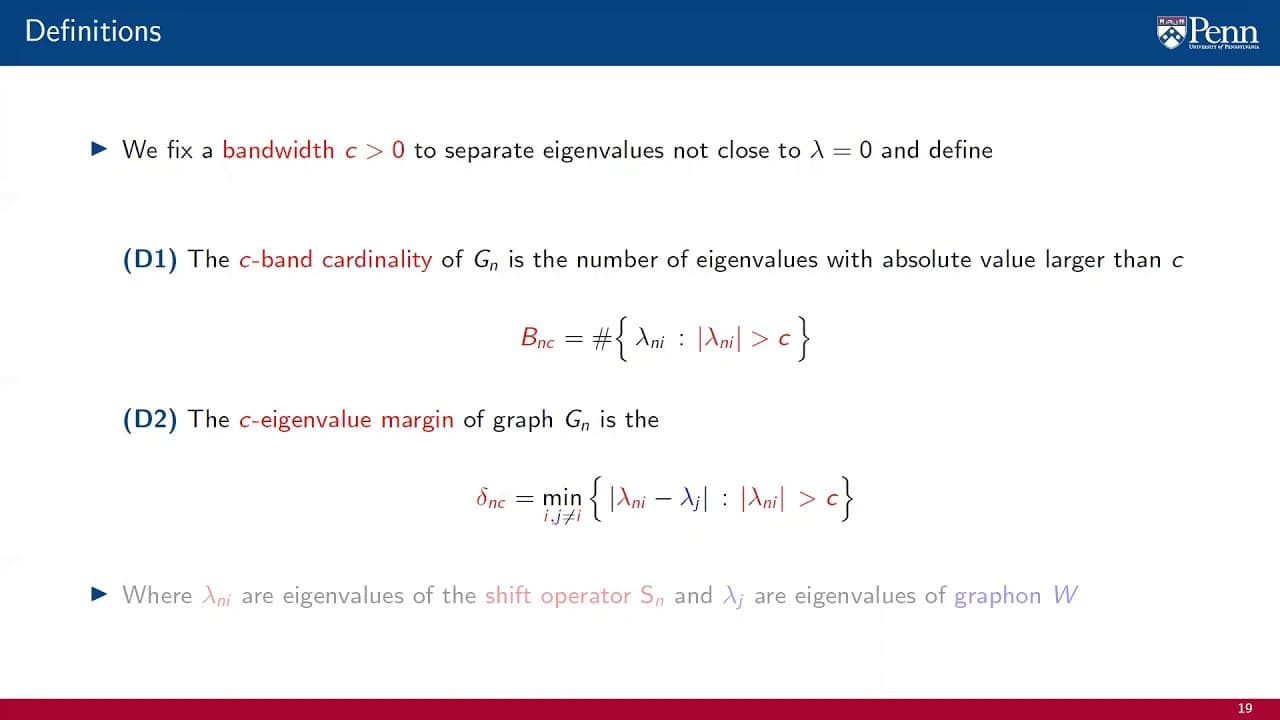
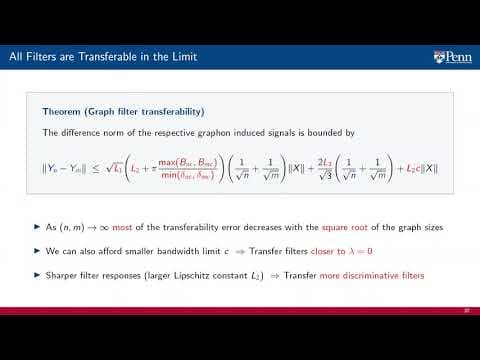
- Approximation bounds depend on conditions like Lipschitz constants for graphon and filter, eigenvalue margin, and the number of eigenvalues in the passing band.
- The variability of filters is crucial; low variability around zero aids in approximation but hinders discriminability of components with eigenvalues close to zero.
- Graph filters' approximation quality is influenced by the transferability constant, which is affected by filter parameters and eigenvalue distribution.
- As graphs grow, the number of eigenvalues in the passing band can increase, improving filter discriminability without harming approximation quality.
Install to Summarize YouTube Videos and Get Transcripts
Explore YouTube Video Summarizer or Get YouTube Transcript Extractor
Questions & Answers
Q: What conditions allow graph filters to approximate graphon filters?
Graph filters can approximate graphon filters when the eigenvalues of the graph sequences converge to those of the graphon. This convergence allows the frequency response of graph filters to match that of graphon filters. Conditions such as Lipschitz continuity of the graphon, filter, and signal, along with a defined eigenvalue threshold, are crucial for effective approximation.
Q: How do low-pass Lipschitz filters help in approximating graphon filters?
Low-pass Lipschitz filters aid in approximating graphon filters by focusing on eigenvalues above a certain threshold. This approach simplifies the matching process between graph and graphon eigenvalues, especially around zero where eigenvalue accumulation occurs. The filter restricts variability in this region, aiding in the approximation while maintaining certain discriminability.
Q: What role do high-pass filters play in graphon filter approximation?
High-pass filters with low variability around zero facilitate the approximation of graphon filters by easing the matching of graph eigenvalues to graphon eigenvalues near zero. This characteristic allows for tighter approximation bounds, as the filters remove components associated with graphon frequencies, improving the overall approximation quality.
Q: How do approximation bounds depend on Lipschitz constants?
Approximation bounds are significantly influenced by Lipschitz constants of the graphon, filter, and signal. These constants determine the variability allowed in the filter's response and the graphon's behavior. A lower Lipschitz constant results in tighter approximation bounds, improving the quality of the approximation by ensuring less variability and better alignment of eigenvalues.
Q: Why is filter variability important in graphon filter approximation?
Filter variability is crucial because it impacts both the approximation quality and the discriminability of the filter. Low variability around zero aids in achieving tight approximation bounds but can limit the filter's ability to discriminate between components with eigenvalues close to zero. Balancing variability is essential for optimal filter performance.
Q: What is the significance of the transferability constant in approximation?
The transferability constant plays a vital role in determining the quality of graph filter approximation. It is influenced by the filter's Lipschitz constant, eigenvalue distribution, and passing band parameters. A higher transferability constant implies better approximation quality, as it indicates the filter's ability to adapt to changes in eigenvalue distribution effectively.
Q: How does graph size affect the approximation of graphon filters?
As graph size increases, the number of eigenvalues in the passing band can also increase, enhancing the filter's discriminability without negatively affecting the approximation bounds. Larger graphs allow for more eigenvalues to be included in the passing band, providing better alignment with graphon eigenvalues and improving overall approximation quality.
Q: What challenges exist in achieving good approximation bounds?
Achieving good approximation bounds presents challenges, particularly in balancing the filter's discriminability and approximation quality. Filters need to maintain low variability around zero to ensure tight bounds, but this can limit their ability to discriminate between components with similar eigenvalues. As graph size increases, these challenges lessen, allowing for better approximation without sacrificing discriminability.
Summary & Key Takeaways
-
This lecture explores how graph filters can approximate graphon filters, focusing on conditions and quality of approximation as graph size increases. It discusses the convergence of eigenvalues and the use of low-pass and high-pass Lipschitz filters to enhance approximation.
-
The lecture outlines the importance of eigenvalue distribution and Lipschitz constants in determining approximation quality. It highlights the balance between approximation bounds and filter discriminability, emphasizing the role of transferability constants.
-
Graph size plays a crucial role in approximation quality. As graphs grow, more eigenvalues can be included in the passing band, enhancing discriminability without compromising approximation bounds, which are vital for effective filter design.
Read in Other Languages (beta)
Share This Summary 📚
Summarize YouTube Videos and Get Video Transcripts with 1-Click
Try YouTube Summary with ChatGPT & Claude or YouTube Transcript Generator
Explore More Summaries from Alelab Alelab 📚
Summarize YouTube Videos and Get Video Transcripts with 1-Click
Try YouTube Summary with ChatGPT & Claude or YouTube Transcript Generator