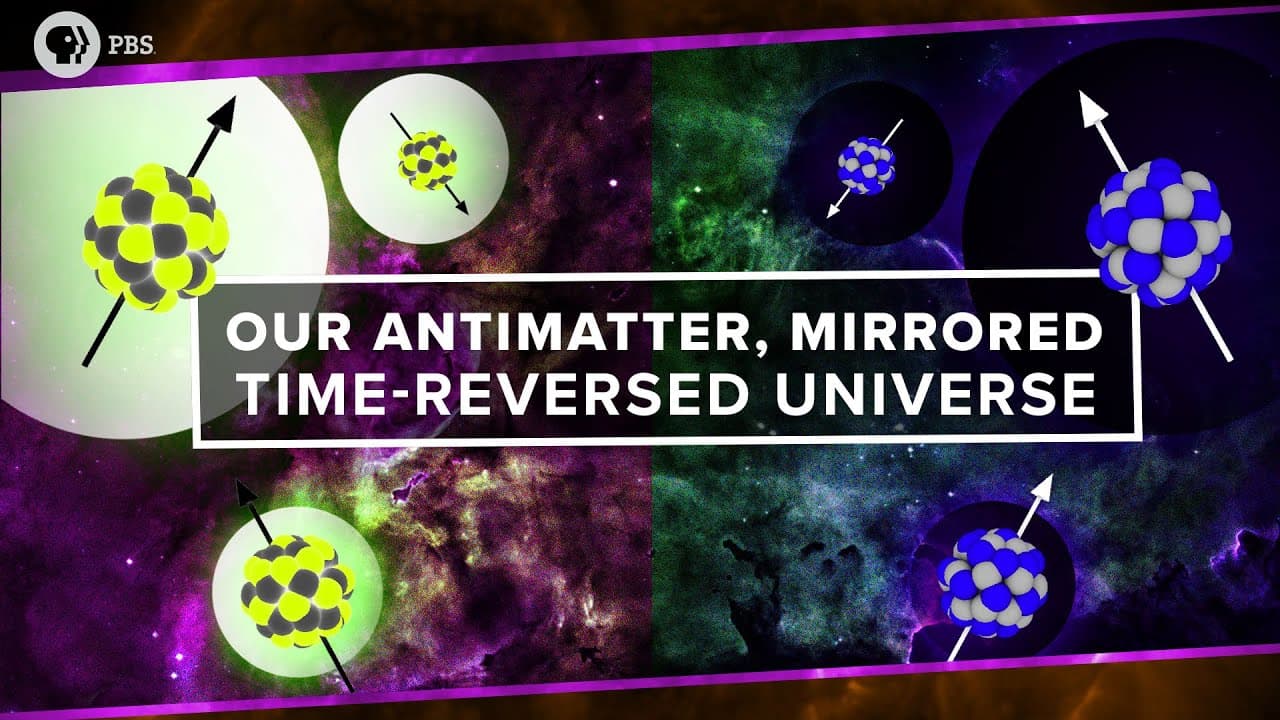
Our Antimatter, Mirrored, Time-Reversed Universe
TL;DR
Quantum symmetries break, challenging foundational physics.
Transcript
The foundations of quantum theory rest on its symmetries for example it should be impossible to distinguish our universe from one that is a perfect mirror opposite in charge handedness and the direction of time but one by one these symmetries were found to be broken threatening to break all of physics along with them. In his famous lectures on phys... Read More
Key Insights
- The concept of symmetry in quantum theory implies that our universe should be indistinguishable from its mirror opposite in charge, handedness, and time direction.
- Richard Feynman's mirror clock thought experiment illustrates the complexity of parity symmetry, showing that a mirror image clock would not function identically.
- Experiments have demonstrated that parity symmetry is violated, as seen in cobalt-60 nuclei decay, which behaves differently in a mirror-reflected universe.
- CPT symmetry, combining charge, parity, and time, is crucial for quantum field theory, suggesting physics should remain unchanged under these transformations.
- The violation of CP symmetry, as shown in Kaon decay experiments, implies a deeper violation of time reversal symmetry.
- The CPT theorem posits that an antimatter, mirror-reflected, time-reversed universe should adhere to the same physical laws as our own.
- Time reversal symmetry, when violated, indicates that the future may not mirror the past, challenging the conservation of quantum information.
- String theory's reliance on supersymmetry and its untestability at current energy scales highlight ongoing challenges in theoretical physics.
Install to Summarize YouTube Videos and Get Transcripts
Explore YouTube Video Summarizer or Get YouTube Transcript Extractor
Questions & Answers
Q: What is the significance of symmetry in quantum theory?
Symmetry in quantum theory implies that our universe should be indistinguishable from its mirror opposite in charge, handedness, and time direction. This foundational concept suggests that physical laws should remain consistent under these transformations, providing a basis for understanding fundamental interactions in the universe.
Q: How does Feynman's mirror clock thought experiment illustrate parity symmetry?
Feynman's mirror clock thought experiment demonstrates the complexity of parity symmetry by proposing a clock governed by cobalt-60 decay. In a mirror-reflected universe, the clock would not tick identically due to the reversed direction of decay electrons, highlighting the non-symmetric nature of physical laws under parity transformations.
Q: What are the implications of CP symmetry violation?
CP symmetry violation, observed in Kaon decay experiments, suggests that time reversal symmetry is also broken. This violation implies that the future may not perfectly mirror the past, challenging the conservation of quantum information and potentially affecting our understanding of fundamental physics.
Q: What is the CPT theorem and its significance in quantum field theory?
The CPT theorem posits that an antimatter, mirror-reflected, time-reversed universe should adhere to the same physical laws as our own. This theorem is crucial for quantum field theory, ensuring that physics remains consistent under combined charge, parity, and time transformations, preserving the integrity of theoretical models.
Q: How does time reversal symmetry relate to quantum information conservation?
Time reversal symmetry suggests that the future should mirror the past, ensuring the conservation of quantum information. If this symmetry is violated, as indicated by CP symmetry violations, it challenges the notion that quantum information is preserved, impacting the fundamental principles of quantum mechanics.
Q: What challenges does string theory face regarding supersymmetry?
String theory relies on supersymmetry, which has not been detected at expected energy scales. This non-detection presents a challenge as supersymmetry is compelling for resolving the hierarchy problem. The untestability of string theory at current energy levels complicates its validation, highlighting ongoing theoretical challenges.
Q: How does the concept of an antimatter universe relate to CPT symmetry?
An antimatter universe, when combined with mirror reflection and time reversal, should share the same physical laws as our universe according to the CPT theorem. This concept underscores the importance of CPT symmetry in ensuring that physics remains consistent across different transformations, maintaining theoretical coherence.
Q: What role do experiments play in understanding symmetry violations?
Experiments, such as those observing Kaon decay, play a crucial role in revealing symmetry violations like CP symmetry. These findings challenge existing theories and prompt reevaluation of fundamental principles, driving advancements in our understanding of quantum mechanics and the underlying structure of the universe.
Summary & Key Takeaways
-
Quantum theory's symmetries suggest our universe should be identical to its mirror opposite, but experiments reveal broken symmetries, challenging foundational physics. Feynman's mirror clock experiment demonstrates parity symmetry's complexity, with real-world implications seen in cobalt-60 nuclei decay.
-
The CPT symmetry, a cornerstone of quantum field theory, combines charge, parity, and time, maintaining consistent physical laws. However, CP symmetry violations, as observed in Kaon decay, suggest time reversal symmetry is also broken, impacting quantum information conservation.
-
String theory's dependence on supersymmetry and its current untestability at accessible energy scales present significant theoretical challenges. Despite these issues, the CPT theorem remains intact, suggesting an antimatter, mirror-reflected, time-reversed universe shares our physical laws.
Read in Other Languages (beta)
Share This Summary 📚
Summarize YouTube Videos and Get Video Transcripts with 1-Click
Try YouTube Summary with ChatGPT & Claude or YouTube Transcript Generator
Explore More Summaries from PBS Space Time 📚
Summarize YouTube Videos and Get Video Transcripts with 1-Click
Try YouTube Summary with ChatGPT & Claude or YouTube Transcript Generator