What Is the Matrix Math Behind Transformer Neural Networks?
TL;DR
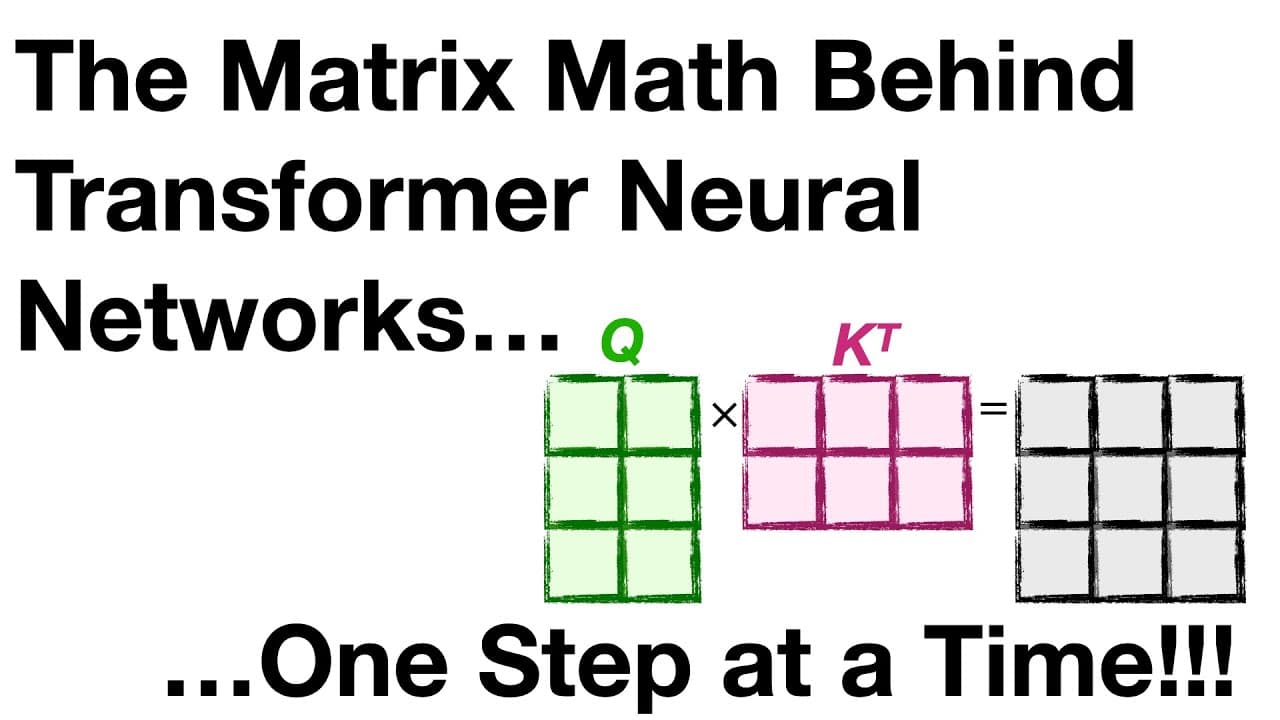
The matrix math behind transformer neural networks includes steps for calculating word embeddings, positional encodings, and self-attention scores. This mathematical framework is crucial for understanding how transformers convert input sequences into output sequences, particularly in tasks like translation, using an encoder-decoder architecture.
Transcript
we're going to do a lot of math row by column aray stat Quest hello I'm Josh starmer and welcome to stat Quest today we're going to talk about the Matrix math behind Transformer neural networks and we're going to go through it one step at a time this stat Quest is brought to you by the letters a b and c a always b b c be curious always be curious n... Read More
Key Insights
- 🍽️ Matrix math is fundamental to understanding the inner workings of Transformer neural networks.
- 🖐️ Word embeddings and positional encodings play essential roles in representing tokens and their positions within sequences.
- 🤳 Self attention empowers tokens to compute their relevance to others, enhancing network performance.
- ❓ Encoder-decoder architecture facilitates the translation process by leveraging attention mechanisms.
- 🦻 Teacher forcing aids in training by guiding the network towards generating expected output sequences.
- 🤳 Masking ensures tokens focus only on relevant information during self attention calculations.
- ❓ Fully connected layers and softmax functions are utilized in generating output tokens in the decoder.
Install to Summarize YouTube Videos and Get Transcripts
Explore YouTube Video Summarizer or Get YouTube Transcript Extractor
Questions & Answers
Q: What is the importance of understanding Matrix notation in coding Transformers and neural networks?
Understanding Matrix notation is crucial for coding Transformers as it simplifies the process of implementing neural network architectures efficiently and accurately. It provides a structured framework for handling complex mathematical operations required in network computations.
Q: How are word embeddings and positional encodings utilized in Transformer neural networks?
Word embeddings capture semantic relationships between tokens by mapping them to continuous vector spaces. Positional encodings enhance the embeddings with spatial information, enabling the network to consider token positions within a sequence during computation.
Q: Explain the concept of self attention in Transformer neural networks and its significance.
Self attention allows tokens to gauge their relevance to each other within a sequence, facilitating the identification of important relationships during computation. It forms the foundation of the Transformer architecture, enabling efficient processing of input tokens.
Q: Why is teacher forcing used during training in the decoder of a Transformer neural network?
Teacher forcing involves providing known output values to initialize the decoder during training, expediting the learning process by guiding the network towards producing desired outputs. It enhances training efficiency and improves convergence towards correct translation sequences.
Summary & Key Takeaways
-
Explanation of Matrix math behind Transformer neural networks in a step-by-step manner.
-
Discusses word embeddings, positional encodings, self attention, and encoder-decoder architectures.
-
Details the process of calculating attention scores and generating output tokens in the decoder.
Read in Other Languages (beta)
Share This Summary 📚
Summarize YouTube Videos and Get Video Transcripts with 1-Click
Try YouTube Summary with ChatGPT & Claude or YouTube Transcript Generator
Explore More Summaries from StatQuest with Josh Starmer 📚


Summarize YouTube Videos and Get Video Transcripts with 1-Click
Try YouTube Summary with ChatGPT & Claude or YouTube Transcript Generator