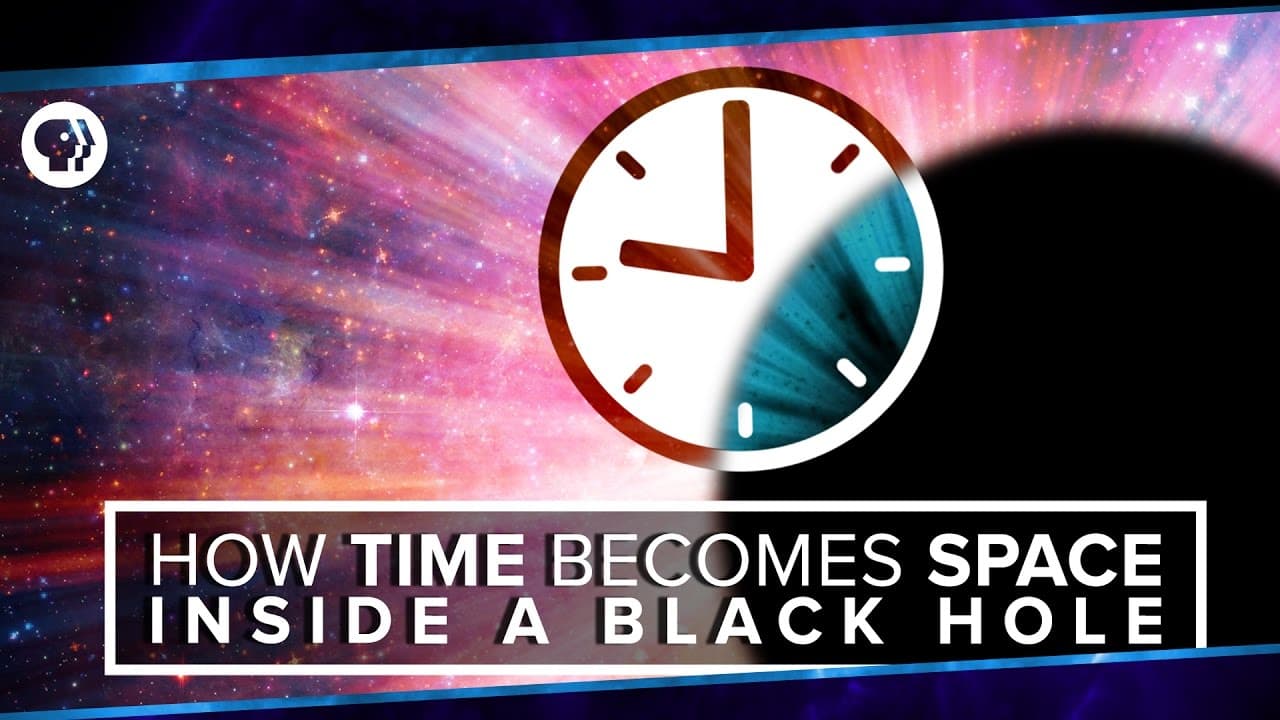
How Time Becomes Space Inside a Black Hole | Space Time
TL;DR
Explores how time and space switch roles inside black holes.
Transcript
This episode is sponsored by Crunchyroll. Today on Space Time we're going to talk about time-space. Or: the strange switching in the roles of space and time that occurs in the mathematics when we drop below the event horizon of a black hole. What does this bizarre statement — space and time switching roles — even mean? Is this "space-time dyslexia"... Read More
Key Insights
- Inside a black hole, the roles of time and space switch, with space becoming time-like and time becoming space-like.
- The Schwarzschild solution to Einstein's equations describes how space-time behaves near a non-rotating black hole.
- Outside the event horizon, time behaves normally and causality is maintained unless faster-than-light travel occurs.
- Inside the event horizon, space falls inward faster than light, carrying objects towards the singularity inevitably.
- The Penrose diagram is useful for visualizing the extreme warping of space-time near a black hole.
- As one crosses the event horizon, the outside universe exits the future light cone, leaving only the singularity.
- Time crystals are quantum systems with periodic internal state changes but require energy input to maintain oscillations.
- The video encourages viewers to explore additional resources for a deeper understanding of complex scientific concepts.
Install to Summarize YouTube Videos and Get Transcripts
Explore YouTube Video Summarizer or Get YouTube Transcript Extractor
Questions & Answers
Q: What happens to time and space inside a black hole?
Inside a black hole, the roles of time and space are reversed. The radial coordinate 'r', which typically represents space, becomes time-like, meaning it only moves in one direction towards the singularity. Conversely, the time coordinate 't' becomes space-like, allowing for movement in any direction. This switch results in an inevitable journey towards the singularity, as space itself falls inward faster than light.
Q: What is the Schwarzschild solution?
The Schwarzschild solution is a solution to Einstein's field equations that describes the gravitational field outside a spherical, non-rotating mass such as a black hole. It provides the first accurate description of a black hole, detailing how space-time is warped by the mass of the black hole. The solution is crucial for understanding the behavior of objects as they approach and cross the event horizon.
Q: How does the Penrose diagram help in understanding black holes?
The Penrose diagram is a tool used to represent the extreme warping of space-time near a black hole. It compactifies lines of constant space or time, maintaining the upright position of light cones even within the black hole. This allows for a clearer visualization of how space and time behave as one approaches and crosses the event horizon, illustrating the complex interplay of these dimensions.
Q: What are time crystals and why are they significant?
Time crystals are quantum systems that exhibit periodic changes in their internal states over time. Unlike traditional crystals with spatial periodicity, time crystals have temporal periodicity. Although they require energy input to maintain oscillations, they represent a fundamentally new type of oscillating system. Their discovery opens up potential applications in quantum computing and other fields, making them a subject of significant scientific interest.
Q: What happens to light as it approaches a black hole?
As light approaches a black hole, its path is bent towards the gravitational field of the black hole. This bending becomes more pronounced closer to the event horizon. Inside the event horizon, light struggles to escape, as space itself is falling inward faster than light. This results in light being overtaken by the inward flow of space-time, preventing it from making headway outwards.
Q: Why is the concept of time and space switching roles significant?
The concept of time and space switching roles inside a black hole is significant because it challenges our conventional understanding of these dimensions. It illustrates the extreme conditions under which the fabric of space-time can behave counterintuitively, providing insights into the fundamental nature of the universe. This reversal also impacts our understanding of causality and the ultimate fate of objects falling into black holes.
Q: How does gravity affect the future light cone near a massive object?
Near a massive object, gravity causes the future light cone to tilt towards the mass, altering the direction of future events. This tilting becomes more extreme as one approaches a black hole's event horizon, where the future light cone and time axis blur with the inward radial axis. This gravitational influence fundamentally changes the geometry of space-time and the progression of time.
Q: What role does the Schwarzschild radius play in black holes?
The Schwarzschild radius defines the event horizon of a black hole, marking the boundary beyond which nothing can escape the gravitational pull. It is the critical distance from the singularity where the escape velocity equals the speed of light. Within this radius, the roles of time and space switch, and objects are inevitably drawn towards the singularity, unable to escape the black hole's grasp.
Summary & Key Takeaways
-
This episode of Space Time explores the fascinating concept of time and space switching roles within a black hole. The discussion is grounded in the Schwarzschild solution to Einstein's equations, which describes how space-time is distorted near a non-rotating black hole. The episode uses both mathematical and graphical representations to illustrate these complex ideas.
-
The episode explains how, outside the event horizon, time maintains its normal properties, ensuring causal progression unless disrupted by faster-than-light travel. However, once inside the event horizon, space itself falls inward faster than light, dragging objects inevitably towards the singularity. This results in a reversal of roles, with space becoming time-like and time becoming space-like.
-
Additionally, the episode touches on the concept of time crystals, which are quantum systems that exhibit periodic internal state changes. Despite requiring energy input to maintain these oscillations, the discovery of time crystals represents a new type of oscillating system with potential applications. The episode concludes with a call for viewers to engage with additional resources for deeper understanding.
Read in Other Languages (beta)
Share This Summary 📚
Summarize YouTube Videos and Get Video Transcripts with 1-Click
Try YouTube Summary with ChatGPT & Claude or YouTube Transcript Generator
Explore More Summaries from PBS Space Time 📚
Summarize YouTube Videos and Get Video Transcripts with 1-Click
Try YouTube Summary with ChatGPT & Claude or YouTube Transcript Generator