Products
Features
YouTube Video Summarizer
Summarize YouTube videos
Web & PDF Highlighter
Highlight web pages & PDFs
Chat with PDF
Ask any PDF questions with AI
Ask AI Clone
Chat with your highlights & memories
Audio Transcriber
Transcribe audio files to text
Glasp Reader
Read and highlight articles
Kindle Highlight Export
Export your Kindle highlights
Idea Hatch
Hatch ideas from your highlights
Integrations
Obsidian Plugin
Notion Integration
Pocket Integration
Instapaper Integration
Medium Integration
Readwise Integration
Snipd Integration
Hypothesis Integration
Apps & Extensions
Chrome Extension
Safari Extension
Edge Add-ons
Firefox Add-ons
iOS App
Android App
Discover
Discover
Ideas
Discover new ideas and insights
Articles
Curated articles and insights
Books
Book recommendations by great minds
Posts
Essays and notes from readers
Quotes
Inspiring quotes collection
Videos
Curated videos and summaries
Explore Glasp
Glasp Newsletter
Weekly insights and updates
Glasp Talk
Interview series with great minds
Glasp Blog
Latest news and articles
Glasp Use Cases
Learn how others use Glasp
Build & Support
Glasp API
Access Glasp's API for developers
MCP Connector
Connect Glasp to Claude & ChatGPT
Community
Glasp Reddit Community
Students
Student discount and benefits
FAQs
Frequently Asked Questions
AboutPricing
DashboardLog inSign up

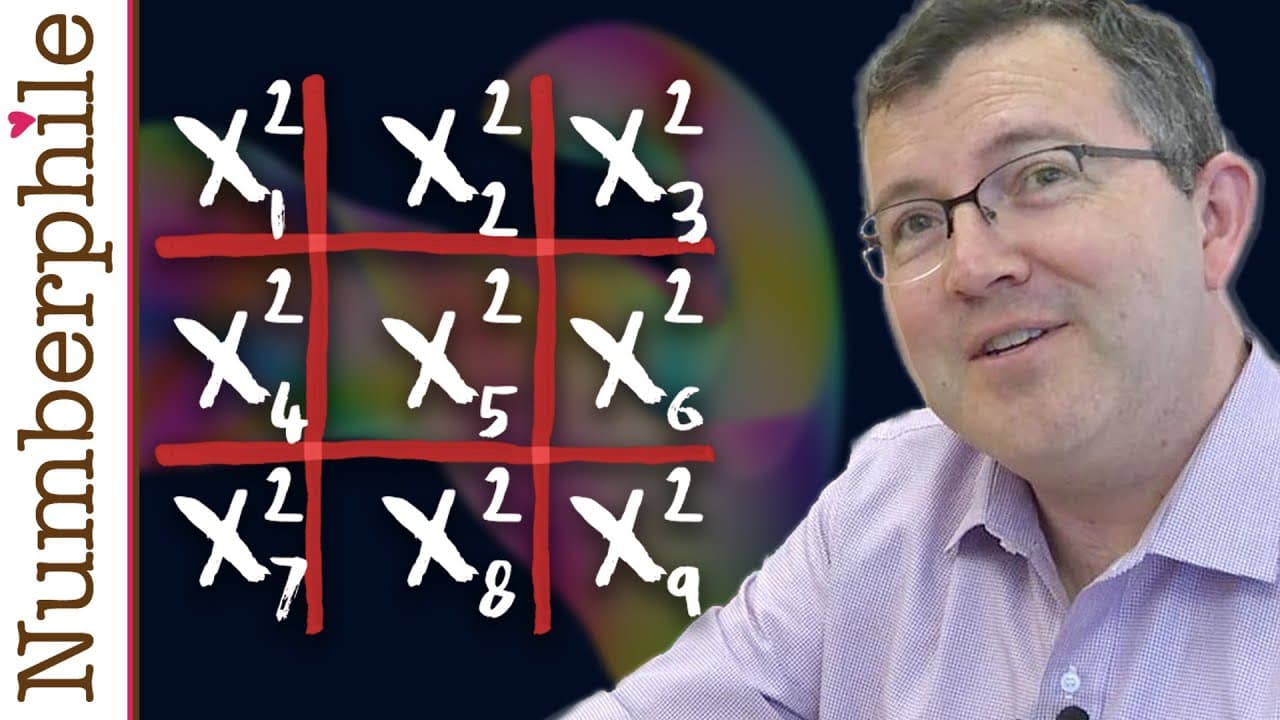
Magic Squares of Squares (are PROBABLY impossible) - Numberphile
210.2K views
•
June 13, 2023
by
Numberphile
YouTube video player
Magic Squares of Squares (are PROBABLY impossible) - Numberphile

TL;DR

Investigating the elusive nature of magic squares, from ancient origins to modern mathematical complexity.

Transcript

We're going to talk about magic squares of  squares. So first thing we're going to do is   uh talk about what a magic square is. We're going  to start with a 3x3 grid; we're going   to have 8, 1, 6, 3, 5 and a 7 and 4, 9, 2. So   this is a 3x3 array of numbers and  what's incredible here is that if you add the   numbers down the columns - so like 8... Read More

Key Insights

  • 😫 Ancient magic squares like the Lo Shu set the stage for the exploration of mathematical patterns in number arrays.
  • ❎ The search for magic squares of squares leads to intricate geometric analyses in high-dimensional spaces.
  • ⬛ Euler's 4x4 magic square of squares showcases the complexity and potential of larger-sized magic squares.
  • 🖐️ The concept of rational and elliptic curves plays a crucial role in understanding the distribution of integer solutions on mathematical surfaces.

Install to Summarize YouTube Videos and Get Transcripts

Explore YouTube Video Summarizer or Get YouTube Transcript Extractor

Questions & Answers

Q: What defines a perfect magic square?

A perfect magic square is one where every row, column, and diagonal in the array of numbers add up to the same sum, known as the magic constant.

Q: How did ancient civilizations like the Chinese contribute to the development of magic squares?

Ancient civilizations like the Chinese showcased the earliest known magic squares, such as the Lo Shu, which date back to 2200 BC and have special historical significance.

Q: Why are magic squares of squares more complex than traditional magic squares?

Magic squares of squares require each entry in the array to be the square of a number, adding a new level of complexity by demanding that not only the sums but also the values themselves possess a mathematical property.

Q: How does the geometry of high-dimensional spaces impact the search for magic squares of squares?

As the dimensionality of the space increases with larger magic squares, the geometric constraints dictate the scarcity or abundance of rational and elliptic curves containing integer solutions.

Summary & Key Takeaways

  • Magic squares are arrays of numbers where every row, column, and diagonal add up to the same sum.

  • Historical magic squares like the Lo Shu from 2200 BC and modern attempts like the Parker Square are discussed.

  • Exploring n-dimensional spaces to analyze the possibility of magic squares of squares reveals intricate mathematical challenges.


Read in Other Languages (beta)

English

Share This Summary 📚

Summarize YouTube Videos and Get Video Transcripts with 1-Click

Download browser extensions on:

Try YouTube Summary with ChatGPT & Claude or YouTube Transcript Generator

Explore More Summaries from Numberphile 📚
What Is Pascal's Triangle and Its Mathematical Patterns? thumbnail
What Is Pascal's Triangle and Its Mathematical Patterns?
Numberphile
Statistics, Storks, and Babies - Numberphile thumbnail
Statistics, Storks, and Babies - Numberphile
Numberphile
Cow-culus and Elegant Geometry - Numberphile thumbnail
Cow-culus and Elegant Geometry - Numberphile
Numberphile
Professors React to 2048 - Numberphile thumbnail
Professors React to 2048 - Numberphile
Numberphile
Brown Numbers - Numberphile thumbnail
Brown Numbers - Numberphile
Numberphile
The Most Favourite Number - Numberphile thumbnail
The Most Favourite Number - Numberphile
Numberphile

Summarize YouTube Videos and Get Video Transcripts with 1-Click

Download browser extensions on:

Try YouTube Summary with ChatGPT & Claude or YouTube Transcript Generator

Apps & Extensions

  • Chrome Extension
  • Safari Extension
  • Edge Add-ons
  • Firefox Add-ons
  • iOS App
  • Android App

Key Features

  • YouTube Video Summarizer
  • Web & PDF Summarizer
  • Web & PDF Highlighter
  • Chat with PDF
  • Ask AI Clone
  • Audio Transcriber
  • Glasp Reader
  • Kindle Highlight Export
  • Idea Hatch

Integrations

  • Obsidian Plugin
  • Notion Integration
  • Pocket Integration
  • Instapaper Integration
  • Medium Integration
  • Readwise Integration
  • Snipd Integration
  • Hypothesis Integration

More Features

  • APIs
  • MCP Connector
  • Blog & Post
  • Embed Links
  • Image Highlight
  • Personality Test
  • Quote Shots

Company

  • About us
  • Blog
  • Community
  • FAQs
  • Job Board
  • Newsletter
  • Pricing
Terms

•

Privacy

•

Guidelines

© 2026 Glasp Inc. All rights reserved.