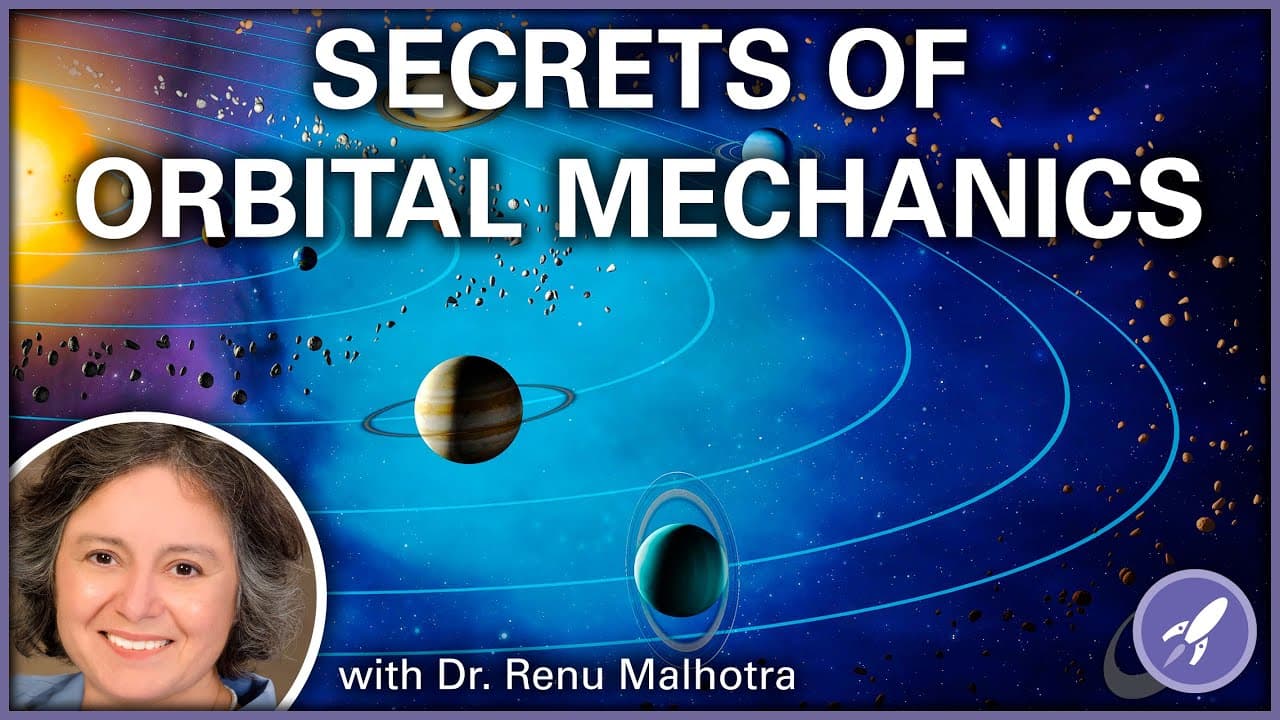
Weird Orbits and How They Work with Dr. Renu Malhotra
TL;DR
Dr. Malhotra explores Pluto's chaotic orbit in a groundbreaking research paper.
Transcript
hi everyone i'm fraser kane i'm the publisher of universe today i've been a space and astronomy news journalist for over 20 years now and in addition to all of the work that we're doing reporting all the stories sometimes to try to give you a behind-the-scenes look conversations with the researchers who are actually generating doing the research th... Read More
Key Insights
- 🖐️ Pluto's inclination challenges current solar system models, with influences from giant planets playing a crucial role in its unique orbit.
- 🤩 Passing stars and the collective gravity of the Milky Way contribute to the circularization of cometary orbits and the formation of the Oort cloud.
- 🥮 The possibility of moons having moons is limited by the Hill radius and chaotic dynamics, resulting in short-lived systems like mini-moons around Earth.
- 💁 Stellar encounters and galactic gravity influence planetary system formation, creating diverse configurations like the TRAPPIST-1 system with multiple Earth-sized exoplanets.
Install to Summarize YouTube Videos and Get Transcripts
Explore YouTube Video Summarizer or Get YouTube Transcript Extractor
Questions & Answers
Q: How does Pluto's inclination to the solar system's plane impact its orbital dynamics?
Pluto's inclined orbit poses a challenge to solar system models, with partial insights suggesting influences from Neptune and other giant planets causing deviations in its trajectory.
Q: What role do planetary perturbations and passing stars play in shaping the orbital dynamics of comets in the solar system?
Passing stars and the collective gravitational field of the Milky Way contribute to the formation of the Oort cloud by circularizing orbits of comets that were previously ejected from close encounters.
Q: Can moons have moons and what limits the stability of moon-moon systems in the solar system?
While moons having moons is possible, the Hill radius and chaotic interactions limit the stability of such systems, making mini-moons or quasi- satellites short-lived anomalies in celestial dynamics.
Q: How do close stellar encounters and the overall Milky Way's gravity influence the formation and orientation of planetary systems in the galaxy?
Stellar encounters and galactic gravity sculpt planetary systems, such as the TRAPPIST-1 system, creating diverse configurations with multiple terrestrial-mass exoplanets in close orbits while ensuring long-term stability.
Summary & Key Takeaways
-
Dr. Malhotra discusses the complexity of Pluto's unique orbit and the recent insights from her research paper.
-
Shedding light on the mechanisms of orbital dynamics in the solar system with a focus on Pluto's inclination.
-
Exploring the stability and chaos in orbits, touching on moon-moon interactions and planetary resonances.
Read in Other Languages (beta)
Share This Summary 📚
Summarize YouTube Videos and Get Video Transcripts with 1-Click
Try YouTube Summary with ChatGPT & Claude or YouTube Transcript Generator
Explore More Summaries from Fraser Cain 📚




Summarize YouTube Videos and Get Video Transcripts with 1-Click
Try YouTube Summary with ChatGPT & Claude or YouTube Transcript Generator