Telling Time on a Torus | Infinite Series
TL;DR
Explore how clock configurations can be analyzed using topology and quotient shapes for problem-solving.
Transcript
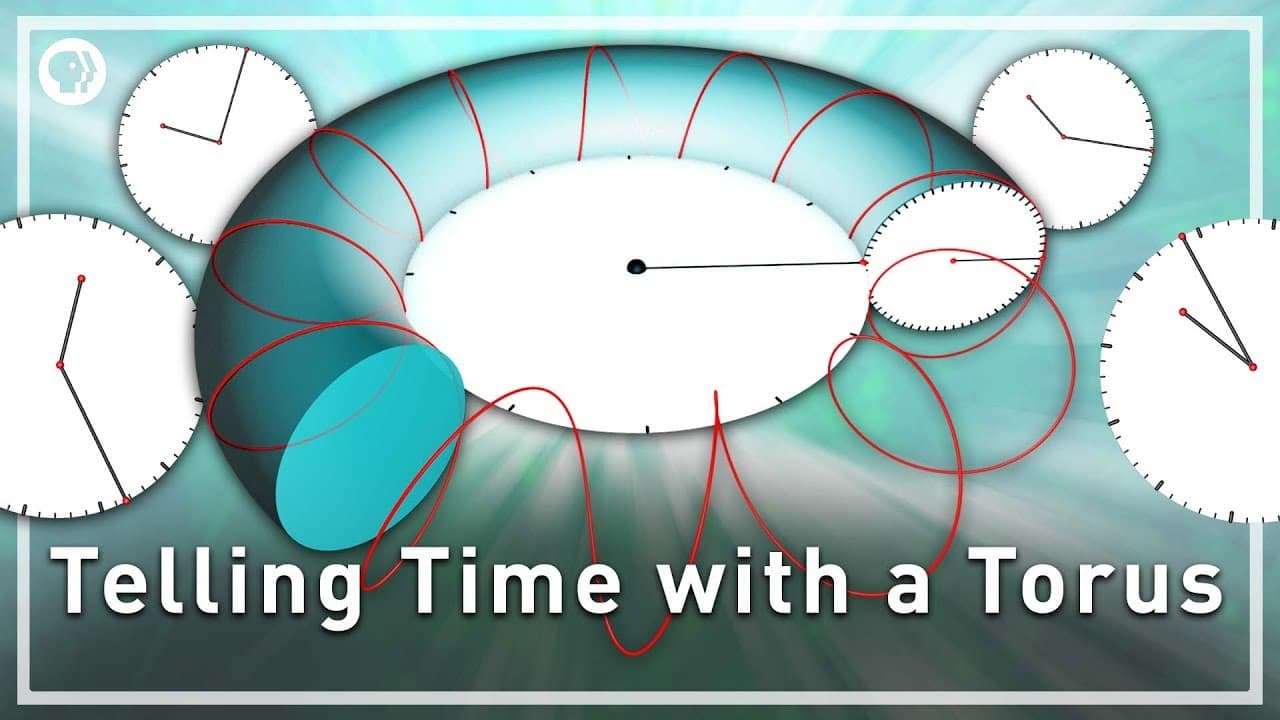
[MUSIC PLAYING] What shape do you most associate with a standard analog clock? Your reflex answer might be a circle. But a more natural answer is actually a torus. Surprised? Than stick around. I'll explain what I mean and pose a clock puzzle challenge problem that adopting this viewpoint might help you to solve. [MUSIC PLAYING] Some configuration... Read More
Key Insights
- ⏰ Clock configurations can be analyzed on a torus, providing a unique perspective for problem-solving.
- 🍼 Quotienting a square creates shapes like a cone, Mobius strip, and Klein bottle, expanding mathematical exploration.
- ➗ The division algorithm guarantees unique integers for quotient and remainder, essential for mathematical operations.
- 🥺 Equivalence relations play a vital role in defining equivalent points when quotienting a square, leading to the creation of new shapes.
- 😋 Abstract mathematical concepts like rings and group theory are interconnected, offering a deeper understanding of mathematical structures.
- 💠 Understanding quotient shapes and topology can enhance problem-solving skills by providing alternative perspectives.
- 💠 Quotienting offers a visual and theoretical approach to building complex shapes from simple base shapes, opening up new avenues for mathematical exploration.
Install to Summarize YouTube Videos and Get Transcripts
Explore YouTube Video Summarizer or Get YouTube Transcript Extractor
Questions & Answers
Q: How are clock configurations related to the concept of quotient shapes?
Clock configurations can be represented on a torus, where each point corresponds to a valid configuration, showcasing the power of quotient shapes in problem-solving.
Q: What does the division algorithm guarantee in terms of the quotient and remainder?
The division algorithm ensures that unique integers for quotient and remainder are found so that the dividend can be expressed as the product of the divisor and quotient plus the remainder.
Q: How can quotienting a square lead to the creation of other shapes like a cone or Mobius strip?
By equating specific points on the square, various shapes can be created through quotienting, such as a cone or a Mobius strip, offering a creative exploration of mathematics.
Q: How does the concept of equivalence relation play a crucial role in quotienting a square?
The equivalence relation defines which points on the square are equivalent, leading to the creation of new shapes through quotienting, demonstrating the importance of this concept in mathematical analysis.
Summary & Key Takeaways
-
Clock configurations can be analyzed on a torus, with each point corresponding to a valid hand configuration.
-
Quotienting a square creates shapes like a torus, cone, Mobius strip, and Klein bottle, offering problem-solving power.
-
Division algorithm ensures unique integers for quotient and remainder, vital in understanding mathematical concepts.
Read in Other Languages (beta)
Share This Summary 📚
Summarize YouTube Videos and Get Video Transcripts with 1-Click
Try YouTube Summary with ChatGPT & Claude or YouTube Transcript Generator
Explore More Summaries from PBS Infinite Series 📚




Summarize YouTube Videos and Get Video Transcripts with 1-Click
Try YouTube Summary with ChatGPT & Claude or YouTube Transcript Generator