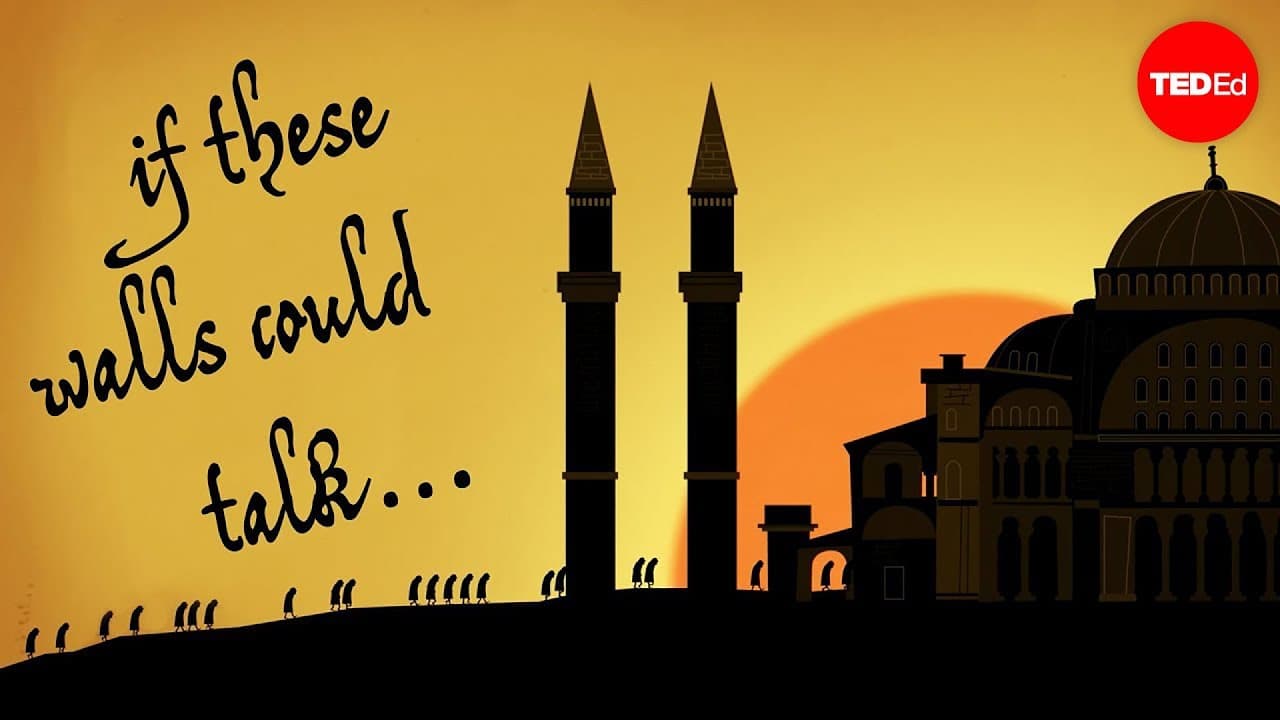
It's a church. It's a mosque. It's Hagia Sophia. - Kelly Wall
TL;DR
The Hagia Sophia carries the diverse history of Constantinople, now Istanbul, from church to mosque to museum.
Transcript
They say that if walls could talk, each building would have a story to tell, but few would tell so many fascinating stories in so many different voices as the Hagia Sophia, or holy wisdom. Perched at the crossroads of continents and cultures, it has seen massive changes from the name of the city where it stands, to its own structure and purpose. ... Read More
Key Insights
- ✊ Hagia Sophia's complex history encapsulates the shifting dynamics of power and culture in Constantinople, now Istanbul.
- 🏛️ The architectural and artistic elements of the building reflect a fusion of Eastern and Western influences.
- 🇹🇷 The Hagia Sophia's status as a museum highlights Turkey's transition from Ottoman traditions to a more secular identity.
- 🏛️ Challenges of preserving and interpreting the building's diverse heritage continue to provoke debate and reflection.
- 🫒 The Hagia Sophia serves as a living monument to the interplay of faiths and civilizations over centuries.
- ⛪ The structure's transformation from church to mosque to museum exemplifies the fluidity of religious identities in the region.
- 🤑 Ongoing restoration efforts enable visitors to engage with the building's rich tapestry of history and culture.
Install to Summarize YouTube Videos and Get Transcripts
Explore YouTube Video Summarizer or Get YouTube Transcript Extractor
Questions & Answers
Q: What are some key historical events that impacted the construction and purpose of the Hagia Sophia?
The Nika Riots in 532, the Fourth Crusade in 1204, the Ottoman conquest of Constantinople in 1453, and the secularization by Kemal Ataturk in 1935 all influenced the Hagia Sophia's evolution.
Q: How did different rulers and civilizations leave their mark on the Hagia Sophia?
Greek colonists, Roman emperors, Byzantine rulers, Ottoman sultans, and even Viking warriors contributed to the architecture, mosaics, and inscriptions found within the Hagia Sophia.
Q: Why is the Hagia Sophia considered a symbol of cultural and religious diversity?
The building's transformation from a church to a mosque and later to a museum reflects the intertwining of Christian and Islamic influences in the region's history.
Q: What ongoing challenges exist in preserving the Hagia Sophia's historical and religious significance?
Balancing the restoration of Christian mosaics while respecting Islamic calligraphy, as well as navigating calls from different communities to return the building to its original use, present ongoing dilemmas.
Summary & Key Takeaways
-
Hagia Sophia, originally built in the fourth century, underwent multiple transformations and reconstructions over the centuries.
-
The structure reflects the blend of cultures and faiths with elements from Greek, Roman, Persian, and Viking origins.
-
The building served as a church, mosque, and now a museum, showcasing the layers of history it holds within its walls.
Read in Other Languages (beta)
Share This Summary 📚
Summarize YouTube Videos and Get Video Transcripts with 1-Click
Try YouTube Summary with ChatGPT & Claude or YouTube Transcript Generator
Explore More Summaries from TED-Ed 📚





Summarize YouTube Videos and Get Video Transcripts with 1-Click
Try YouTube Summary with ChatGPT & Claude or YouTube Transcript Generator