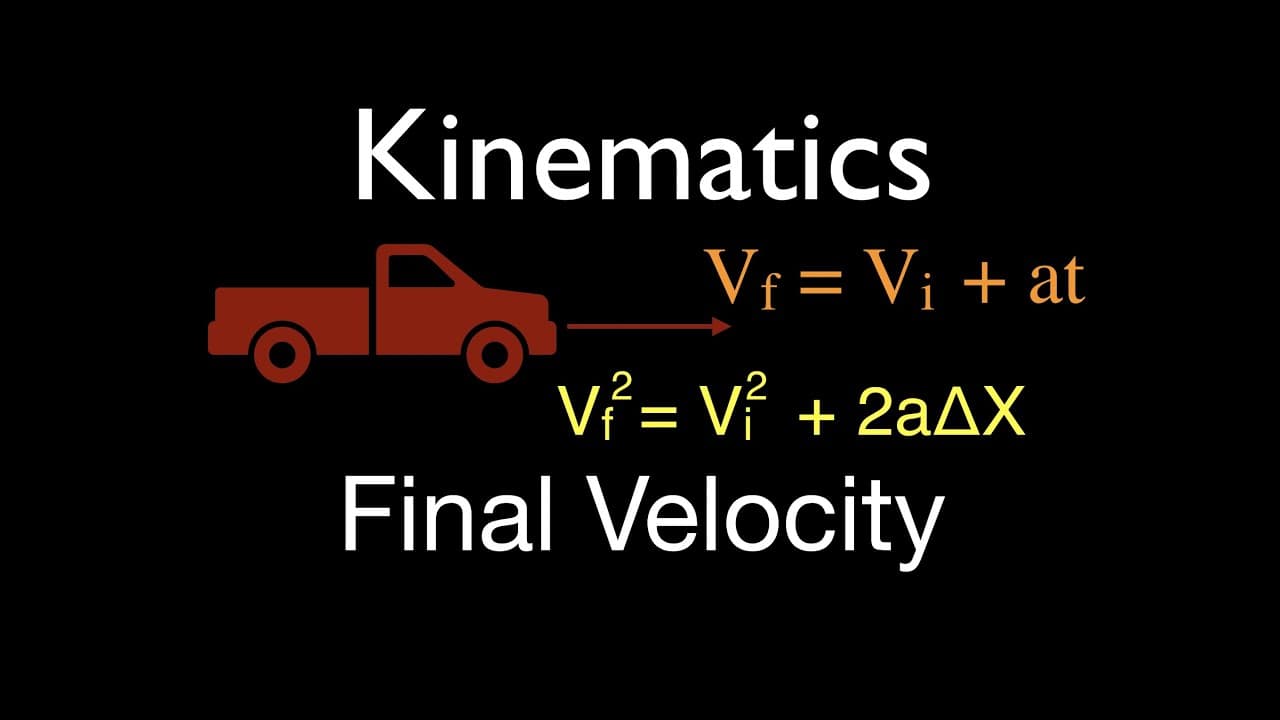
Physics, Kinematics (7 of 7) 1 D Horizontal Motion, Solve for Final Velocity, No. 1
TL;DR
Solving for final velocity using kinematic equations for two scenarios.
Transcript
okay in today's video I'm gonna go over two examples using the kinematic equations for one-dimensional horizontal motion and in this video both examples will be solving for the final velocity the first problem Susie's riding a bicycle on the street with the speed of eight point seven meters per second suddenly she is being chased by chompers the do... Read More
Key Insights
- 🆘 Kinematic equations help solve for final velocity in scenarios involving acceleration.
- 🪪 Proper identification of variables and equations is crucial for accurate final velocity calculations.
- ❓ Considering all five kinematic variables is essential for choosing the correct equation.
- ❓ The step-by-step process involves filling in known values, selecting the appropriate equation, and calculating the final velocity.
- ❎ Simplifying equations using mathematical operations like squaring and square roots can streamline the calculation process.
- 🌍 Applying kinematic equations in real-world scenarios helps understand motion and acceleration concepts effectively.
- 🇦🇪 The importance of units in final velocity calculations is emphasized in the examples.
Install to Summarize YouTube Videos and Get Transcripts
Explore YouTube Video Summarizer or Get YouTube Transcript Extractor
Questions & Answers
Q: How are the kinematic equations used in the examples provided?
The kinematic equations are employed to solve for the final velocity by utilizing initial and final velocities, acceleration, and sometimes displacement or time in the equations.
Q: What steps are involved in solving for the final velocity in each scenario?
The process includes identifying the known and unknown variables, selecting the appropriate kinematic equation with the final velocity, and substituting the values to calculate the final velocity accurately.
Q: Why is it essential to consider all five variables before solving for the final velocity?
Considering all five variables, including initial and final velocities, acceleration, displacement, and time, ensures that the correct kinematic equation is chosen and executed correctly to determine the final velocity accurately.
Q: How does the square root of the equation simplify the calculation process?
Taking the square root of the equation simplifies the calculation by isolating the final velocity, making it easier to substitute the values for acceleration and displacement to find the final velocity in the scenarios.
Summary & Key Takeaways
-
Two examples are presented, one involving Susie accelerating on a bicycle to escape a dog, and the other about Johnny's acceleration in a race.
-
Initial and final velocities, acceleration, and distance are used to calculate the final velocity in each scenario using kinematic equations.
-
The step-by-step process involves identifying variables, choosing the relevant equation, and plugging in values to find the final velocity.
Read in Other Languages (beta)
Share This Summary 📚
Summarize YouTube Videos and Get Video Transcripts with 1-Click
Try YouTube Summary with ChatGPT & Claude or YouTube Transcript Generator
Explore More Summaries from Step by Step Science 📚


Summarize YouTube Videos and Get Video Transcripts with 1-Click
Try YouTube Summary with ChatGPT & Claude or YouTube Transcript Generator