Microscopy: How To Focus (Ron Vale)
TL;DR
Learn essential steps for focusing a microscope accurately.
Transcript
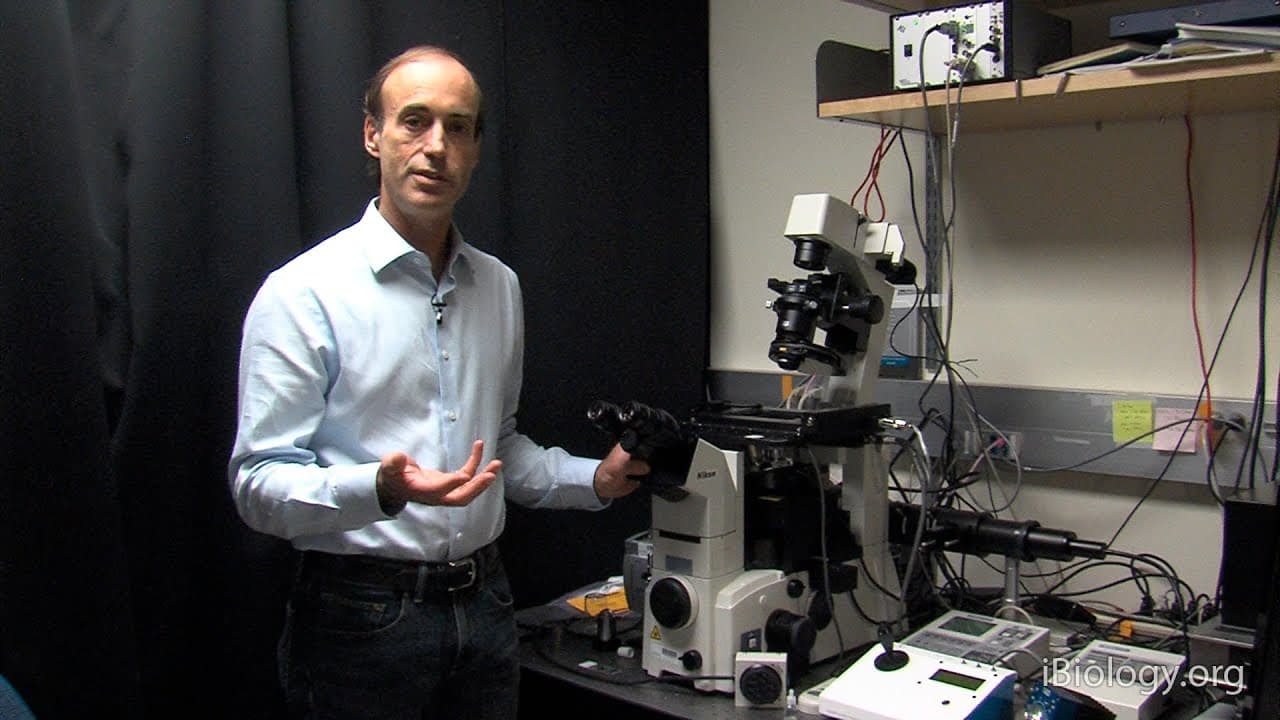
Hello. I'm Ron Vale, and we're going to discuss how to focus the microscope on your specimen. And we're going to go through a number of tips, but, with practice, many of these steps will become second-nature to you. But whenever you're focusing the microscope, it's always important to do it with a great deal of care, because one's working with an ... Read More
Key Insights
- Focusing a microscope requires understanding and familiarity with the focusing knobs, including both fine and coarse adjustments, to avoid damaging expensive objectives.
- It's crucial to set up the light path correctly to ensure the image is projected to the eyepiece, particularly when using fluorescence microscopy.
- Understanding the type of objective lens being used, such as air, water, or oil-immersion, is essential for proper specimen preparation and focusing.
- Proper orientation of the specimen, ensuring the coverslip is in contact with the objective lens, is vital for achieving the correct focus.
- Dark adaptation and minimizing ambient light in the room can significantly enhance the visibility of dim fluorescence signals.
- Using a camera instead of an eyepiece might be necessary for extremely dim fluorescence samples, allowing for better focusing through sensitive imaging.
- Avoid over-focusing by stopping and reassessing if the objective lens starts to lift the slide, which can damage the lens.
- Spring-loaded objective lenses can provide protection against over-focusing, but careful manual focus adjustments remain the best strategy.
Install to Summarize YouTube Videos and Get Transcripts
Explore YouTube Video Summarizer or Get YouTube Transcript Extractor
Questions & Answers
Q: What are the initial steps before focusing on a specimen?
Before focusing on a specimen, it is important to familiarize yourself with the microscope's focusing knobs, understanding the fine and coarse adjustments and their directions. Additionally, ensure the light path is set up correctly to project the image to the eyepiece. These steps help prevent damage to expensive objectives.
Q: Why is it important to know the type of objective lens being used?
Knowing the type of objective lens, such as air, water, or oil-immersion, is crucial for proper specimen preparation and focusing. Each type requires different handling, particularly oil-immersion lenses, which need a drop of oil between the lens and the coverslip to achieve the correct focus and image clarity.
Q: How can ambient light affect fluorescence microscopy?
Ambient light can significantly impact the visibility of fluorescence signals, especially if they are dim. To enhance visibility, it is recommended to turn off room lights and allow your eyes to become dark-adapted. This adaptation helps in seeing the dim fluorescence more clearly through the eyepiece.
Q: What should be done if the fluorescence is extremely dim?
For extremely dim fluorescence samples, it may be necessary to use a sensitive camera instead of the eyepiece. This setup allows better focusing and visualization of the fluorescence by capturing the image through the camera, which can be more sensitive to low light levels than the human eye.
Q: How can over-focusing be avoided?
To avoid over-focusing, which can damage the objective lens, stop and reassess if the lens starts lifting the slide. Use a spring-loaded lens for protection, but primarily rely on careful manual adjustments. If over-focus is suspected, reset the objective to a starting position and begin the focusing process again.
Q: What is the role of spring-loaded objective lenses?
Spring-loaded objective lenses provide a protective mechanism against over-focusing. If the lens pushes against something, the spring-load allows the lens to retract slightly, preventing damage. However, the best protection is still careful manual focusing to avoid reaching the point where the spring-load is needed.
Q: How should the specimen be prepared for focusing?
The specimen should be prepared by ensuring the coverslip is correctly oriented and in contact with the objective lens. For oil-immersion objectives, place a single drop of oil between the lens and coverslip. This setup is crucial for achieving the correct focus and obtaining a clear image of the specimen.
Q: What is the importance of understanding focusing knob directions?
Understanding the directions of the focusing knobs is important to control the movement of the objective lens accurately. Different microscopes may have varying directions for knob adjustments, so knowing how they correspond to lens movement helps prevent accidental damage and ensures precise focusing on the specimen.
Summary & Key Takeaways
-
Ron Vale explains the importance of careful focusing in microscopy, emphasizing the need to familiarize oneself with the microscope's focusing knobs and the direction of their movement. Proper setup of the light path and understanding the type of objective lens used are also crucial steps in the process.
-
The video provides detailed guidance on preparing the specimen, including the correct placement of the coverslip and the use of oil for oil-immersion objectives. It highlights the importance of dark adaptation to improve the visibility of fluorescence signals.
-
Tips are given for dealing with extremely dim samples, suggesting the use of a camera for focusing. The video also advises on avoiding over-focusing to prevent damage to the objective lens, recommending the use of spring-loaded lenses and careful manual adjustments.
Read in Other Languages (beta)
Share This Summary 📚
Summarize YouTube Videos and Get Video Transcripts with 1-Click
Try YouTube Summary with ChatGPT & Claude or YouTube Transcript Generator
Explore More Summaries from iBiology Techniques 📚


Summarize YouTube Videos and Get Video Transcripts with 1-Click
Try YouTube Summary with ChatGPT & Claude or YouTube Transcript Generator