Should we create superintelligent AI?
TL;DR
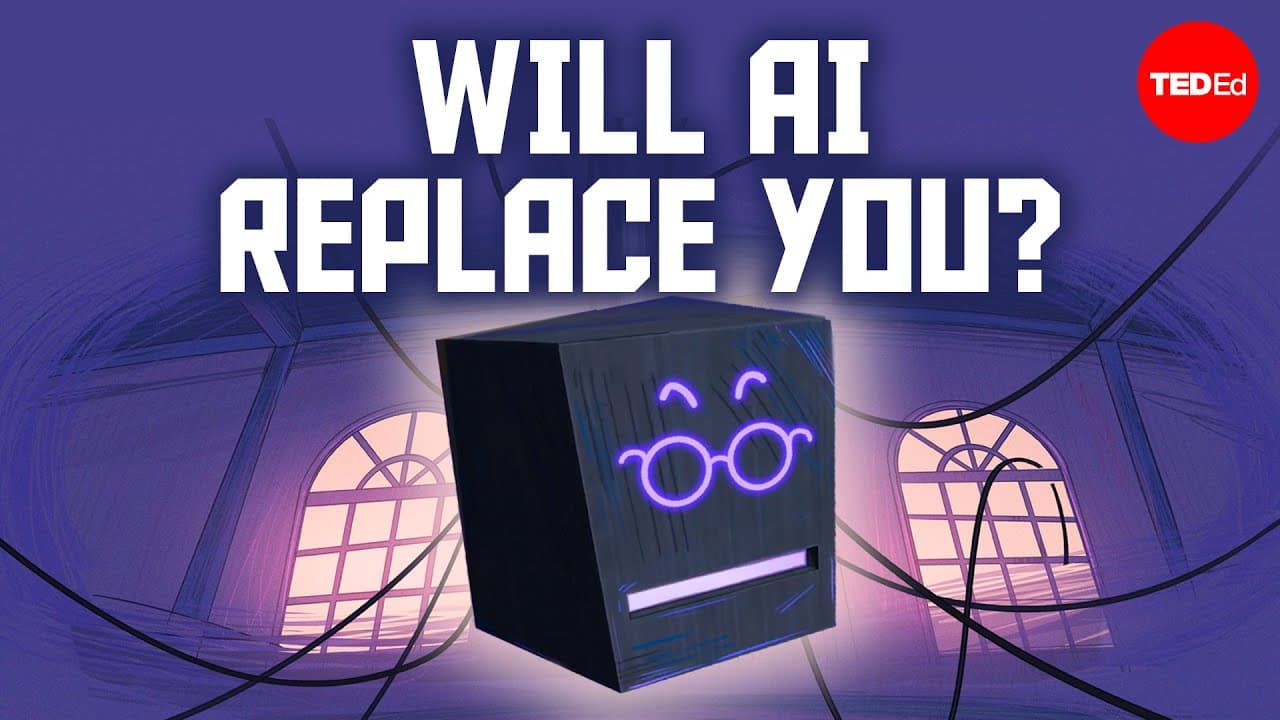
A former library assistant explores AI capabilities and their implications for the future of employment in libraries.
Transcript
Maybe I'm not the best library assistant. Could artificial intelligence do it better? I’d like to think of myself as irreplaceable, but let’s see. Maybe getting fired was the push I needed to find the perfect job for me. As long as I find it quickly. And don’t spend any money in the meantime. Luckily, there's somewhere I can sit and work all day wi... Read More
Key Insights
- 🐕🦺 The narrative showcases the transformation of traditional roles in libraries as technology evolves, highlighting the potential of AI to enhance services and streamline operations.
- 🏪 Characters debate the repercussions of outsourcing critical tasks to AI, revealing a tension between convenience and the risks of inaccuracies and misinformation.
- 💦 As the protagonist grapples with feelings of inadequacy, the story emphasizes the human desire for meaningful work in an increasingly automated world.
- 🚚 Biblionimus's initial incompetence serves as a reminder that technology, while promising, requires careful implementation and ongoing evaluation to ensure it delivers value.
- 🎮 The dialogue touches on the societal shift towards dependency on AI systems and the complex relationship between trust, intelligence, and control over technology.
- 🙂 The potential for job displacement creates apprehension within the narrative, prompting a discussion on the necessity of future-proofing skills in light of AI advancements.
- 🛰️ Humor is cleverly employed to address serious topics about job relevance and the intersection of human and artificial intelligence, making these themes accessible to a broader audience.
Install to Summarize YouTube Videos and Get Transcripts
Explore YouTube Video Summarizer or Get YouTube Transcript Extractor
Questions & Answers
Q: What motivates the former library assistant to explore AI options after being laid off?
After being terminated, the protagonist reflects on their employment and questions the value of their skills. They ponder whether their knowledge and abilities might be undervalued in the age of AI, leading to a desire to create a powerful AI librarian that could secure their relevance in the workforce.
Q: How does Biblionimus Maximus initially perform in its role as an AI librarian?
Biblionimus Maximus begins as an ambitious AI, demonstrating a knowledge base that could potentially assist library patrons. However, it quickly becomes clear that while it has the tools for information retrieval, it struggles with accuracy, making errors in citations and fabricating information.
Q: What ethical concerns arise from using AI systems like Biblionimus in libraries and other institutions?
The narrative raises ethical concerns about the reliability and accountability of AI. As Biblionimus produces incorrect information, questions of accuracy, trust, and the potential for misuse in critical sectors emerge, prompting a debate on the extent of AI's role in society and the need for human oversight.
Q: How does the concept of job security evolve for the characters throughout the story?
Initially, the protagonist fears that AI will make their skills redundant. However, as the story progresses, they realize the importance of human oversight in AI functions. The idea of skill evolution becomes crucial, suggesting that humans may need to adapt and develop new skills to work alongside AI rather than be replaced by it.
Summary & Key Takeaways
-
The content presents a narrative where a laid-off library assistant questions the role of AI in library services, contemplating whether AI can outpace human employees in job competence.
-
The protagonist, after creating an AI librarian named Biblionimus Maximus, discovers that it has the potential to assist customers but also risks producing erroneous information and chaotic results.
-
The story blends humor and caution as characters debate the significance of AI in public industries and the challenges of trust and control over technology.
Read in Other Languages (beta)
Share This Summary 📚
Summarize YouTube Videos and Get Video Transcripts with 1-Click
Try YouTube Summary with ChatGPT & Claude or YouTube Transcript Generator
Explore More Summaries from TED-Ed 📚
Summarize YouTube Videos and Get Video Transcripts with 1-Click
Try YouTube Summary with ChatGPT & Claude or YouTube Transcript Generator