What Is the Ideal Brayton Cycle in Gas Turbines?
TL;DR
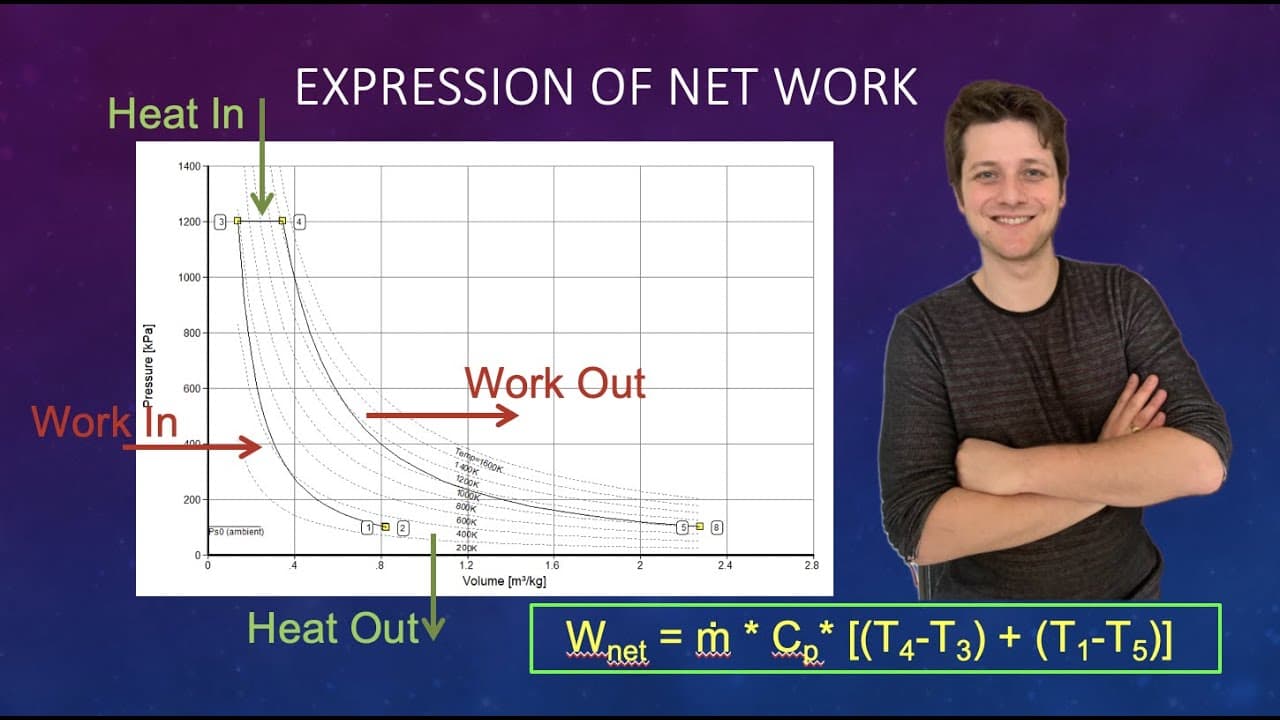
The ideal Brayton cycle describes the thermodynamic processes of gas turbines, including compression, combustion, and expansion. It is crucial for determining efficiency, pressure ratios, and air mass flow, enabling designers to meet customer requirements while balancing performance and cost. Key efficiency factors are temperature and pressure ratios derived from the specific heat capacities of the working fluid.
Transcript
so hello again step by step scientists and welcome to today's talk which will be part two of the gas turbine technology series where we discuss the ideal brayton cycle and the ideal brighton cycle is the thermodynamic cycle that all gas turbines are using and designed around if you haven't watched my first video yet on an apple introduction to the ... Read More
Key Insights
- 🫢 The ideal Brayton cycle forms the basis for gas turbine technology, utilizing compression, combustion, and expansion processes.
- 🥳 Efficiency calculations involve considering temperature ratios, pressure ratios, and specific heat capacities.
- 🤩 Customer requirements drive the design process, determining key parameters like compression temperatures and fuel consumption.
- 💦 Material limitations like maximum working temperatures impact turbine design, efficiency, and cost considerations.
- 🎆 Calculations for properties like net work, efficiency, pressure ratio, and air mass flow help in practical engineering applications.
- 🫢 Temperature and pressure ratios play vital roles in determining the performance of gas turbine systems.
- 🫢 The importance of balancing efficiency, cost-effectiveness, and design constraints in gas turbine engineering.
Install to Summarize YouTube Videos and Get Transcripts
Explore YouTube Video Summarizer or Get YouTube Transcript Extractor
Questions & Answers
Q: What is the ideal Brayton cycle in gas turbine technology?
The ideal Brayton cycle is the thermodynamic cycle that all gas turbines are designed around, involving processes of compression, combustion, and expansion to generate work.
Q: How is the efficiency of a gas turbine system calculated?
The efficiency is calculated as the net work output divided by the total energy input, considering factors like temperature ratios and pressure ratios in the cycle.
Q: What factors influence the design of a gas turbine for a specific application?
Customer requirements like power output, fuel consumption, and size constraints drive the design process, determining properties such as compression temperatures and air mass flow.
Q: Why is it important to consider material limitations in gas turbine design?
Material limitations, such as maximum working temperatures, impact the efficiency, lifespan, and cost of gas turbines, influencing decisions on temperature settings and material choices.
Summary & Key Takeaways
-
Introduction to the ideal Brayton cycle in gas turbine technology.
-
Discussing the thermodynamic processes involved in the cycle.
-
Calculation of key properties like net work, efficiency, pressure ratio, and air mass flow for an engineering example.
Read in Other Languages (beta)
Share This Summary 📚
Summarize YouTube Videos and Get Video Transcripts with 1-Click
Try YouTube Summary with ChatGPT & Claude or YouTube Transcript Generator
Explore More Summaries from Step by Step Science 📚
Summarize YouTube Videos and Get Video Transcripts with 1-Click
Try YouTube Summary with ChatGPT & Claude or YouTube Transcript Generator