What Is the 3D Shape of a Molecule and Why Does It Matter?
TL;DR
Molecules do not have fixed shapes like physical objects; instead, their 3D arrangement is determined by electron cloud distributions and atomic nuclei positions. The geometrical configuration maximizes attraction between opposite charges and minimizes repulsion between like charges, affecting chemical properties and behaviors crucial in fields like drug design and materials science.
Transcript
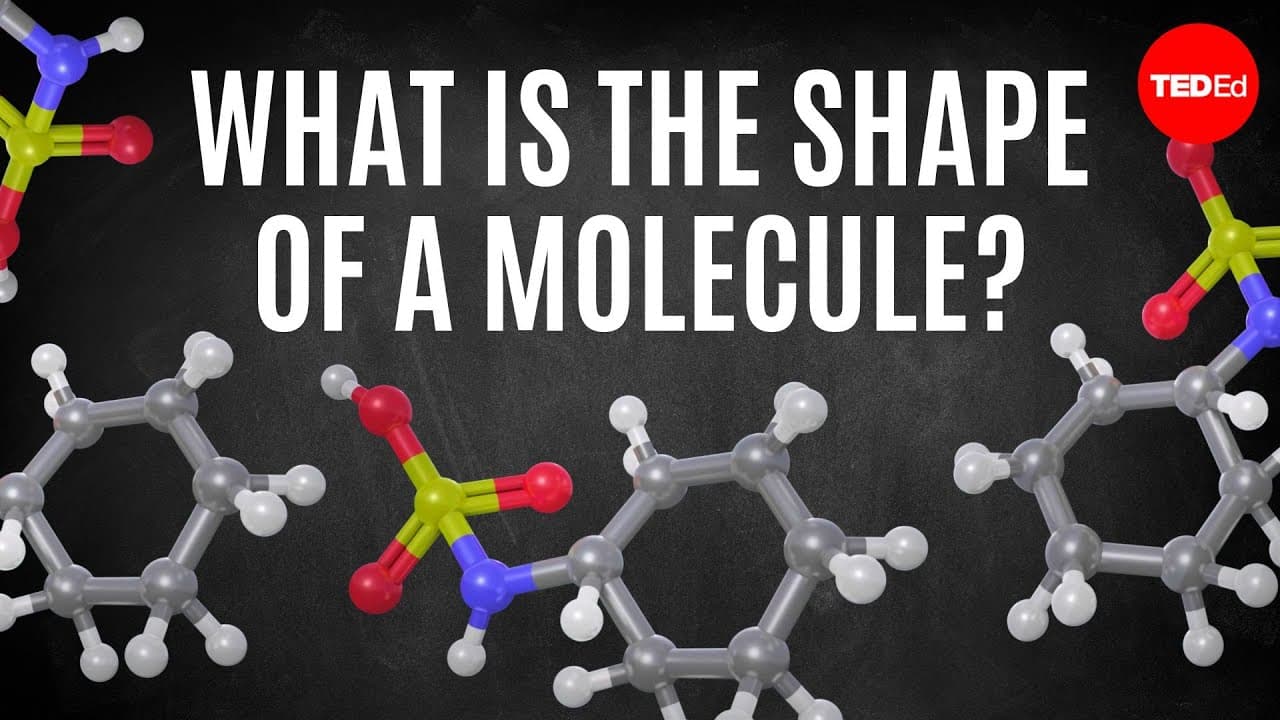
What is the shape of a molecule? Well, a molecule is mostly empty space. Almost all of its mass is concentrated in the extremely dense nuclei of its atoms. And its electrons, which determine how the atoms are bonded to each other, are more like clouds of negative charge than individual, discrete particles. So, a molecule doesn't have a shape in the... Read More
Key Insights
- 😶🌫️ Molecules lack physical shapes like objects, with nuclei and electron clouds determining their configurations.
- 💠 Electron arrangements dictate 3D shapes of molecules, crucial for predicting properties and reactions.
- 🫥 Variations in atom bonding lead to diverse molecular shapes like tetrahedrons, pyramids, or straight lines.
- 💱 Multiple stable arrangements exist for some molecules, showcasing dynamic structural changes in chemical interactions.
- 💠 Experimental validation of predicted shapes confirms theories while revealing exceptions.
- 🦻 Understanding molecular shapes aids in designing drugs, materials, and biological systems.
- ⚾ Shape prediction based on electron distributions is essential for industries like pharmaceuticals and material science.
Install to Summarize YouTube Videos and Get Transcripts
Explore YouTube Video Summarizer or Get YouTube Transcript Extractor
Questions & Answers
Q: How do electron configurations influence molecular shapes?
Electron configurations dictate where atoms bond in 3D space, determining unique shapes like tetrahedrons or pyramids based on distancing negative charges.
Q: Why is it crucial to predict molecular shapes accurately?
Predicting shapes helps understand chemical properties, reactions, and biological functions, guiding industries from pharmaceuticals to genetics through structure-function relationships.
Q: Can molecules have multiple stable shapes?
Yes, some molecules exhibit two or more stable arrangements due to electron repulsions and attractions, showcasing interesting chemistry in dynamic structures without altering atom composition.
Q: How do experiments validate predicted molecular shapes?
Experimental observations confirm theoretical predictions, providing evidence for anticipated shapes while discovering exceptions that challenge current models.
Summary & Key Takeaways
-
Molecules consist of densely packed nuclei and electron clouds, not having a tangible shape like objects.
-
Understanding electron configurations helps predict 3D shapes of molecules.
-
Different atoms lead to varied molecular shapes like tetrahedron, pyramid, or straight line.
Read in Other Languages (beta)
Share This Summary 📚
Summarize YouTube Videos and Get Video Transcripts with 1-Click
Try YouTube Summary with ChatGPT & Claude or YouTube Transcript Generator
Explore More Summaries from TED-Ed 📚






Summarize YouTube Videos and Get Video Transcripts with 1-Click
Try YouTube Summary with ChatGPT & Claude or YouTube Transcript Generator